Thermometers

Inkbird X6 and Meater+

Pretty much everywhere you look, the accepted wisdom of the BBQ/Live Fire/Meat Cookery world is that a way of finding out the internal temperature of what you are cooking is a must. There are 2 main reasons for this:

1. Food poisoning is not fun.

2. Good meat is expensive and you don’t want to over or under cook it.

My brother bought me the BGE dual thermometer as a birthday present which was great. It worked really well, was easy to set up and certainly improved the quality of the cooks. An early one was a simple roast chicken which I cooked to 68°C then rested until it got to the safe temp of 74°C. The result was juicy and delicious and didn’t need all those Delia Smith checks of tugging the leg or checking the colour of the juices as they dripped onto a white plate. I was sold. Then one of the probes stopped working and I couldn’t source a replacement.

Next up, I shelled out about £35 on the Inkbird IBT-6X which connect to a phone app via Bluetooth. As a temperature probe the Inkbird is great. Really great. The app is good and has several pre-set temperature ranges for you to set up what you are cooking. You can track progress with a graph of temperature over time. You don’t actually need the app if you’re not bothered about the Bluetooth connectivity as there is a really bright LCD display that scrolls through the temperatures of the connected probes. I’ve never cooked anything requiring 6 probes at a time and I’m not sure I ever will but I could if I wanted to. I like the design and having calibrated it in boiling water, I can tell you it is pretty accurate. One small gripe is that all the probes supplied are really long which can make it different to get them into the meat being cooked and still fit inside the Egg dome; it would have been nice if it had come with a couple of the stubbier “pit” style probes to attach to the cooking grate. All in all, I thought it was a pretty good device for what it cost.

But

Bloody probes. Of the 6 it came with, only 2 now work. I can buy replacements but they seem disproportionately expensive compared to the original overall cost. Maybe the ones supplied with it are not the best quality. Those that do work, work well and they are super-flexible. I did some deep fried chicken over the weekend and used 1 probe for the oil and the other for the chicken. Had to be careful with the crossed wires though.

So the latest buy was the Meater+. They’ve been on the market for a while now and I have been keeping my eye on them. Just before Christmas, I took advantage of a 1st time customer discount voucher from Farmison and Co and took the plunge. The Meater+ promises more bluetooth range plus the ability to monitor your cooks online via another device. I guess this means your dinner guests can be remotely kept abreast of things if you really want to.

Before the first use, there is a bit of setting up to be done. You have to charge it for 8 hours before you actually use it (I left mine overnight) and then pair it with your phone via the Meater app. If you want to use the guest-informing WiFi feature, you have to sign up for an account. I would say the app is almost the Meater’s best feature – like the Inkbird you can choose preset temperature based on what you’re cooking and adjust up or down depending on your preference. I love that 1 probe does both the internal temperature and the ambient and, once it’s had a chance to ponder on these for a bit, the app will estimate how long it will take for your food to be cooked. You get an alert to take your joint off the heat when the internal temperature is within a few degrees of what you want; you then leave the probe in while it monitors the resting period. It’s impressive and works pretty seamlessly. With no wires involved it is brilliant. After each cook, I follow various bits of advice and give the probe a really good clean to get rid of any brown, burnt on bits – there is a risk these interfere with the charging contact. I have found fine gauge wire wool works perfectly.

It’s not without what we might euphemistically call “wrinkles” however. Although I can have my phone in the kitchen while the probe and base unit are out in the garden, the Bluetooth does get a bit sketchy if I move my phone further inside. To try to combat this I paired the probe with my iPad, but now if both it and my phone are in range of the probe when I set up the cook, it doesn’t connect to either unless I turn the Bluetooth on one of them off. Small issue I know, but there we are. I actually also slightly miss the app-less temperature readout on the Inkbird which is rather handy if you just want to probe something while it’s in a pan on the hob. You can’t do this with the Meater+, but it’s probably not really designed for this purpose I guess.

Overall, the Meater+ is great; easy to set up, works really well and the app is fantastic. It feels like there is less to go wrong since there are no vulnerable wires to twist or overheat and the build quality feels excellent. From my experience, I’d recommend it highly, but prospective buyers should bear in mind what it does and how it does it before committing. If you need something quick and efficient for checking burgers or steaks on a hot griddle, then it might not be the thing for you. If you do a lot of long cooks, it’s very, very good.
Big Green Egg rEGGulator cap

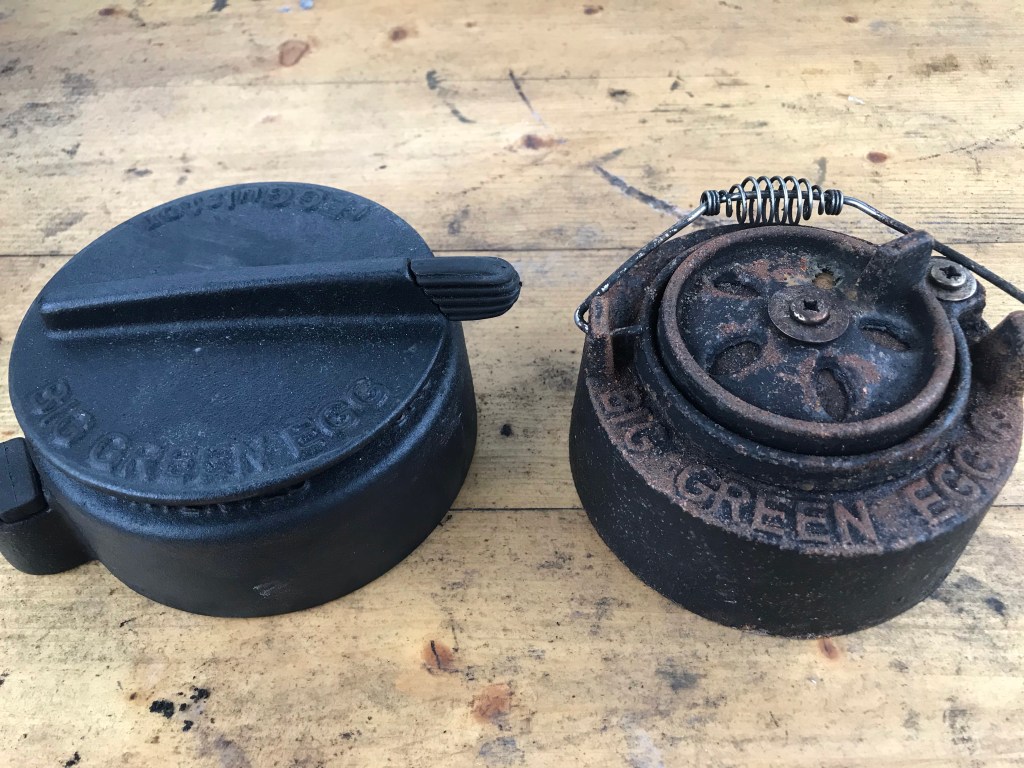
The new and the old. On the right is the original daisy wheel cap that came with the Egg. It’s seen a lot of action. It’s never let me down and once set it holds a stable temperature for hours. Lots of people seem to complain that it slides open or closed when the lid is opened but I’m not sure that’s ever really been a noticeable thing for me. I’ve taken it to bits a few times to give it a go over with a wire brush and tightened the screws pretty firmly to reassemble. Maybe that’s why there’s no sliding.

On the left is the rEGGulator. On the Big Green Egg website, they list the rEGGulator at £45 for the Minimax size and £47.50 for all the other sizes. Shopping around, I got the Minimax version for £28.20 all in from Diss Ironworks, which included a 10% discount off the base price of £25 as a first time buyer from them and £6 for shipping. I don’t think it was any kind of special promotion, but it seemed weird that there was such a price difference when compared to buying direct from BGE (*see update below)

The first impression was quite a surprise – it’s a good bit bigger and heavier than the original. I stuck a ring of Nomex felt around the inside to give it a great seal on the top dome; my worries about the compatibility with our small Egg dissipated. It looks pretty good too; a bit sleeker generally. The blurb reckons it is more rust resistant than the original so we’ll see how accurate that promise is in time I guess. There’s a hole on one side to accommodate a rain cap, but since our Egg is undercover I won’t need one. The hole is sealed with a silicone bung. The adjuster has a silicone grip which protects your fingers from the heat.

The way the rEGGulator slides open and closed has a reassuring resistance and it sounds a bit like the air locks closing behind Captain Dallas in the movie Alien. This is pleasing to me. 

First Use.

Blimey. They are not kidding when they say that it gives up to 30% more air flow. I lit the egg for a low and slow cook, aiming for 125°C. Did my usual faffing about waiting for the charcoal to settle down and suddenly it was up to 300. Luckily, closing it down dropped the temp just as quickly. I’ve now done another couple of low temperature cooks, plus a couple at fierce grilling heat and the adjustment is a piece of cake. It stays rock steady once set up. It’s really good going from low to high for a reverse sear. This kind of adjustment is where it comes into its own. The daisy wheel on the old cap is good, but there is some fiddling and experimentation to get the temperature you want and the rEGGulator feels much more controllable and stable. As I write this, I realise that I haven’t really had to adjust the bottom vent, even when cooking low.

One nice thing is it totally seals off the dome when it’s fully closed so there’s no need to swap it over for the ceramic top at the end of your cook – just shut the bottom vent and it’s done. The machining of the sliding surfaces is really accurate and smooth – it’s clearly a quality manufacturing process.

Overall, it’s really good. The rEGGulator comes as standard on new Eggs now, but if you’re reading this as a the proud owner of a more vintage edition it’s well worth the upgrade.

*UPDATE – 14/03/2021

It turns out I was the lucky beneficiary of an error made by the retailer as they now have them at £45, albeit still with a 10% discount for first-time customers. Apparently even retailers can’t buy rEGGulators for the price I paid. Still totally worth it at full price though…

Knives

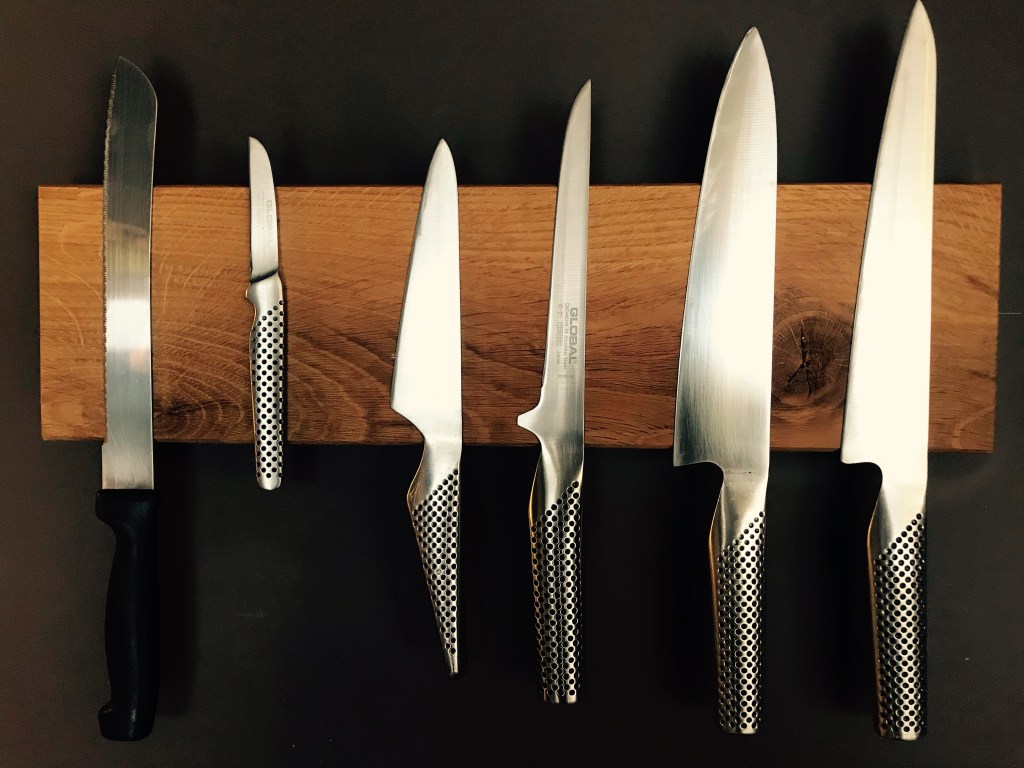
L-R IKEA bread knife, Global GSF-23, Global GS-3, Global G-21, Global G2, Global G-20

I recall that as a young chap making his way in the world of the kitchen, a hankering after quality knives was a pretty keen emotion. Early on, I had a Kitchen Devils cooks knife (still got it in fact) which sharpened well and had a nice heft to it. It still comes camping and it’s been all round the world in the hold luggage to mitigate the blunt, thin, hopeless offerings often found in self-catering accommodation. The grip is only a little bit melted from being left too near the flames.

However, a Kitchen Devil is not a Global. I remember clearly the first time I saw Global Knives – a display case in Tylers in Loughborough – and the serious hankering began. I loved the shapes, the shine and especially the way the handle flowed smoothly into the blade. They seemed impossibly glamorous and, for someone in 6th Form, impossibly expensive.

They are not cheap.

But they are sensationally good. In my mind’s eye they are hand crafted by an acquaintance of Hattori Hanzō with an ancient forging process known only to a chosen few specialists whose ancient skills are reserved for discerning Samurai. The reality may be a bit more commercial than that however. The G2 second from the right is the workhorse, as good when finely slicing an onion as when dicing shin of beef. I’ve had it over 20 years now and it as good as ever. The edge still strong, the balance in my hand still perfect. When something finer is required the GS-3 13cm cook’s knife comes out. The 21cm G-20 is great when there is fish to be dealt with; the blade is very thin and super-flexible and I can just as easily fillet a turbot as slice wafer thin cuts of home-smoked salmon. I makes a great carving knife too. The 16cm G21 is a more classically shaped boning knife and is brilliant for separating flesh close to the bone leaving minimal waste. It is the perfect knife for getting rid of fat caps and the silver skin from big joints like lamb shoulder or beef short ribs. The tiddler on the left was a present and a good one. I’m not sure I’d have bought a GSF-23 but for onion and garlic peeling and for paring off slivers of citrus for cocktail garnish it’s perfect.

They keep an edge beautifully and I probably only need to sharpen them every 4-6 weeks which, given they get used everyday, I think is pretty cool. I use whetstones of various grits from 800 to 3000 to get them back to a level of sharpness that Kevin Costner would have been proud to get on his sword in The Bodyguard.

A note on the IKEA bread knife. It cuts bread. I could buy about 30 of them for the cost of the Global equivalent. Nuff said.

Cote de Boeuf + Bearnaise

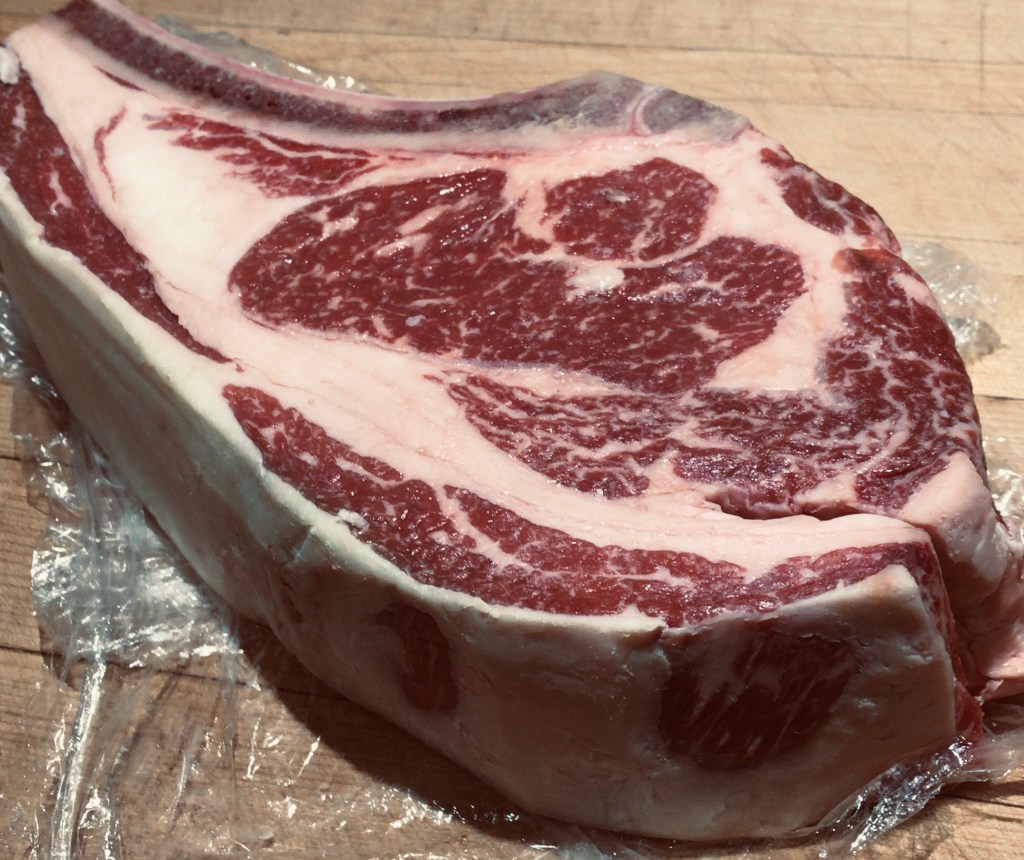
We’ve been getting a regular meat box from Phillip Warren in Launceston, Cornwall – everything they’ve sent us has been amazing and this slab of beef was no exception. About 2 inches thick with a beautiful marbling of fat throughout. I sliced away a bit of the fat on the outside and brushed on a thin slick of French’s yellow mustard, then gave it all a liberal sprinkling of Angus & Oink’s Moo Mami rub. It rested in the kitchen while I lit the Egg to let the rub properly stick. For this cook I used the reverse-sear method which I have found works best for big steaks. I plonked in the plate setter, set the temperature to around 110˚C and let everything settle down for about half an hour. It was the first time I used the new rEGGulator cap and it took a bit of getting used to. I used a mixture of beech and hickory chips that had been pre-soaked to prolong the exposure of the steak to the smoke.

The steak went in for just under an hour, monitored by my Meater+ probe. The target internal temperature was 48˚C and when it got there, I took the steak off the heat and removed the plate setter to crank the temperature up for the searing stage; probably 3 minutes each side using the cast iron grid. Once off the heat, I wrapped it in foil and let it rest for a good 10 minutes. To serve, I sliced the meat from the bone and made good thick slices across the grain. Served with Aunt Bessie’s chips and a home-made bearnaise, the result was tender, gently smoky and delicious.

Interestingly though, the steak was not cooked as consistently throughout as I’d managed before. Lovely and pink at medium rare in the centre third, but the ends were edging towards medium to well done. I wonder if this was because the cut was so enormous? The thinner end sat nearer the edge of the grate, meaning it caught more of the hot air flowing around the edge of the plate setter. Perhaps it was because the bone itself had heated up and cooked the adjoining flesh a bit quicker than the rest. Who knows? Maybe next time I will aim the point of the Meater+ more towards the thin end of the meat.

Recipe – Bearnaise Sauce

Bearnaise really is a winner with steak and chips. I’ve tried a few different recipes, but the basics are always the same:

  1. Finely dice a shallot and add to a small pan with the roughly chopped stalks of a bunch of tarragon, plus a peppercorn crushed with the heel of your knife.
  2. Add a good glug of white wine vinegar and reduce over a high flame until you barely have anything of the vinegar left.
  3. Pass this essence through a sieve and into a mixing bowl and add a couple of egg yolks. Put the bowl over a pan with a centimetre or two of barely simmering water in it – excess heat is the enemy of egg-based sauces – make sure the water isn’t touching the bottom of the bowl with the eggs in.
  4. Whisk this mixture vigorously until it has thickened to a sort of ribbony stage
  5. In another pan, you need about 120g of very gently melted butter – don’t let it get to hot or you increase the risk of the whole thing splitting
  6. To begin with, take the eggs off the heat and whisk in just a few drops of butter at a time – if you lose patience your sauce will split. Once you have an emulsified mixture, you can be a bit bolder with the butter and plonk your bowl back on the bain marie.
  7. Your whisking hand will be tired by now. Plough on.
  8. Add a bit more melted butter. Keep whisking.
  9. As you whisk, think happy, relaxed thoughts. Keep an eye on your sauce – it should be a nice pale colour and be thickening nicely
  10. Once all the butter is incorporated, take the bowl off the heat and fling in some finely shredded tarragon and a good squeeze of lemon. It will need salt, but only the barest crack of pepper. The finished sauce will be just about pourable.
  11. Prepare the jug you are going to serve it in by filling it with boiling water for 5 minutes – pour the water out and the jug will be at the perfect temperature to keep the sauce warm, but not so hot it will ruin all your hard work by splitting it.

If the sauce splits, it can be rescued (I know this through bitter experience). Plop a new egg yolk into a fresh bowl, off the heat. Whisk in your split sauce literally a drip at a time to begin with, only adding more as each drip is fully incorporated. Once rescued, the sauce can be re-heated over the gentlest of bains marie.

The Live Fire Journal

So, a new year full of the best intentions. Ordinarily the intentions of Polly and I would revolve around enjoying life to the full, pottering about in the garden, doing up the house, getting away and travelling and planning what to eat that day.

But our plans have been sent awry by the virus and this has forced upon me a period of introspection. Lockdown 1 was OK; the weather was set fair and warm and we kept calm and carried on pretty well. Lockdown 2 was short. Now however it is dark and cold and miserable. I am missing my friends and family and the simple joy of an impromptu beer in the pub, maybe accompanied by a sausage roll. Reading the paper is a grim experience with seemingly no positives to report, save England’s (and Joe Root’s in particular) form in Sri Lanka.

So how to lift the fog of gloom around me?

I’ve always enjoyed cooking. Both my grandmothers were sensational cooks, my Mum too. There was nothing better than mini rugby on a Sunday morning followed by a roast chicken or leg of lamb for lunch.  My early memories include making Wellington Squares (millionaire’s shortbread in modern parlance) and helping to peel the veg for Sunday lunch. Delia Smith and Madhur Jaffrey were my guides and making Sticky Chocolate Log and Malai Wali Murghi were recipes I got stuck into and enjoyed. Others enjoyed them too and that made me happy.

Mum and Dad were very confident I wasn’t going to starve at university.

Polly is a kindred spirit. She is an amazing and intuitive cook. Her Mum is an amazing and intuitive cook. Every conversation with my mother-in-law will include a discussion of what is being cooked today, what is being cooked at the weekend and had I seen the recipe in the newspaper supplement?

Barbecue has always been a style of cooking I’ve loved. It has associations of sunny weather, camping, friends, laughter, beers and fun. We got a Big Green Egg a few years ago and it has become something of an obsession; I read, research, watch YouTube, think, ponder and obsess over new kit. The process of lighting a fire and then cooking something with it is amazing. The results are usually delicious. There is a kind of intangible quality to any food cooked over charcoal or wood and it is in this alchemy that I see a glimmer of light.

So, first stop, this blog. Second, to dip a toe in the murky waters of Instagram and Twitter (both @livefirejournal) and maybe YouTube. Third, a resolution to document the food and recipes I cook over live fire, try a few things and give my thoughts on them. Like all good intentions, I mean to cook and update the reader regularly but let’s see how I get on in the first place.

Sam