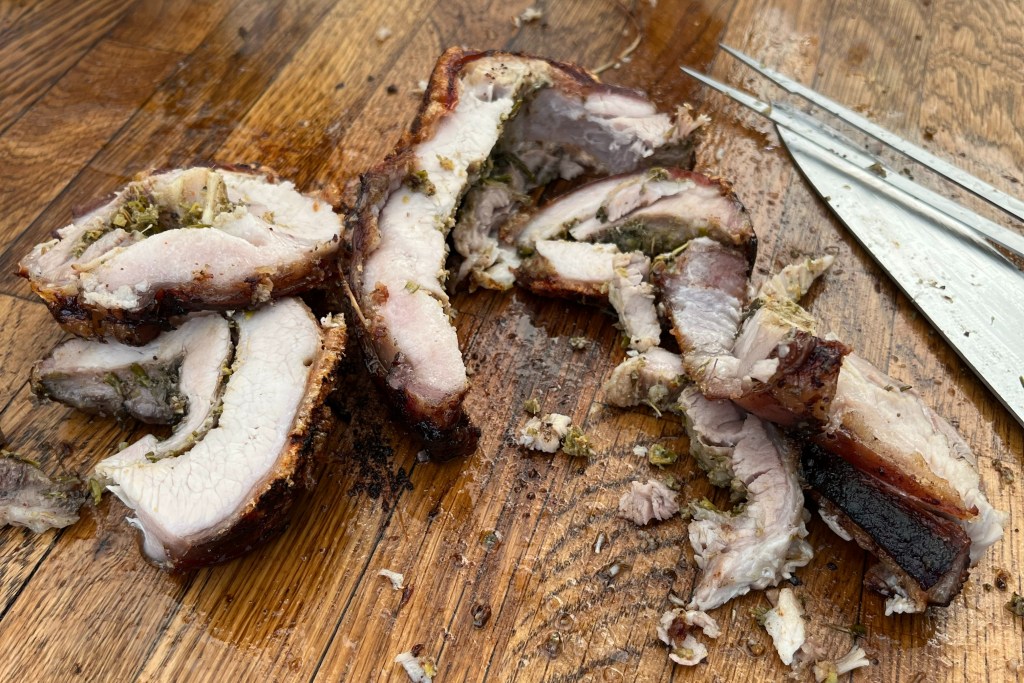
Porchetta

I often need to have a good long think before setting out on a new blog post. Is it to be about a new dish I’ve cooked, a new piece of kit or a party we’ve held? Mostly, they seem to end up being a bit of a combination of all three, but there is always a nagging doubt of originality and just the littlest fear that I’m riding on the coat tails of proper chefs and food authors who do this sort of thing for a living. I’m keen to avoid replicating recipes verbatim from an individual, so for this blog I am writing about this brilliant, traditional Italian dish which I cooked by gathering together the best bits from a range of different sources.  A bit like the British Lions I suppose. 

Porchetta starts with pork belly – a lot of recipes call for the loin to be included as well so the belly wraps around the loin to make a bigger joint. However, we only had a couple of people coming for lunch and, to be honest, I find pork loin one of those bits of a pig that has the most delicate (or absence of) flavour and I wasn’t sure it would add anything other than about £15 to the cost, so I left it out. 

The next key elements are the flavours to be included in the rub/marinade for the meat. Almost all recipes I read include Fennel seeds, garlic and lemon zest. Some go for rosemary or thyme or oregano, some include chilli flakes, one I found even included fennel pollen (I looked it up. It’s astonishingly expensive. Decided to leave it out). I found some chefs prepare a kind of stuffing of lardons and nuts to go in theirs and others prick the flesh and massage in a glug of white wine. After I’d cooked it, the Savage BBQ guys on Instagram recommended adding Nduja. It seems to me that, whilst this is very much a traditional dish, you can pick and choose what you want to include and it can still be called Porchetta. Having now actually cooked one, I imagine whatever you do, the result will still be absolutely banging, to use the modern vernacular.

In any event, this is what I did: 

For Sunday lunch, we set out on Saturday morning to the butchers at Webbs of Wychbold. They are brilliant. I explained to the butcher what I wanted and she disappeared into their dry-ager and returned with a slab of belly with the ribs still on. She asked a load of questions about how I was going to cook the porchetta and offered loads of good advice as she neatly removed the rib bones and scored the skin for me. We paid about £30 for just over 4kg of pork belly, plus she chucked in the ribs and the porky equivalent of a bavette steak for free. Perfect.  

Once we got it home, I carefully sliced away a couple of sections to make it an even thickness, plus trimmed off one end to square it up a bit. I think I will make some bacon with these bits, but they went in the freezer for the time being. Next, the marinade which was largely based on what we had in the garden/fridge/store cupboard: 

Marinade Ingredients. 

(Very rough measurements) 

3 tbsp Fennel seeds 

A big handful each of rosemary and marjoram (leaves only – strip them off the woody stems) 

Zest of 2 lemons 

Juice of 1 lemon 

4 fat garlic cloves 

1tsp Piment d’Espelette (you can substitute this with Cayenne pepper or chilli flakes, or do without) 

20g of rock salt  

About the same amount of olive oil as the lemon juice 

First, heat a pan and dry fry the fennel seeds until they start giving off a lovely aroma and have taken on a bit of colour. Add them to a pestle and mortar and give them a good grind. Now add your sliced up garlic, the lemon zest, the piment d’Espelette and the salt and grind away until you get a smoothish paste. Finely chop your herbs and add them to the paste and keep grinding. Finally, add the lemon juice and olive oil and incorporate. A note of caution here; it was extraordinarily hot when I did this, plus my pestle and mortar is one of those heavy-duty granite ones. If you want avoid the super perspiring “Ted Stryker making an emergency landing” look, you could blitz this all up with a stick blender or one of those mini food processors. Or wait for it to be colder. 

Going back to the pork, I laid the rectangular piece skin-side down on my board with the long side facing me and, with my sharpest knife, made a shallow, horizontal slice all the way along the front edge to start the process of butterflying the joint. I then held open the small wing of flesh I’d created and made another pass, keeping my blade parallel to the board and making lots of shallow cuts (a bit like fileting a fish), opening the wing further until stopping just short of the end. Butterflying the belly means you get more surface area to add marinade to, plus, I think, makes it a bit easier to roll up afterwards. Taking the marinade, I poured about half on the top of the pork, spreading it evenly with a spatula. This top bit got rolled fairly tightly leaving the bit with the skin on still flat on the board. The remaining paste got spread all over this part, then I rolled this bit around the bit I’d already rolled. Picture a porcine Swiss roll.  

To hold everything together, and to keep as uniform a shape as possible, I tied the porchetta every couple of centimetres. Proper butcher’s knots are a bit fiddly, but there are some brilliant videos on YouTube to teach you. I did a lot of practice with a rolling pin which was time well invested since the knots, once mastered, do lock everything in place properly. Finally, pat the skin of the pork dry, and rub in a good lot of salt. Place the joint on a rack, above a tray and leave, uncovered, in your fridge overnight. The salt will draw moisture from the skin and should help to get the crackling going. 

Now nearly all the recipes I read to prep for this give times and temperatures for cooking in the oven. I really wanted to build a fire and use the rotisserie for the Fire Cage, and “Oven Journal” doesn’t quite have the same ring does it? I lit a load of charcoal and, once it was glowing nice and evenly, I made 2 long, thin coal beds each side of where the Porchetta was going to cook – I didn’t want the heat directly under the meat – I figured more of a glancing blow would be best. Between these beds, I made a kind of boat out of tin foil to catch the inevitable drips. Once everything was set, I threaded the spit through the middle of the porchetta and mounted it in the motor to get going and shoved my Meater thermometer right in the middle to monitor the temperature; pork is safe to eat at 75°C but I wanted it to go a bit beyond that to render out more of the fat. The Meater app recommended 90°C, so I went with that. 

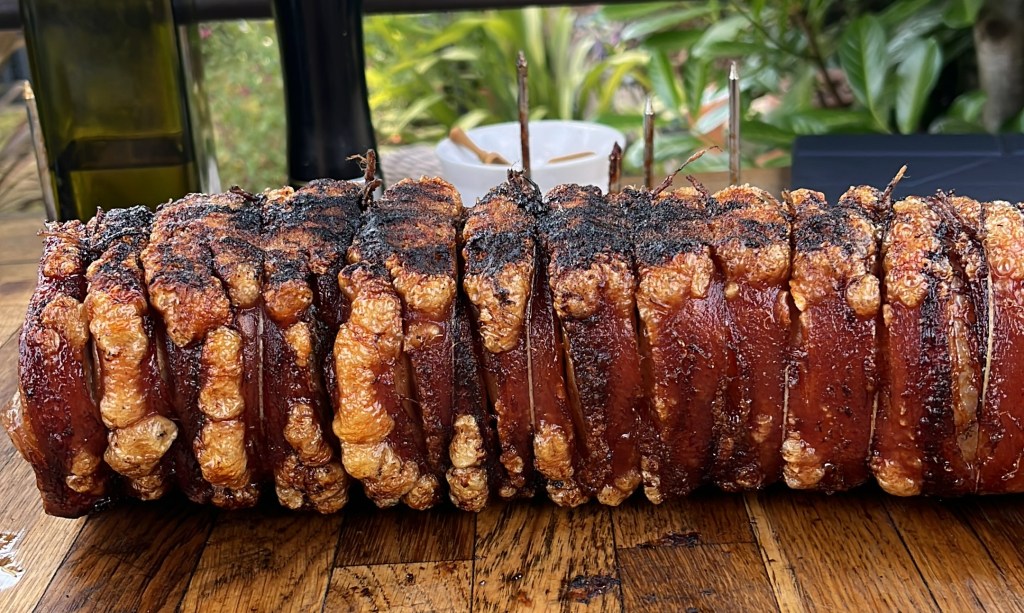
It took a long time. Most oven-based recipes quote about 3 hours, but this took just over 5. It was, however, very cool to watch the evolution of the cook and see how the skin changed from pale, dry and slightly wan, to golden, burnished and crunchy. The Meater showed that for an hour, the joint got stuck at about 86°C. This is known as the stall and happens when the moisture inside the meat makes its way to the surface and evaporates. If you’re doing pulled pork, you just have to wait it out until you get to at least 95°C. Luckily, we had company and sunshine so the wait was fun. However, on reflection we probably could have eaten earlier – you don’t really want your Porchetta to be too soft I reckon.  

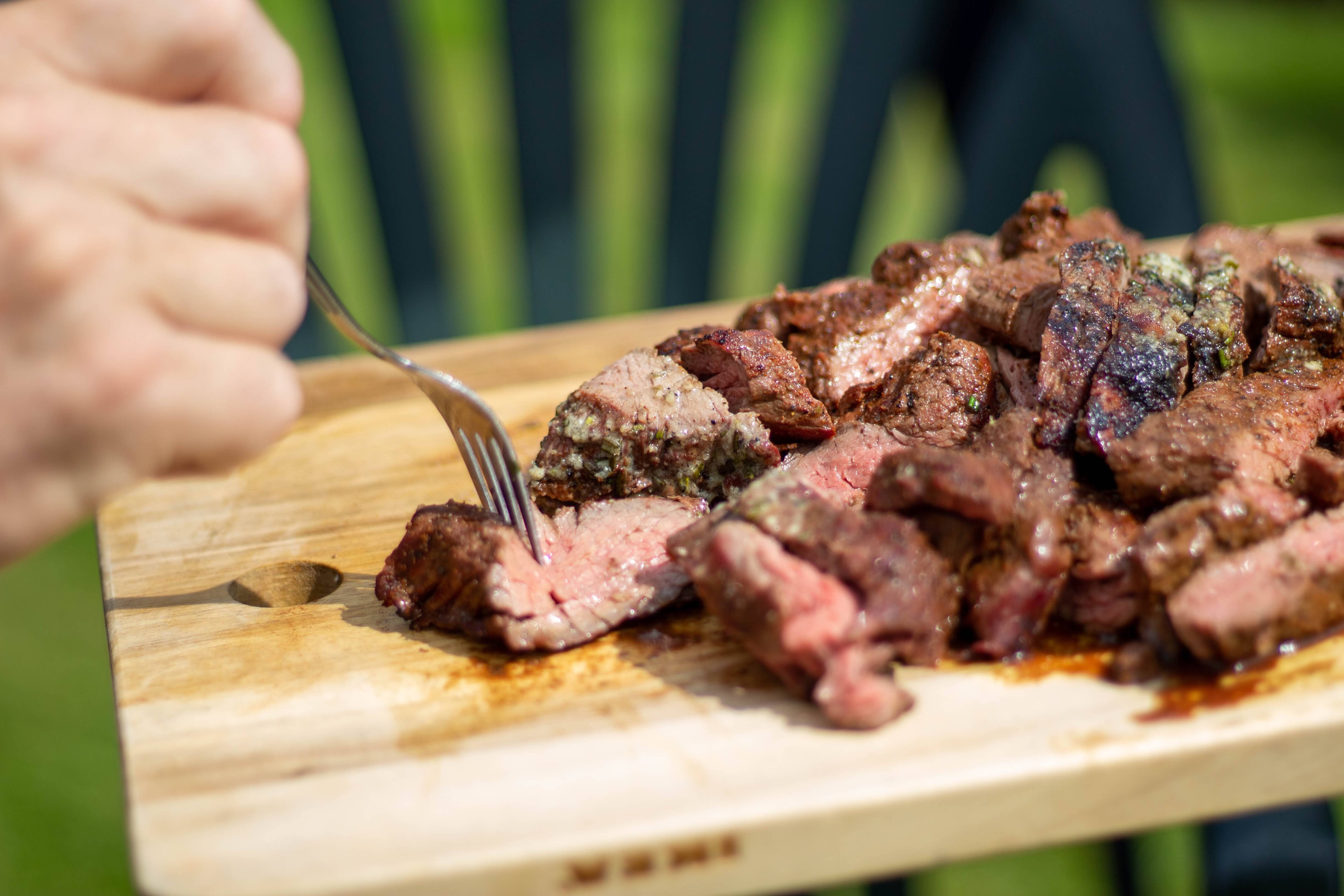
Lastly, I wanted a blast of direct heat to really crisp the crackling, so I stopped the motor, moved the foil boat out of the way and raked all the charcoal together underneath the porchetta for about 10 minutes, letting the motor run for a quarter turn every couple of minutes to expose a different section to the heat. It worked! The crackling was perfect. What was also noticeable was how much of the fat had rendered – the foil boat worked a treat and caught the drips. This meant that each bite was mostly meat, without any big blobs of fat that can sometimes make pork belly a little unappealing in my view. We served the Porchetta with grilled corn (basted with the dripping from the pork), grilled courgettes, roast cauliflower, plus a coleslaw Polly had made with a delicious cider vinegar dressing.  

Like a lot of these low and slow cooks, nothing about doing this is difficult, but you do need some time on your hands. It’s a brilliant recipe and could easily have fed 8-10 people. Unusually, I remembered to take a photo of the finished product and whenever I look at it, it will remind me that I need to cook this again someday. When I do, I will make a couple of tweaks: 

  1. I will leave it to marinade for longer. 36-48 hours should do the trick I think. 
  1. I will be braver with the salt in the marinade. Not that the finished result was bland in any way, but an extra 10g or so, distributed evenly through the whole piece would bring all the flavours together a bit better. 30g might seem a lot, but you are seasoning about 4kg of meat 
  1. Likewise, I would add a few more fennel seeds, but then again, I do absolutely love that anise flavour. I might even consider adding a swig of pastis into the marinade, but that might well be dependent on who I am cooking for. 
  1. I might shell out on the fennel pollen. I hope it’s the same as saffron in that it is expensive, but you get quite a lot of bang for your buck. 
  1. I will score the skin at more regular intervals to make it a bit easier to carve.  

It’s definitely one to have a crack at, especially if you have a few folk coming over. 
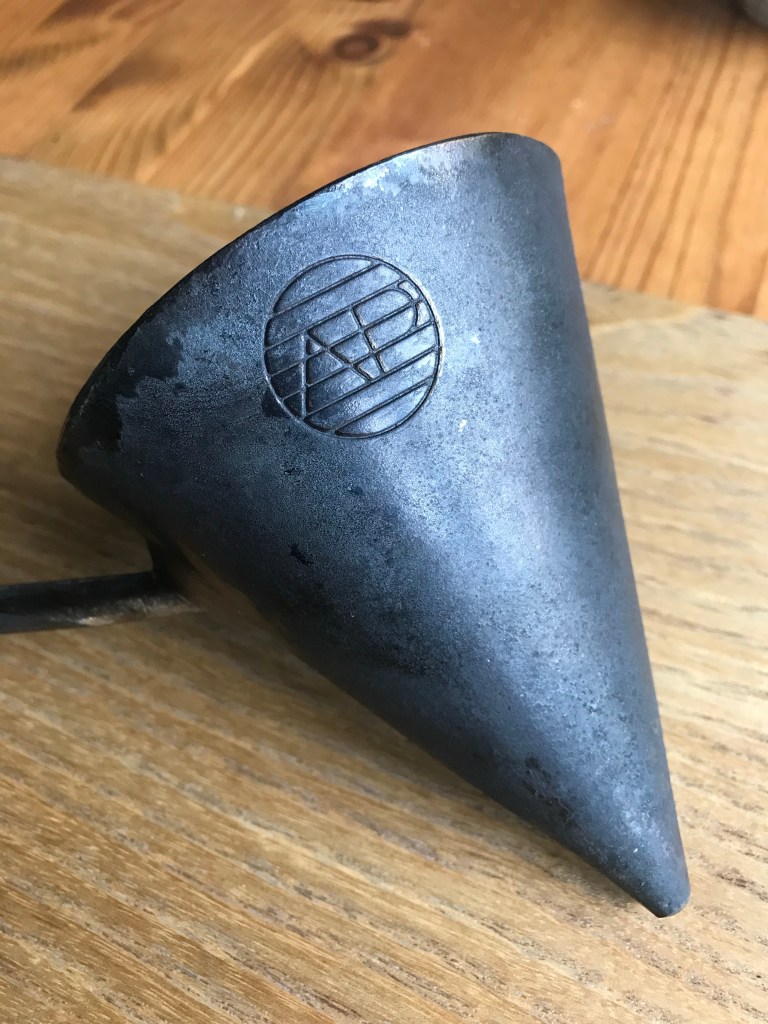
Fun with a Flambadou

A what? 

A flambadou is used to melt fats or butter over whatever it is you are preparing to add flavour and to add a last-minute scorch of heat to finish off the cooking. It consists of a metal cone with the wide opening at the top and a much smaller hole at the bottom – the cone is attached to a long handle. You put your butter in the top and it melts out of the bottom and onto your food. I got mine from Axel Perkins whose strapline is “Cook outside more” (very happy to do so) and it cost about 50 quid. 

The flambadou can be used in 2 different ways, kind of analogous to grilling or cooking low and slow. The low and slow way is to hang the flambadou above your food so that it receives only gentle indirect heat from the fire. This means the butter will melt gently and baste your fish or steak or vegetables as they cook. The second way is much more intense (and much more fun). This method involves burying the flambadou in the embers of your fire until it is almost red hot. At this point, any fat dropped into the cone will instantly catch alight, melt super quickly and will cook and caramelise the food below. It is spectacular, particularly if you have guests, but stout heat-proof gloves are a must. 

I have tried this method both with beef fat rendered from the trimmings of a whole beef forerib and with flavoured butter on meat and vegetables. Although both are delicious, I think I prefer the butter since, as the food cools down the beef fat tends to dominate the flavour a bit too much for my liking. Cold butter remains delicious, cold beef fat does not. 

My ambition is to recreate Niklas Ekstedt’s flamed oyster recipe from his “Food from the Fire” book and I will let you know how it goes the next time I have some oysters, but for now these 2 recipes are the ones that have worked best for me so far.  

Steak with herby garlic butter 

For the Butter  

100g butter at room temperature
A good bunch of Tarragon – substitute any leafy herbs you like if you are not a fan – parsley works just as well.
A clove of garlic
An anchovy fillet
A drip or two of Pernod (optional)
A drip or 2 of hot sauce 

The method is a doddle – chop the tarragon as finely as you can and smash the garlic and anchovy fillet with a pinch of salt in a pestle and mortar until you have a very fine, smooth paste. This is important as big chunks of anything will block the flambadou and frankly it is a bit of a bugger to clean. Now add the Pernod and blend with the butter. Lay a sheet of cling film on your work surface and put the butter in the middle – if you can, make it into a kind of log. Now roll up the cling and twist the ends so you get a tight sausage of butter and then stick it back in the fridge to set. The reason for this is that it is then very easy to slice off the amount you need, and it’s the right shape to go into the flambadou. 

For the steak 

You can use any kind of steak for this, but when I tried the flambadou for the first time I had a good slab of rump which was perfect. Light your barbecue, let it heat up and then cook the steak how you like it. Leave time to let it rest for a good 10 minutes on a cooler part of your grill, well away from the heat. While it’s resting, stick the flambadou into the burning embers to heat up – it should be shimmeringly hot. Slice the steak thinly and then lift onto a warmed dish or plate. Now invite your audience to gather round, but make sure you keep them at a safe distance with their cameras at the ready. This is the fun bit. Wearing heat proof gloves, hold the cone over the steak and add a couple of slices of your tarragon butter; it should catch fire immediately, but if it doesn’t, move the cone back over the coals, as if you were lighting the brandy for the Christmas pud. As the butter melts, move the flambadou so each slice gets doused. As soon as the butter has all gone, the flames will die down. I’m lucky that I have the fire cage with hooks to hang the flambadou on to cool down, but if you are having a go yourself, make sure you have a safe place to put it down. Serve your steak immediately and bask in the glow of the adulation from your guests. 

Root veg with fennel butter. 

This is adapted from the recipe in “Charred” by Genevieve Taylor.
For the Fennel Butter 
100g goat’s butter
A teaspoon of fennel seeds
A teaspoon of honey
Salt & pepper
Root Veg – 4-6 carrots and 4-6 parsnips, peeled and sliced in half length ways – if they are massive then quarter them. If you get really fat parsnips, I recommend chopping out the woody core as well. 

To make the butter, toast the fennel seeds in a hot dry pan until you can start to smell the aroma and see a little colour on them. Take them off the heat and let them cool completely. Now grind them up – I used a pestle and mortar but a coffee grinder would do the job – and blend with the butter, honey and a pinch of salt and a grind of pepper. Make a sausage using cling film as for the previous recipe and cool in the fridge. 

To cook the carrots and parsnips, you are going to need direct and indirect cooking areas on your barbecue so once your fuel is lit and burning nicely, bank the embers to one side. Toss the veg in a little olive oil and salt and pepper and place them, cut side down, directly over the hot embers and leave them for a minute or two to get nicely charred. Now turn them to do the other side. Once you have those lovely grill marks all over, transfer the whole lot to the other side of your grill to finish cooking gently. If your barbecue has a lid, put it on. I used the Fire Cage for this and it took longer than I thought it might and I ended up charring the parsnips a bit more than I would have liked, but never mind. If I was doing this again I would use my Big Green Egg I think. 

Once everything is cooked, take the veg off the grill and transfer to a warm dish and put the flambadou in the flames. Once hot, melt the fennel butter over the dish and toss the carrots and parsnips around a bit to get an even coat. Serve immediately – they are very delicious! 

Afterword

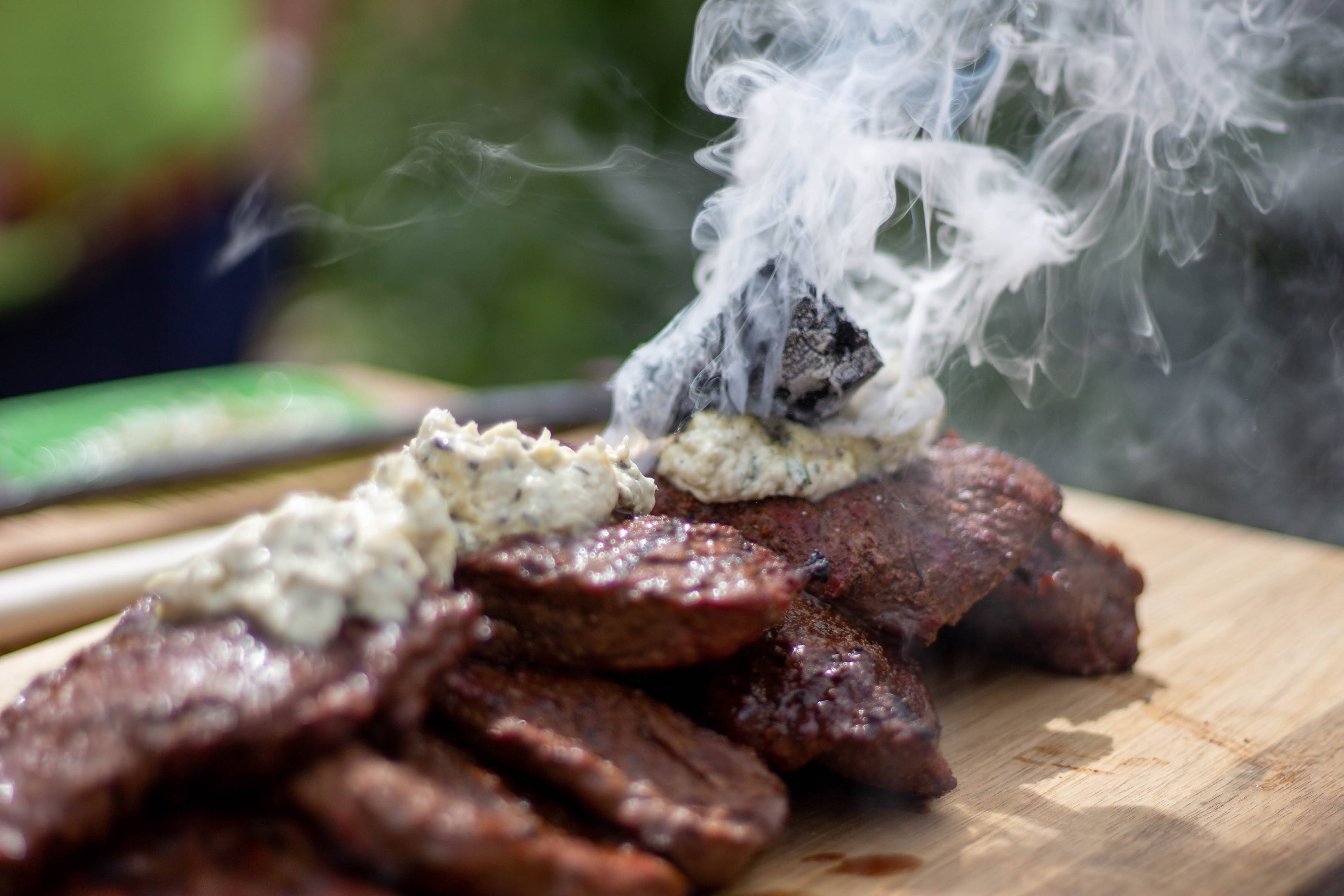
For those of you who choose not to chuck a good chunk of your disposable income at your cooking, you can achieve a similar kind of effect to using a flambadou by adding the flavoured butter on the top of your cooked steak or vegetables and melting it with a big chunk of burning charcoal. It’s an idea I nicked from Marcus Bawdon and it really does work well.

A word on time (not the Stephen Hawking kind)

I noticed with a degree of horror today that is now 6 months or so since my last post here. I’ve wracked my brains and cannot really come up with any particular reason for the hiatus other than sometimes real life gets in the way. In this case my professional life has been pretty all-consuming for the last few months as we geared up for remembering how to prepare students for exams once again and we dealt with those who were finding the whole thing a bit traumatic. However, as the school holidays have started for both of us, I now have the luxury of space and time to get writing again. As I type this, I am listening to the crickets and looking out over the Adriatic of the north Croatian coast and the stresses and strains of the last couple of months seem like a distant memory. What opportunities the availability of time brings…

There are 3 things I have cooked in 2022 which stand out from the crowd, presented here in ascending order of the time required to cook them:

A snip in time – whole bavette caveman style (30 minutes or so)

I think Bavette steak might well be the best steak discovery of my Live Fire journey so far. It’s a fairly unheralded cut doesn’t look particularly glamorous but is delicious as long as some golden rules are adhered to:

  1. It needs to be cooked to at least medium-rare which is in the realm of 60-65C if using a meat thermometer (take the steak off the heat at 60 and it will get to 65 while resting)
  2. Whatever you are cooking it on/in needs to be very hot
  3. To serve it, make sure you slice across the grain.

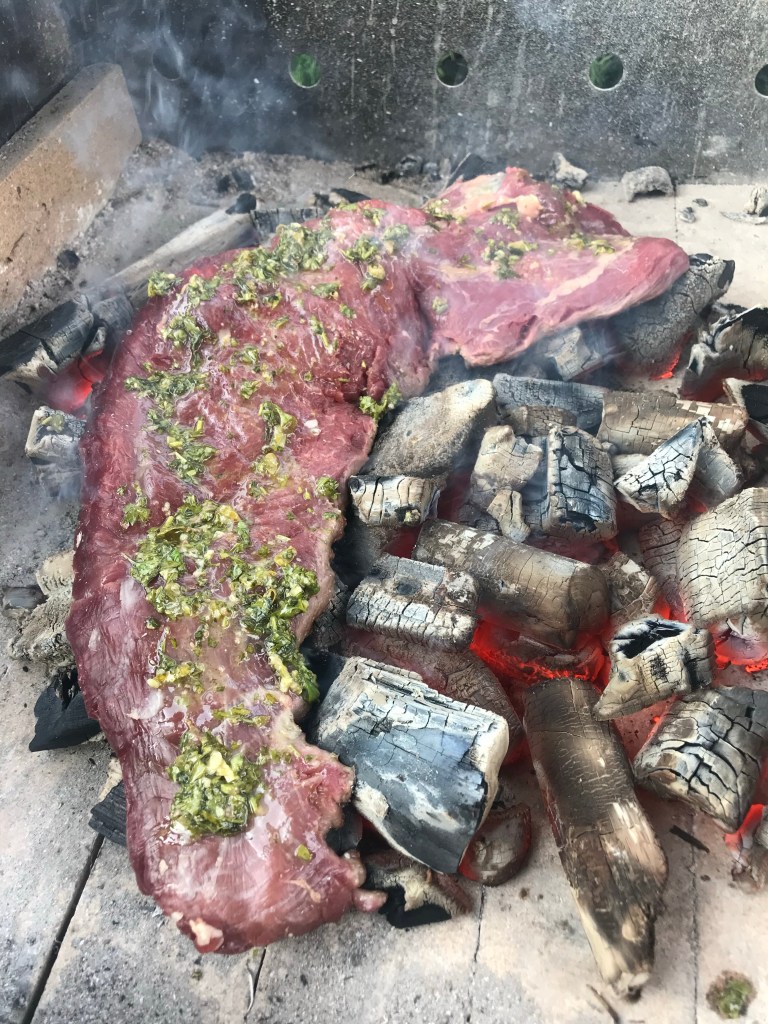
We had a party to celebrate Polly’s birthday and, whilst we had a bit of a show-stopper to serve for lunch (more on this later) we needed something to keep everyone going later on into the night. I’ve mentioned Philip Warren butchers in Launceston before and they sorted me out with 3 whole pieces of bavette – each one weighing about a kilo and probably measuring about 60-65cm in length – big bits of meat in other words. To keep the showstopper vibe alive, I decide to cook them directly on the embers (this is sometimes referred to as an “Eisenhower” steak after the US President who liked this method). I lit a small pile of Globaltic birch charcoal and waited 10 minutes or so for it all the really get burning, then raked out a long thin bed and plonked the bavette straight on (to a very satisfying hiss). Using tongs, I turned the steak every minute or so – each time the meat comes into contact with the embers a beautiful crust is created. More flips = more crust. If you give this method a go yourself, please note you will have to pick off bits of charcoal that have stuck to the meat – this is perfectly safe. Once the steak is cooked, leave it to rest for a good 10 minutes and slice across the grain. Most steaks will be more chewy if you don’t do this, but for Bavette, this is extra specially doubly important. Then smother with chimichurri, that delicious herby, vinegary South American sauce. The first one lasted, I think, under 2 minutes as it was devoured by hungry guests. The other two went the same way. Given what I’d cooked for lunch, this was an excellent effort and is also a guarantee of company; I noticed as the steak cooked I was encircled by friends drawn in by both the delicious smell and the spectacle as moths to a flame. Very satisfying on all fronts.

An afternoon of leisure time – rotisserie Picanha (About 3 hours)

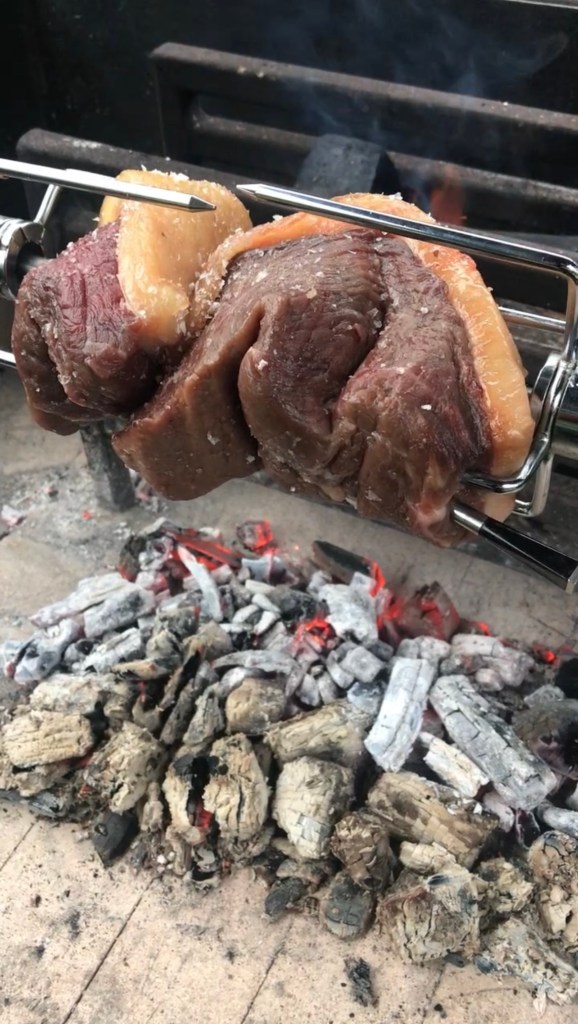
A hugely popular cut of meat in Brazil, Picanha is the triangular tail section of a full sirloin steak. A whole piece will weigh in the region of 1 to 1.5 kg I guess. The Brazilian way of cooking is super-easy but does require a rotisserie to achieve it. The day before, I did my usual thing of finely scoring the fat layer, salting the beef and leaving it uncovered in the fridge overnight. Next morning, I built my fire and waiting an hour or so for the flames to die down to produce a lovely bed of embers to cook over. Next, I cut the Picanha into 4 thick slices. Each slice then got folded back on itself to make a kind of U shape, with the fat on the outside forming a protective layer; each slice then got impaled on the rotisserie spit (in truth, this bit was quite fiddly and I made have said some bad swears – sorry Mum). Once I’d set the rotisserie spinning, that was it.
I used my Meater probe to check the temperature and then just left it alone for the thick end of 2 hours – about the length of time for a traditional Sunday roast. Every now and again I had to add a bit more wood to make new embers but this is one of the least “involved” cooks I’ve done on the cage. I took the steaks off when the internal temperature had reached 55c and let them rest for a good 15 minutes on the high shelf of the cage. I cooked a load of different vegetables on the embers as the meat span and this made a great lunch with plenty of leftovers.

A culinary age – Asado venison a la cruz (a whole day)

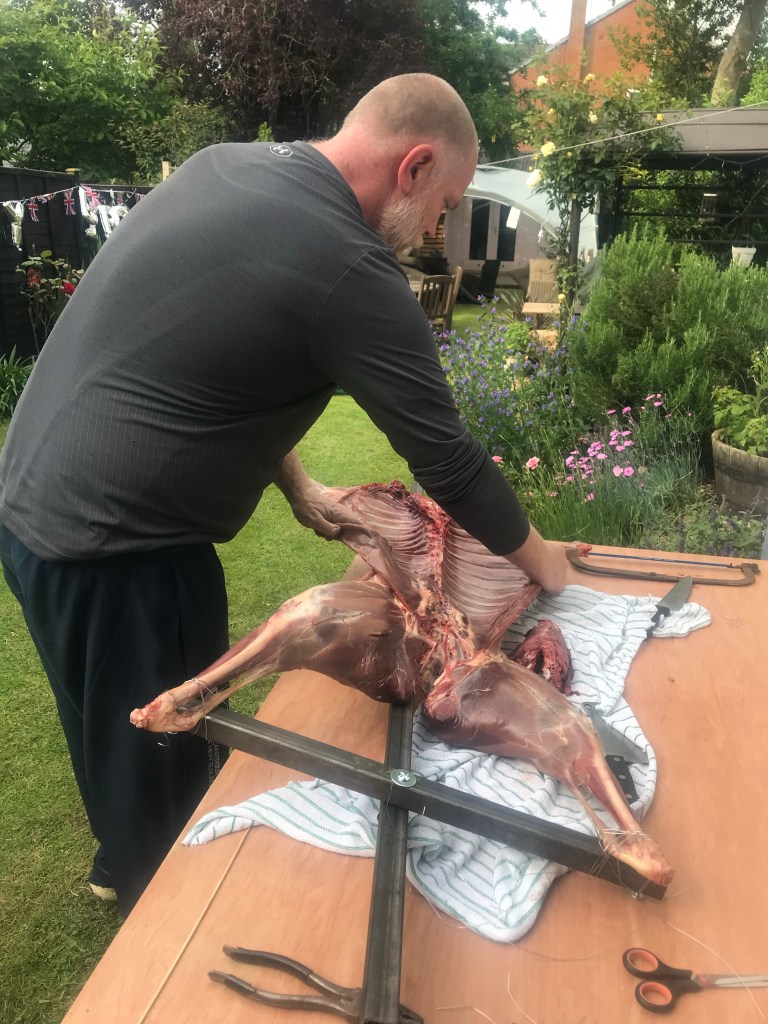
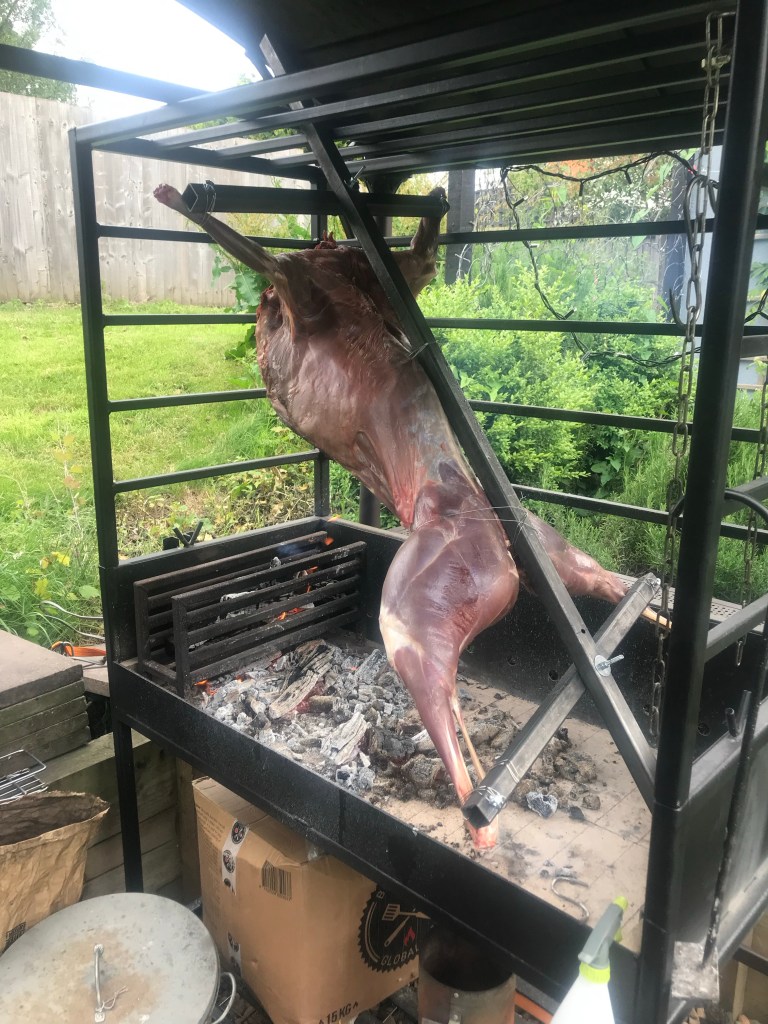
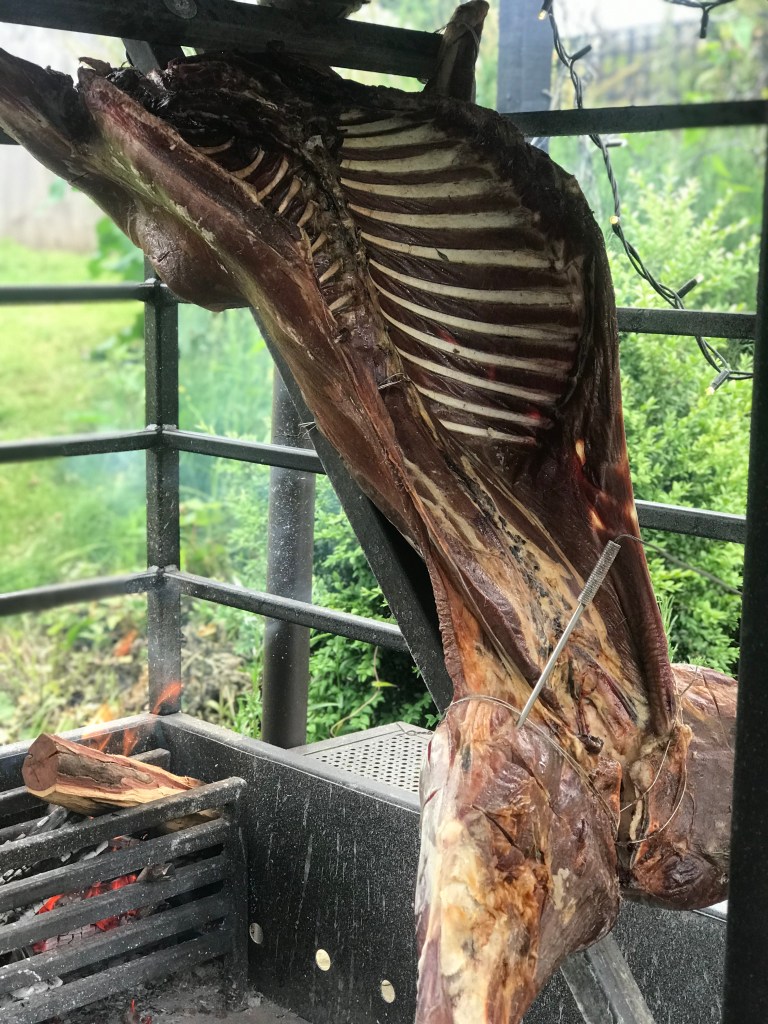
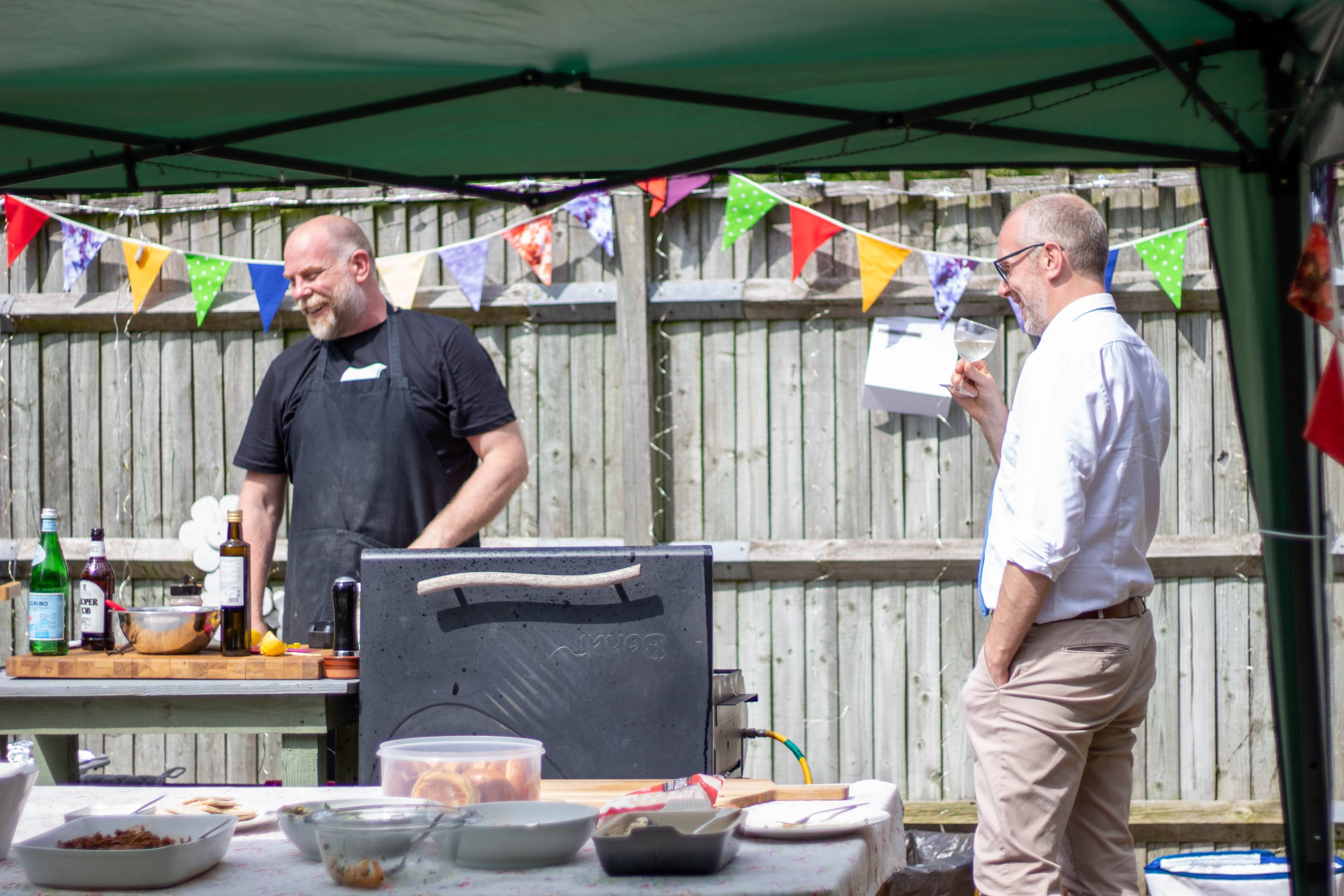
Now for Polly’s party we had a lot of people to feed and she wanted something to use the cage to its full potential. Cooking “a la cruz” means that the meat is mounted on an iron cross which is then suspended near a fire and cooked indirectly over several hours. Whilst not entirely considering the needs of the vegetarians who would be coming, Polly decided that we would go for a whole venison. We managed to source one locally, from a company called Deerbox (lovely, helpful blokes by the way), who are based in Cirencester – this was handy as it was the Queen’s jubilee weekend so in lieu of a delivery, I was able to go and pick it up in the van. You can buy Asado crosses, but for something one-off I decided to make mine out of 30mm box section mild steel, bolted together. A local company cut everything to length, charged me about £25 for the steel and delivered FOC – result. On the day itself, I was up at 0600 to light the fire, knowing it would take an hour or so to properly get going. I tied the venison to the cross using stainless steel wire and mounted the whole thing into the cage. In all honesty, I got the fire too hot to begin with, which led to a bit of a panic that I would overdo things, but there was in the region of 20kg of venison so it didn’t cook too quickly.

The trick to this kind of cooking is to keep the temperature low and to baste the meat with selmuera every 20 minutes or so. Selmuera is basically a brine flavoured with thyme, rosemary, bay and garlic – I made a brush with more sprigs of rosemary to paint it on with. It was ready at about 1400, meaning it had cooked for 7 hours or so. Polly had prepared some brilliant sides and salads to go with, plus we had the bavette steaks on standby, plus a slow-cooked lamb shoulder we did the day before. It was amazing. The outside bits had taken on a delicious salty, crusty texture (I had tested many of them in the cooking process) and the deeper bits of flesh were delicious; tender, juicy and full of flavour. In all honesty, carving the whole carcass felt quite primeval, and I did get more than one Henry XII comment. The party was a roaring success and, in contrast to the party bags with bits of birthday cake, we sent happy guests away with slices of venison – the leftovers just wouldn’t have fitted in our freezer!

The Fire Cage

The Fire Cage

Polly and I went backpacking around Argentina 20 years ago. It was a transformative experience for me in many ways, not least in the pure joy to be had in going to a restaurant where the menu only consisted of about 10 courses of meat. You name it. Bif de Chorizo, Bif de Lomo, pork, chicken, intestines, Mollejas (sweetbreads), Tira de Asado (cross-cut ribs), Morcilla sausages, Vacio (like bavette steak), chorizo sausages and more beef in the form of the amazing Costillar (short ribs). By way of respite, one course was usually Provolone cheese. If you were lucky, you got some grilled peppers. Wherever we went, be it Buenos Aires, Salta, Mendoza, or Iguazu we found open fires with a simple grill over the top with assortments of different cuts cooking away. It was amazing. The quality of Argentinian beef is legendary, and I can confirm the legends do have basis in fact.

Wind forward to the present day and Lewis from Savage BBQ knocked on the door just after Christmas. He had bought with him the Fire Cage that I had been saving up for for a long time. If you wanted to picture my level of excitement, you could bring to mind the image of George Bailey when he pelts through Bedford Falls realising that he does have a Wonderful Life after all.

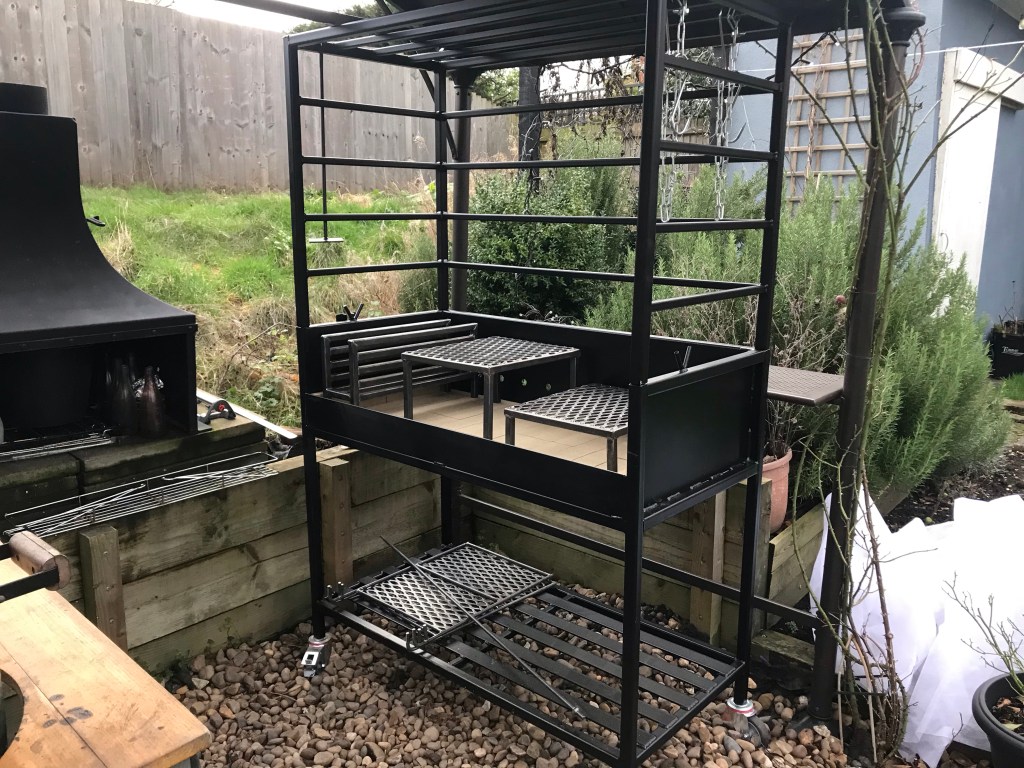
The cage itself consists of a steel fire pit lined with fire bricks, 2 standing grills of different heights and 2 floating shelves which hang on chains and butchers hooks and can be positioned above the fire in a variety of positions. Also included was a rotisserie attachment, an ember rake and a Brasero; basically, a small cage in which to build your fire. Everything feels super-sturdy and is powder coated in a reassuring black.

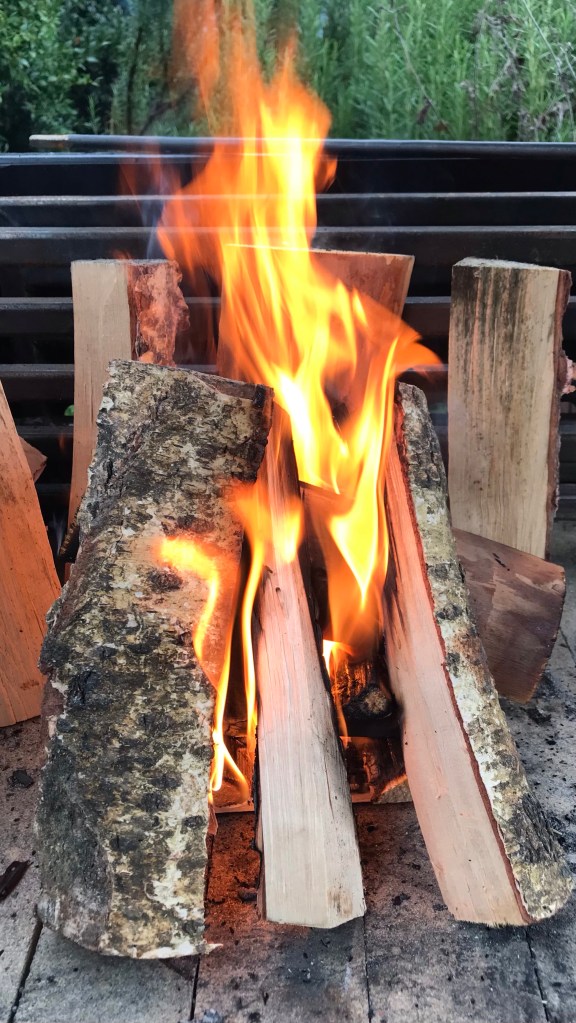
I used it on each of the three subsequent weekends and, like our trip to South America, it has been quite a transformative experience. First up, everything happens s l o w l y which is a beautiful way to cook. When you light your fire, it will be a good hour before it’s ready to go. I’ve used a mixture of birch logs and charcoal which need to burn down in the Brasero until embers fall out of the bottom which can then be raked, scooped and pushed into a large bed underneath the grills. The Brasero then gets topped up with more wood and charcoal to start burning down – you need to have everything to hand and monitor what is going on quite carefully.

Secondly, it is HOT. Given that it is January, this is a good thing, and it does make the outdoor experience a luxurious one. However, I discovered very quickly that heat-proof mitts or welder’s gloves are a must if a chap wants to keep all the skin he had when he started.

Once the ingredients were on, I found the whole cooking process both quite intuitive and splendidly interactive. I quickly fell into a rhythm of check embers, turn steak, turn tomatoes, check embers, add wood, turn peppers, turn steak, turn courgettes, check embers, add charcoal and so on. I loved it – it feels like primeval, proper live fire cooking. You move the grills to the fire, not the fire to the grills. With the Big Green Egg, the temperature is fairly stable and the control of the fire is done by little adjustments of the vents – once set it carries on for hours. The two grills represent contrasting ways of achieving the same thing and I really like that.

So far, I have cooked:

T-Bone Steak – hung on a meat hook over the fire and slightly undercooked it despite using the Meater to check the internal temperature. Would have gone down a bundle in France, but I gave it a last-minute sizzle in a pan to finish it off. It was lovely, especially the fillet side.

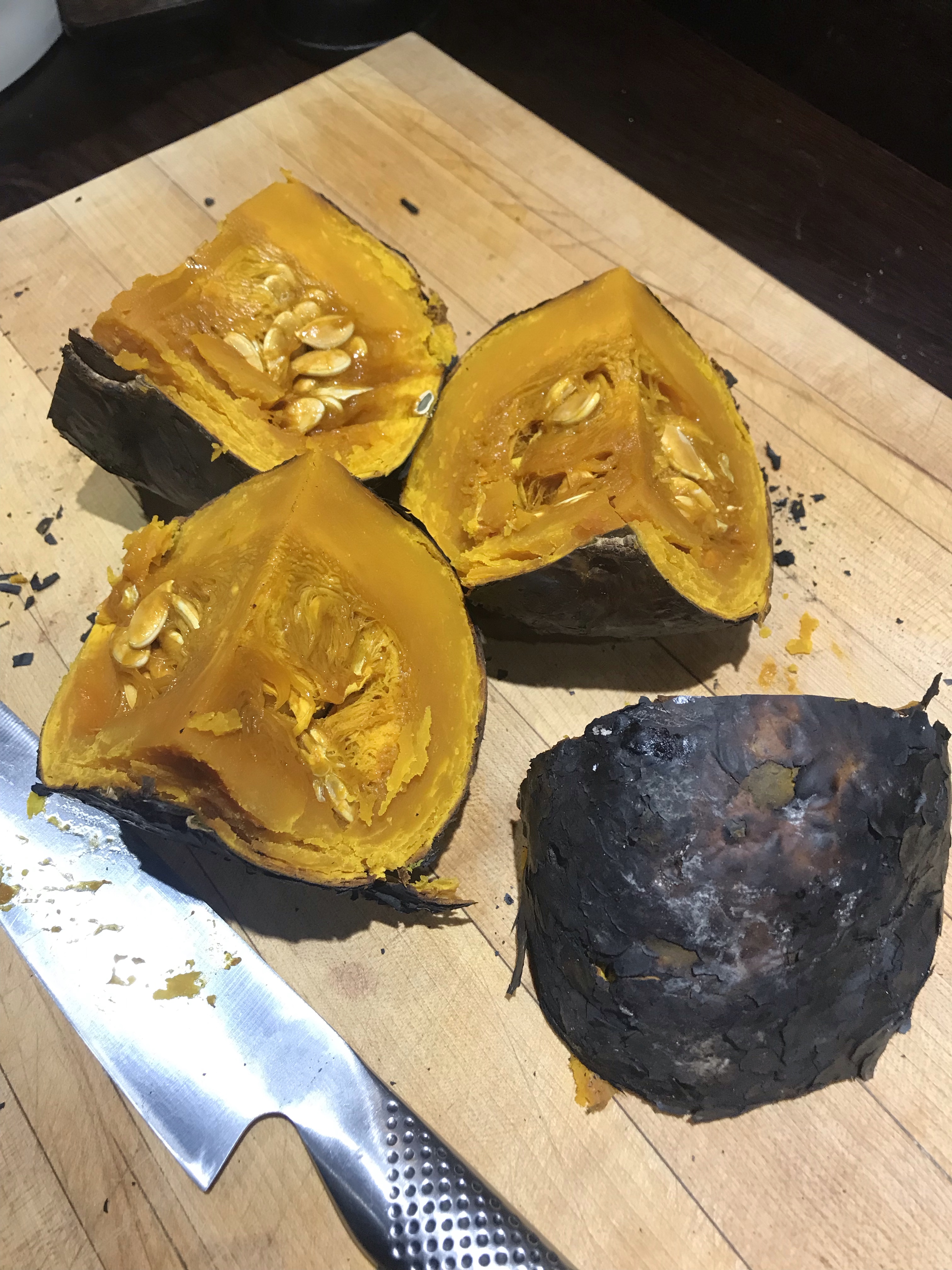
Squash. Interesting. Cooked in the embers until blackened all the way around. Took ages. When sliced, the seeds were scooped out and the flesh cut into cubes. The most interesting thing was the texture – clearly a lot of moisture had evaporated so the squash had a lovely firm, chestnutty flavour.

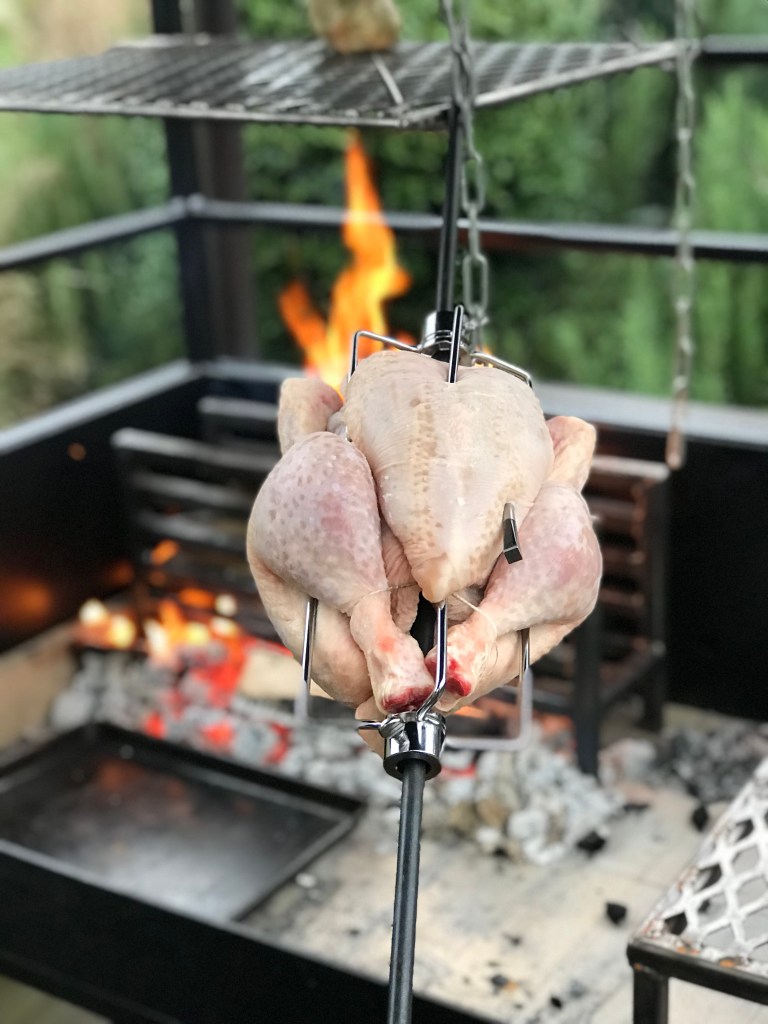
Rotisserie Chicken – perfect. Rotisserie is great fun, and the chicken was beautifully juicy. Used the Meater probe to monitor internal temperature. Basted with Salmeura (a brine flavoured with rosemary, garlic and bay leaf)

Lobster – low grill. Sliced it in half lengthways but slightly overcooked the claws and undercooked the body (had to stick under the grill as we were starving). It was absolutely delicious served with an indecent amount of garlic butter though.

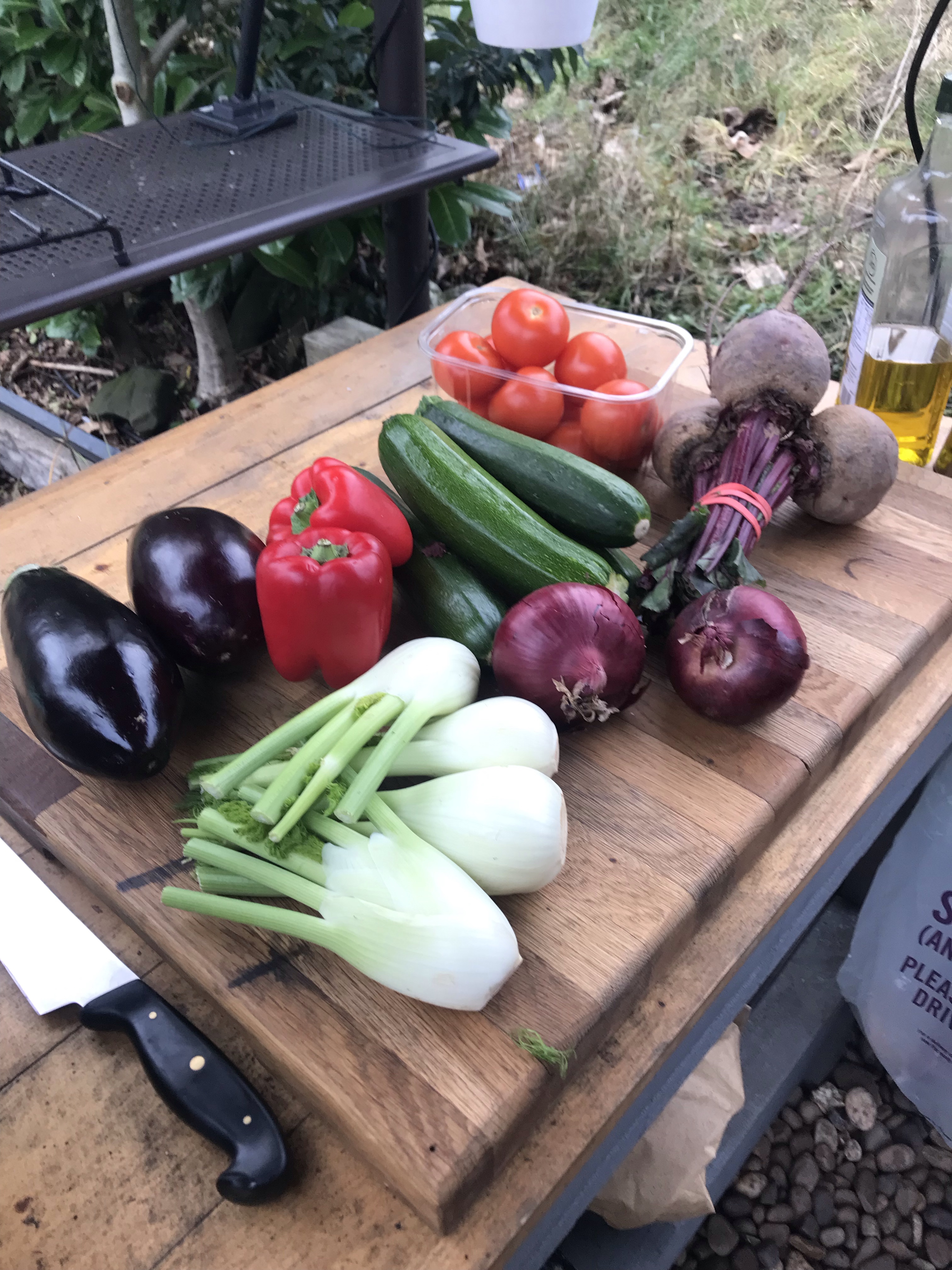
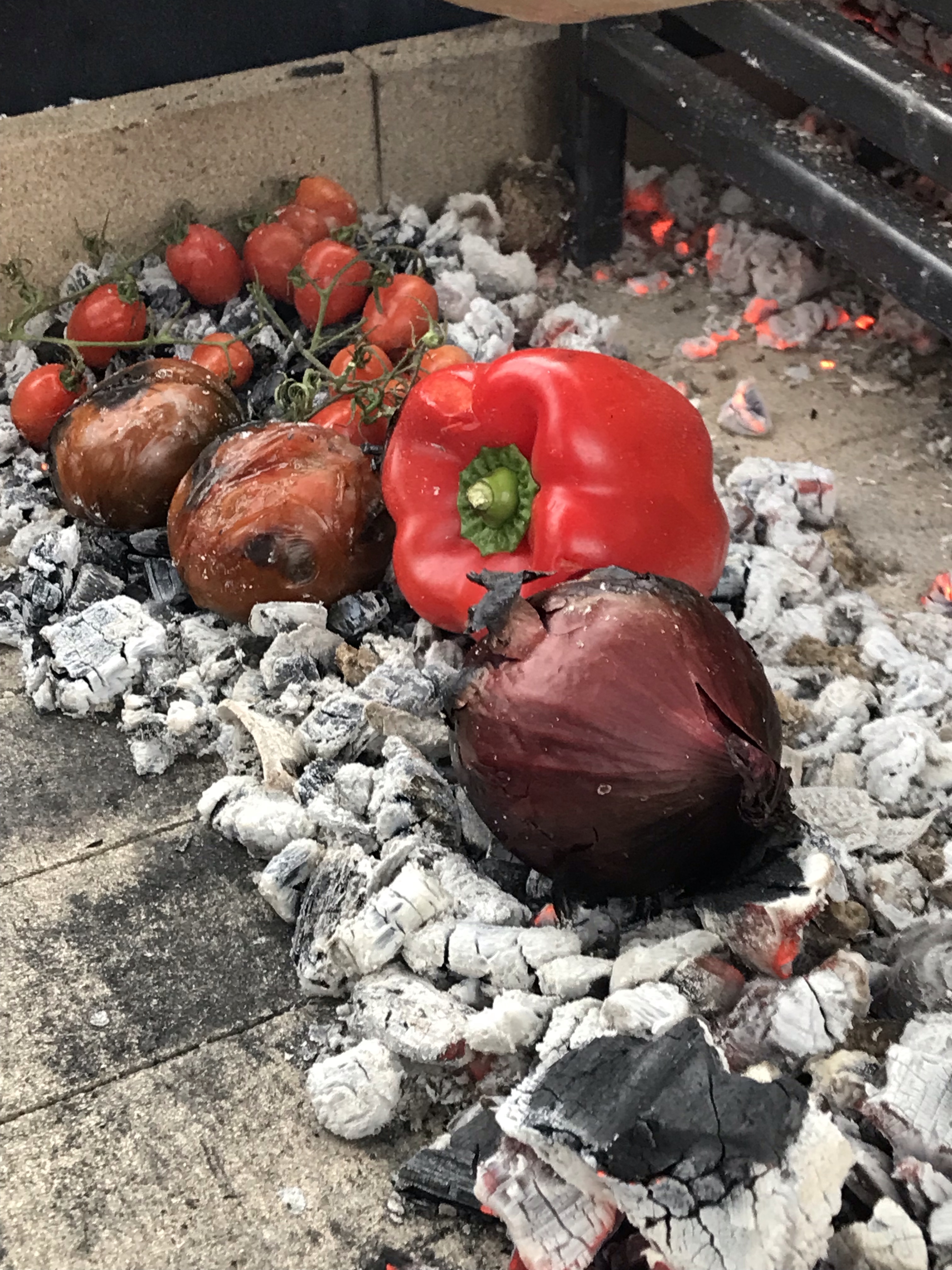
Salsa Roja – have done this twice and each time it has been great. Tomato, peppers, red onion and chillis all blackened in the embers, skinned and then blitzed together with salt and olive oil. Could use it as a dip with tortilla chips, or as a sauce for fish or pasta.

Baba Ganoush – amazing. Aubergines blackened in the embers, garlic gently smoked on a high shelf. Scoop out the cooked aubergine and plonk in a sieve to drain the excess liquid. Toast cumin seeds, crush them up and add them to a blender. Blitz together with the aubergine and garlic. Add a good glug of extra-virgin olive oil. Needs a good pinch of salt.

Grilled courgette – higher grill. Amazing. Chop into slices, plonk in a bowl. Pour a swig of olive oil over them and shake together with a good pinch of salt and pepper. Grill until nicely scorched and then turn to do the other side. Great hot as a side dish, but also very interesting when cooled and added to a salad.

Fennel – as thinly sliced as I could get it. Tossed in oil and cooked on the low grill to the point of almost being totally charred. I combined them with a load of the courgettes and made a dressing of oil and lemon juice. This was absolutely delicious!

Beetroot – cooked in the embers like the other veg. Like the squash, took a long time. Once cooked, I let it cool then cut into smallish cubes, added a couple of spoonfuls of capers, some roughly chopped parsely and made a really mustardy vinaigrette. It was great, but a bit of a red-fingered faff in all honesty.

So there we are – the first forays into a new branch of cooking. It’s a splendid way of getting into the garden and immersing yourself into the process; a lovely Sunday afternoon thing. I absolutely love the way vegetables taste when using the Cage and, in my mind, the vegetable dishes I’ve made have definitely been the most successful. It takes quite a bit of wood and charcoal to keep the fire going, so it makes sense to cook as much as you can to make the most of the energy you have created. The meat and fish I’ve done has been slightly flawed, yet still great, but I think I have a bit of experimenting to do to really understand the time it takes to cook different cuts, and how to bank to embers to best effect. I need to be braver and let things cook for longer I think – it’s bit different to the way to grill using the Egg. From the reading I’ve done, the best Asadors grill super-slowly to what we might term a well-done temperature which lets the intramuscular fat render down and into the meat leaving the result juicy, not leathery as you might expect.

The search for perfection will continue with Francis Mallman, Niklas Ekstedt and Lennox Hastie as my guides…

Fish Friday

Happy new year! 

Friday night is usually a fairly low-key night in for us, but the week before Christmas Polly invited a couple of mates round and ordered a box of delights from Pesky Fish. If you’ve not come across them, they are a business which aims to cut out the middle man between the fishing boats and the consumer. One of the drawbacks of moving from Brixham (where there is a massive fish market) to the West midlands has been the difficulty of getting really good fish at a reasonable price. Pesky Fish seem to have delivered on both. Whatever you order comes packed beautifully and the fish looks spanking fresh – beautiful bright clear eyes, vivid red gills and firm flesh. With some excitement, we opened up the packaging on a dozen scallops, a couple of mackerel and, the pièce de résistance; a 2-kilo turbot. 

First up, I did the mackerel as a starter. I recently picked up a copy of “The Whole Fish” by the Australian chef Josh Niland which has some very interesting ideas on cooking fish. The main one I’ve adopted is to leave your fish uncovered on a rack in your fridge for 24 hours before you want to cook it. This (slightly counter-intuitive) process lets the skin dry a little which then produces a very crispy result when cooked. I used this method with the mackerel and also used Josh’s idea that the fillets are only cooked on the skin side until they are about 90% done. Then take them out of the pan and leave them flesh side down on a warm plate and the residual heat will finish them off. It works really well and for anyone a bit nervy about fish cookery, this is a simple and, seemingly, fool-proof method. To go with the fish, I made a lime, caper and parsley dressing which got spooned over the fish just before serving. It was great. I loved it. 

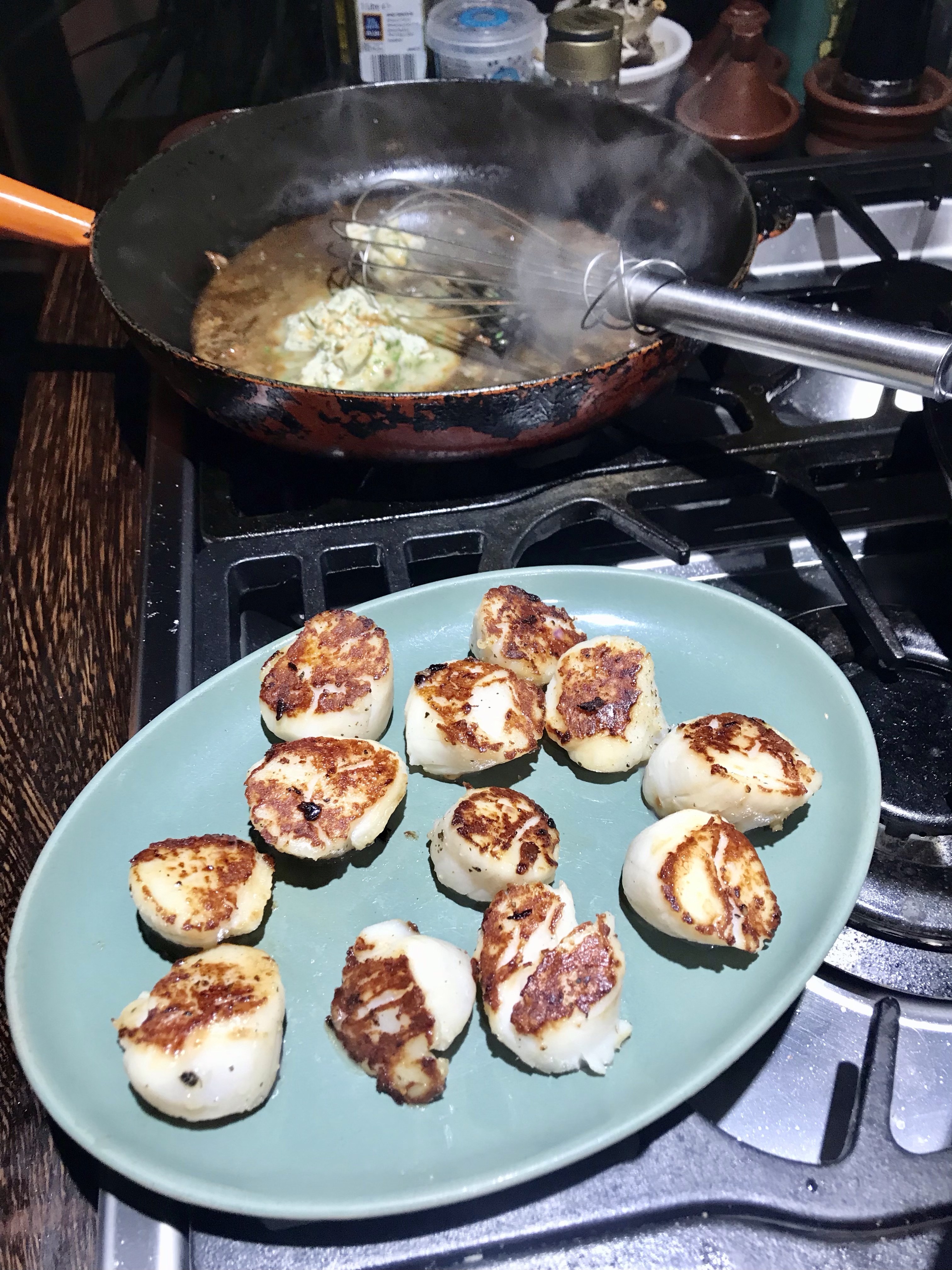
Next came the scallops. Pesky make a big deal about the fact that their scallops are all hand-dived which is great from both a sustainability point of view, but also reduces damage to the sea bed caused by dredging methods of collecting scallops. We had ordered a dozen and at this point whilst we were very sad that one of the invited guests was too ill to make it, but secretly quite glad we had 4 scallops each instead of 3. I think scallops are another thing that folk get nervous cooking. They are a luxury ingredient with a bit of a premium price tag so it is understandable that you don’t want to get them wrong; the cardinal sin is overcooking them. I got a cast-iron pan nice and hot and, as it was heating, dried the scallops on kitchen paper, then added the merest hint of oil and a pinch of salt to them. Again, I was aiming to cook them only on one side and so left them alone for a good 90 seconds before having a peek to see how much colour had developed underneath. When I was happy a nice caramel-coloured crust had formed, I took them out of the pan and rested them in a warmed serving dish.  

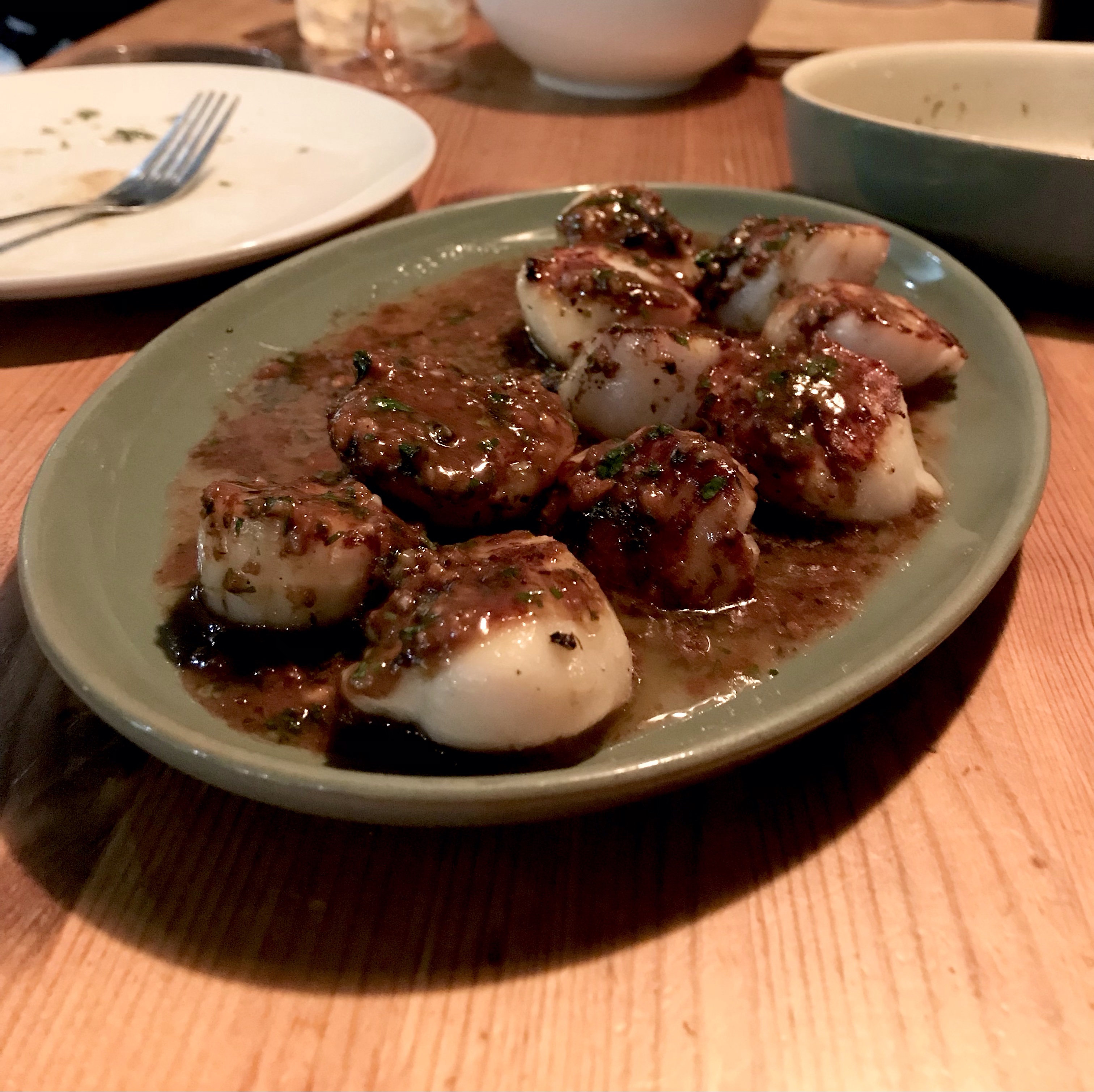
The sauce is one of the best things I’ve made to go with a fish course and I encourage you to give it a try. Start by deglazing your scallop pan with a good glug of white port. If you don’t have any, you could substitute sherry, or vermouth or maybe even brandy (but be careful with the flames). Whilst it is still bubbling fiercely, get a whisk and swirl it around making sure you have incorporated all the bits of caramelised scallop from the bottom – you should end up with a dark brown liquid which has thickened ever so slightly.  

Turn the heat off at this point.  

Add an indecently large amount of garlic butter. I make mine using the recipe they were kind enough to give us once at the Seahorse restaurant in Dartmouth which includes a couple of drops of Tabasco sauce, a tablespoon or so of pastis and a couple of crushed, salted anchovies. Whisk the butter into the sauce using the residual heat in the pan to warm it all through (if you keep the heat on, you slightly run the risk of burning the garlic). The sauce will carry on thickening a bit and, when you are happy, spoon it over the scallops and get ready to keep your elbows out otherwise they will disappear in front of you. Crusty bread is an absolute must to mop up the remaining sauce. 

Now, I’ve eaten Turbot a few times in restaurants, but I’ve never cooked one before so I was keen to make sure I got it right since a) we had guests and b) it would be an expensive cock up if I got it wrong. I also wanted to cook it on the Big Green Egg so I needed to find a way to cook it all in one piece. Apparently, cooking whole Turbot over fire is a Basque speciality so I resolved to embrace my inner southern Frenchman (or northern Spaniard). I lit the Egg with a lot of charcoal – I needed it to be hot. 

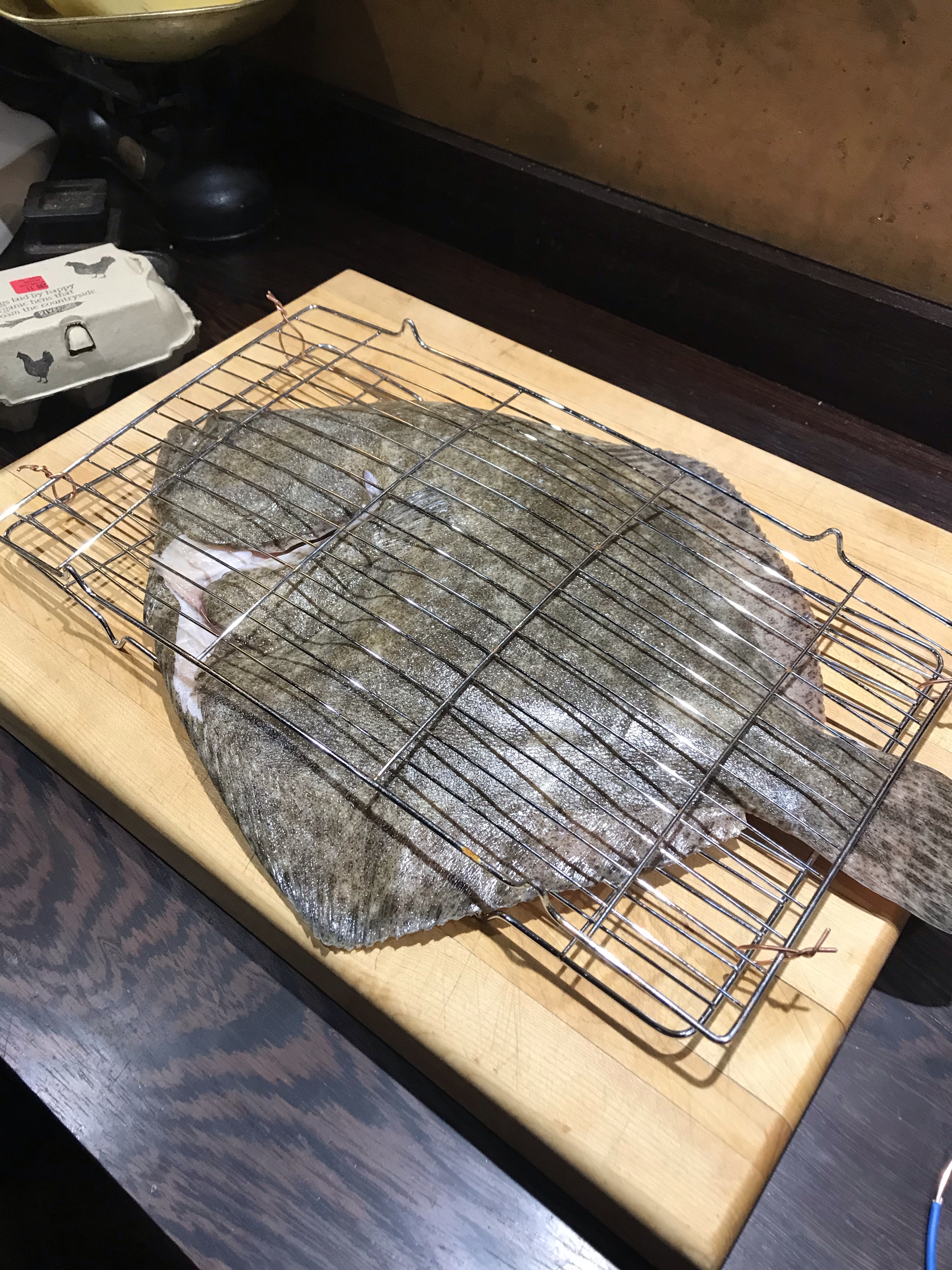
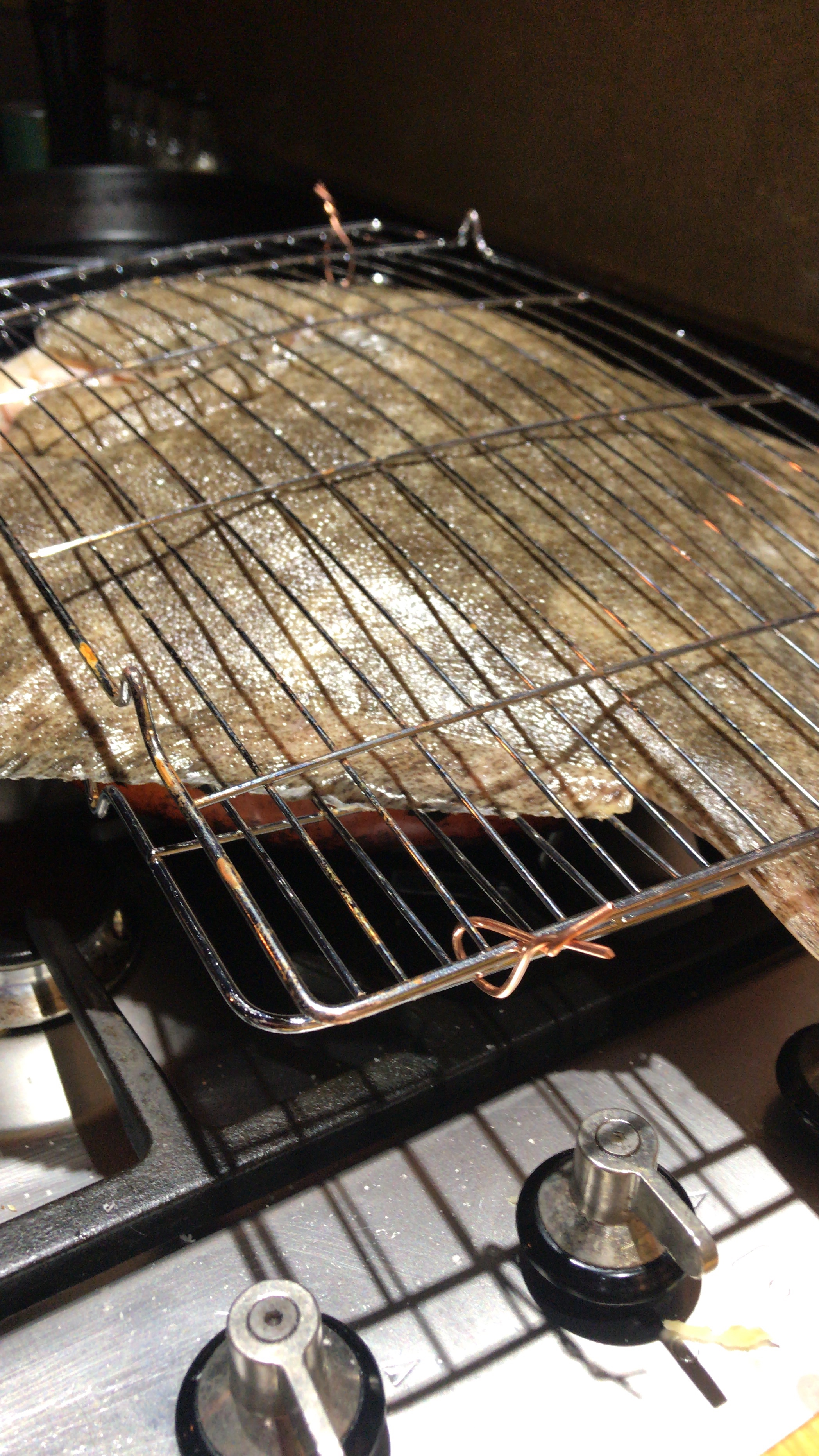
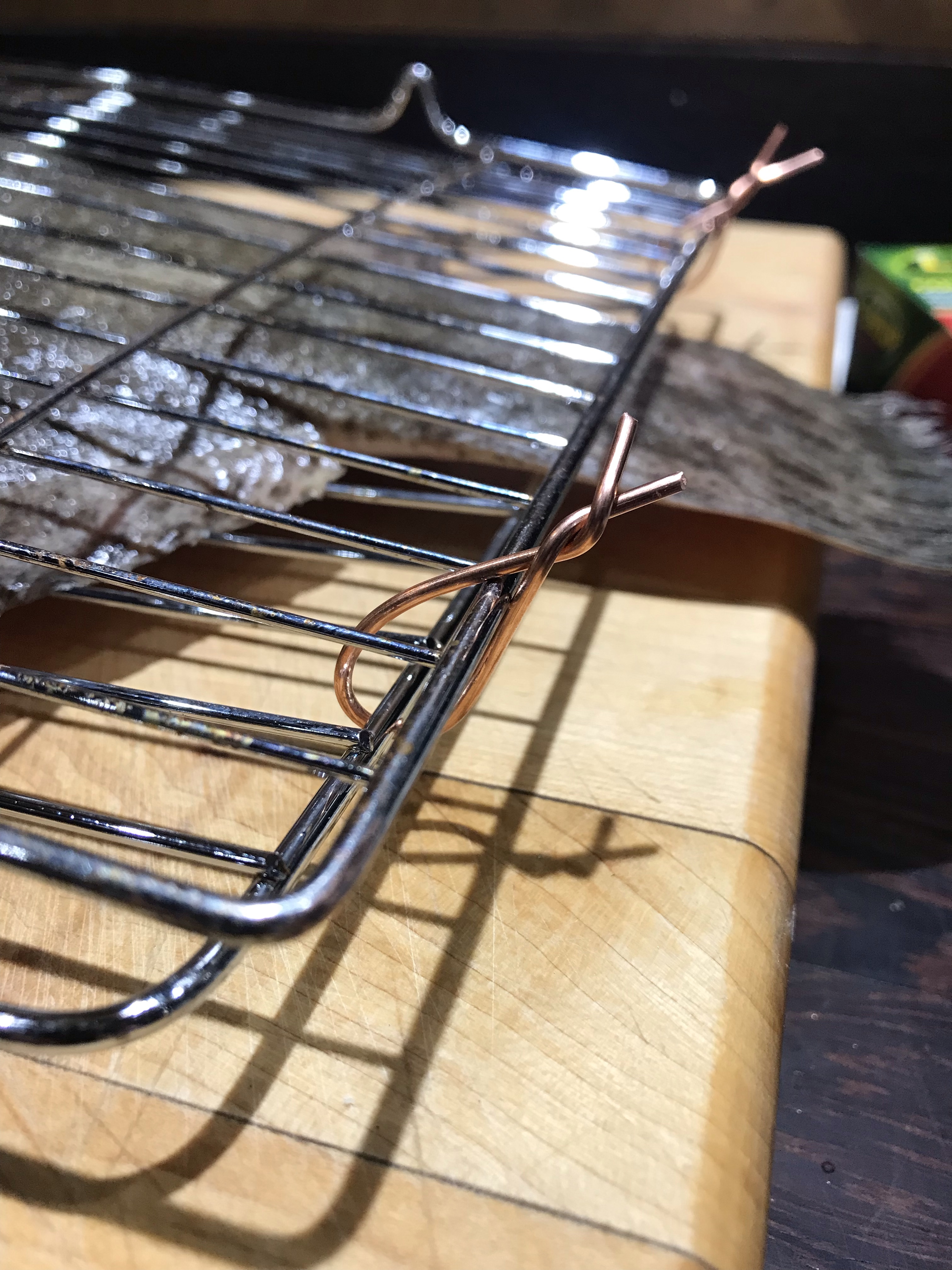
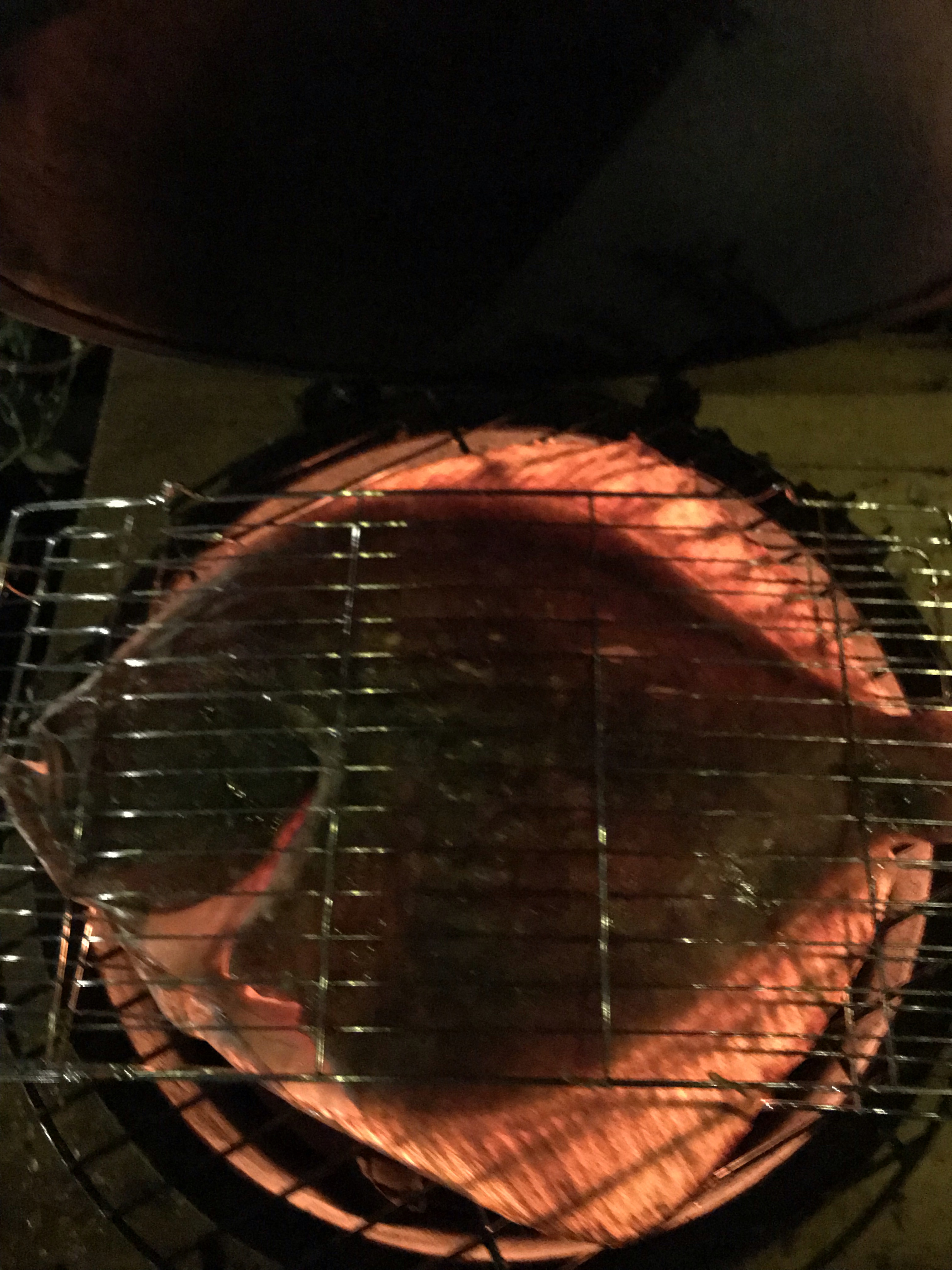
First, I had to create a means of being able to flip the whole fish without it breaking up as it was cooking. Luckily, I came across a video from food writer Tim Hayward where he wired together a couple of cake cooling racks to trap the turbot inside. It took about 5 minutes to create my version. Whether or not I ever cool cakes on the racks again is a different discussion. Next, I created a simple vinaigrette of about 10% white wine vinegar and 90% oil into which goes 2-3 tablespoons of salt. It then gets shaken all together and poured into one of those squeezy bottles with a nozzle. 

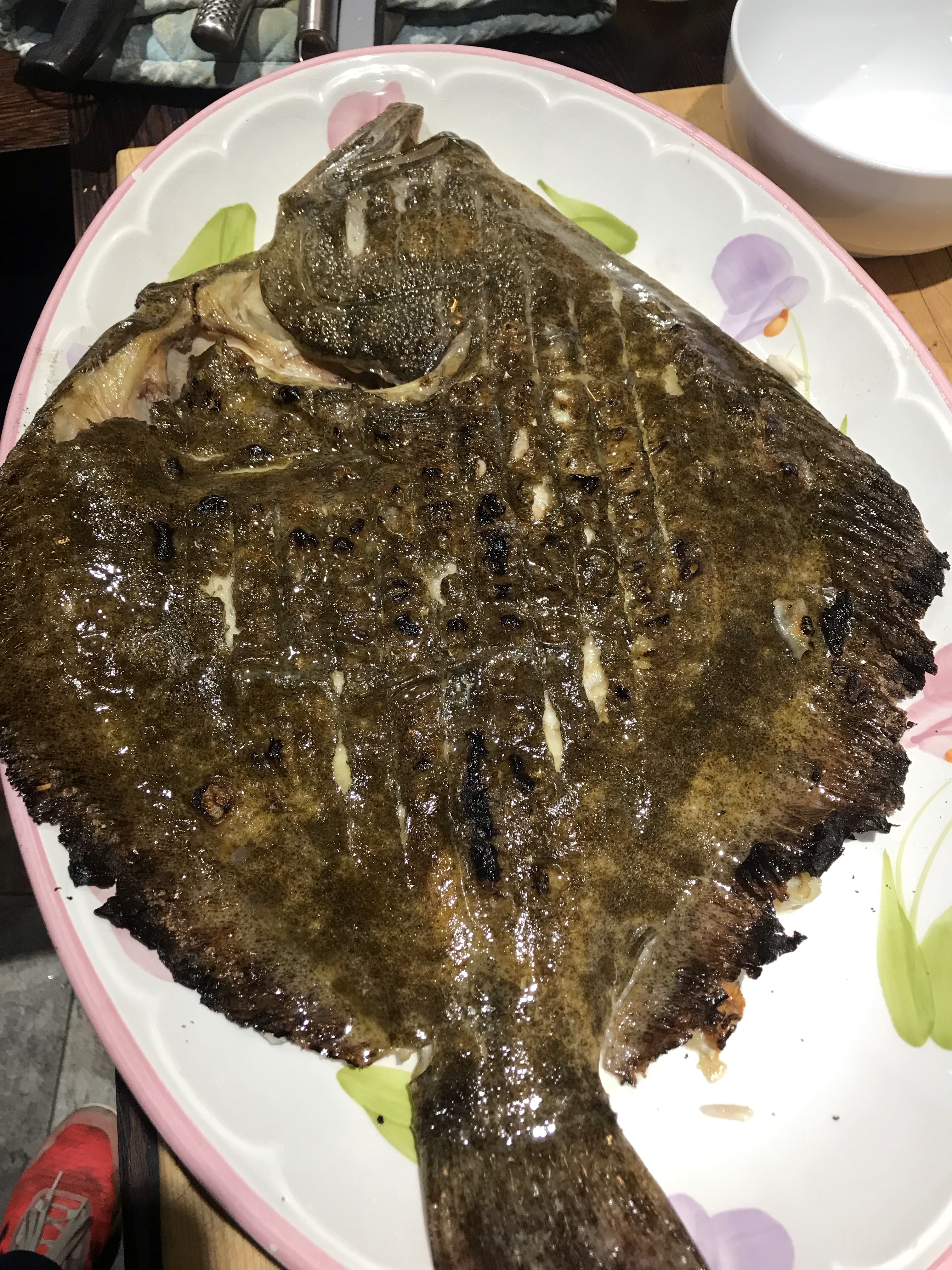
By this time, the Egg was going great guns so I was ready to go. Armed with a probe thermometer, heat proof mitts and my squeezy bottle, I placed the Turbot with the white skin side down over the coals and left it there for a good 3-4 minutes. I then turned it over and squirted vinaigrette on to the cooked surface. Four minutes later I flipped again and added vinaigrette to the freshly cooked side. I did this twice more and then tested the temperature. The target temperature for safe fish cooking is 60°c so I was aiming to take it off the fire when it got to about 55°c to allow the residual heat in the fish to finish it off. I guess in total the cooking time was about 20-25 minutes with maybe half a dozen flips in total. After it hit the temperature, I carefully unclipped the racks and slid the Turbot onto a warmed serving dish and squirted over the rest of my vinaigrette. 

To serve, I sliced carefully down the middle along its backbone with a sharp knife and carefully peeled the skin back. It’s quite sticky and rubbery so it was a bit of a fiddle to do to be honest – although I found it was easier with a normal butter knife. We served it with some Parmentier potatoes and grilled courgettes and IT WAS DELICIOUS.  

Turbot has a lovely firm, yet yielding texture and the flavour was great. The Egg had imparted a subtle smokiness and the vinaigrette really enhanced the taste. Between we ravenous three a whole side was polished off, so I suppose it is not a stretch to imagine that I could have fed 8 with the whole fish which perhaps helps to justify a bit more the original outlay. I guess it is the equivalent of getting a big forerib of beef for Sunday lunch. 

If you’ve got a special occasion coming up, this is definitely a recipe to try. 

Looftlighter Chicken

A lot has happened recently which is why this is my first post for a couple of months. Splendidly, a lot of what has been happening relates to being back at work in a (relatively) COVID-restriction free environment which has been great. From a Live Fire Journal point of view, it has been less good as I have a bit less free time on my hands. Nevertheless, I have been cooking some great food on the Big Green Egg and also broadened my cooking horizons a bit through getting a new book and attending a day at a live fire cooking school. More of these in a later post. 

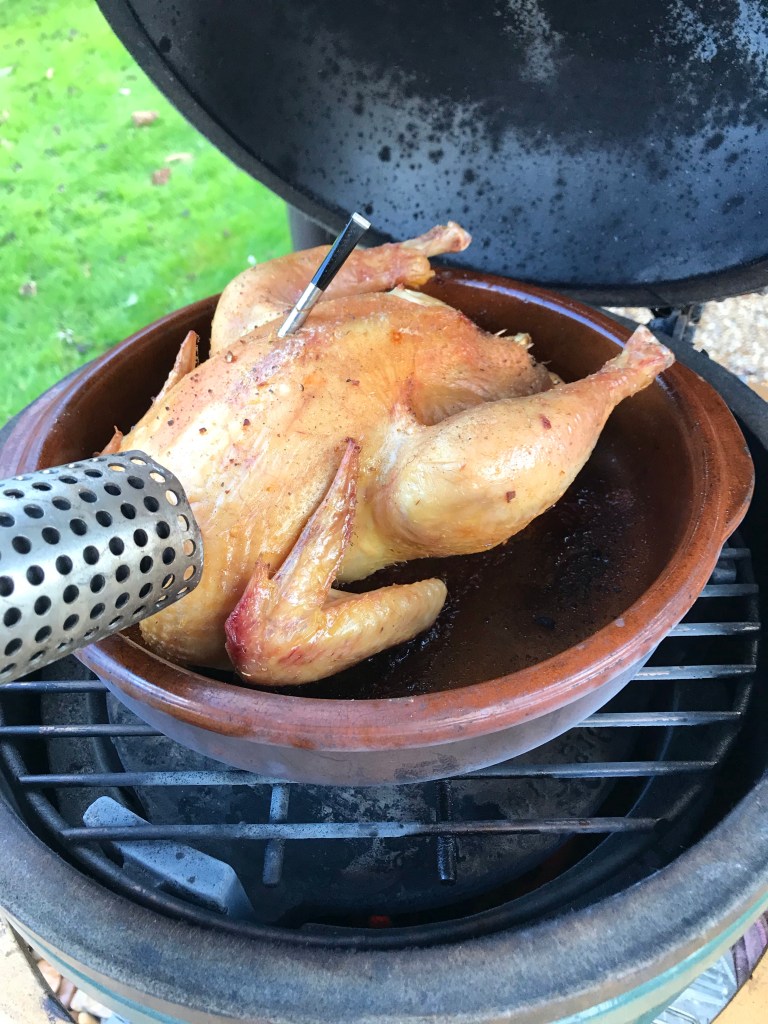
Looftlighter Chicken is a thing I had been meaning to do for absolutely ages, but just hadn’t had a whole chicken to do it with. Roast chicken in the Egg is one of those things which is so simple, yet the results are so joyously delicious that I wonder why I don’t do it every weekend. It’s a Live Fire cooking process which is no different to roasting a chicken in the oven, you set the Egg to cook indirectly at around 180°c and away you go. A family sized chicken of about 1.5kg will take about 80 minutes to cook (aim for a minimum of 74°c on your meat thermometer) and the results have always been soft, juicy and flavourful. If you want to, you can add a few smoking chips to your charcoal, but be careful here as a little smoke goes a long way and it is easy to overpower your bird. Doing a chicken this way makes a perfect Sunday roast with the added bonus that the slightly smoked carcass makes a brilliant stock with which to make a soup or risotto/paella. However, I wanted to up my chicken game. 

I have been reading up about cooking pork in the Egg and going through all the methods people go through to try to ensure the perfect crispy crackling. I read about dry brining, wet brining, pouring over boiling water and/or boiling oil and so on. You name it, someone has tried it and probably made a YouTube video about it. The roast chicken cooked by my Mum on a Sunday always had perfect crispy skin which, after a bit of chilly mini rugby in the morning was a joy to return to – a beautiful evocative memory. Now the one downside of using the Egg is that you tend to get slightly flabby skin which has a lovely smoky flavour, but none of the satisfying mouth feel.  

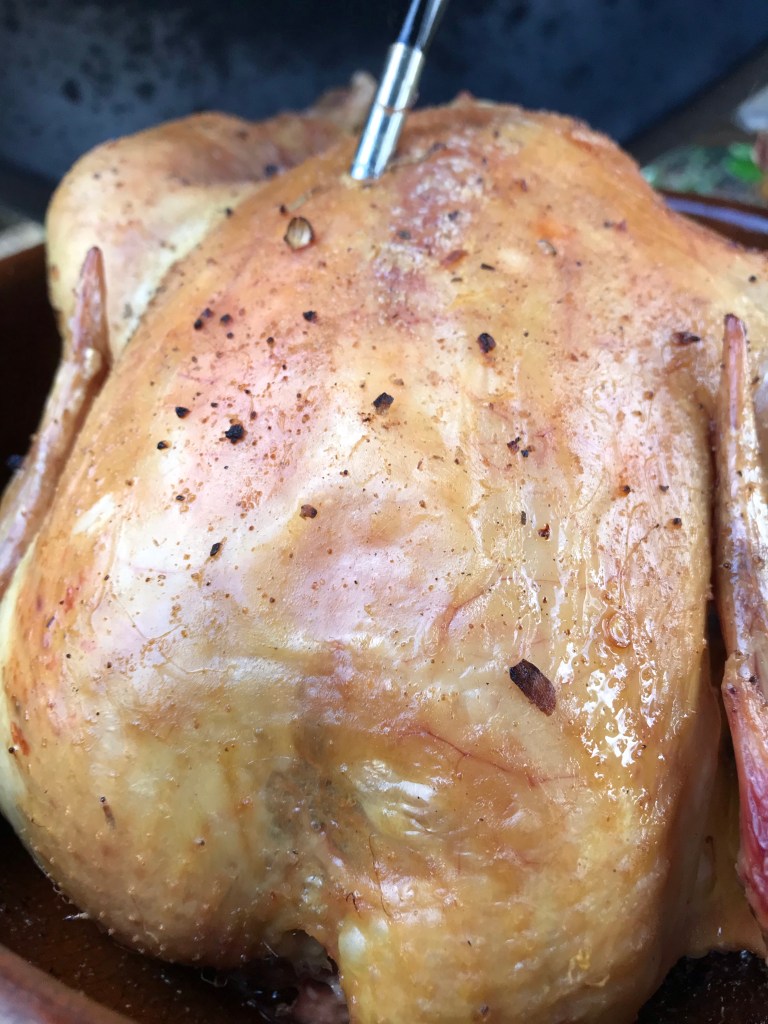
The day before cooking, I took the chicken out of its packaging and dried the skin with kitchen paper. Next, I scattered a couple of pinches of salt over it and gently rubbed it in so it stuck. After that, I put a couple of sheets of kitchen paper on a roasting tray, put a wire rack on top and put the chicken on top of that; the whole lot went into its own shelf in the fridge. The aim was to let the chicken sit overnight so that the salt could draw extra moisture and let the cold, relatively arid fridge atmosphere add a further element of dryness to the skin. A note of caution here – basic food hygiene tends to recommend that raw chicken should be covered and it should be sat as low down as you can get it so that any drips avoid contaminating other foods around it. Please make sure you are careful if you try this yourself. 

The next day was interesting, in that there was no obvious difference in the appearance of the chicken, except the lack of the sort of residual condensation you get from plastic packaging. Anyhow, I cooked the chicken as described above, at more like 200°c to try to get a bit of extra heat to caramelise the outside.  

It worked. 

As the chicken came up to temperature, a quick tap with the back of a knife gave a very satisfying sound and it smelled amazing. I had, however, a further trick up my sleeve to get it even better; a Looftlighter. If you have not come across these, they are amazing. They look a bit like an industrial grade curling iron and they are used to get your charcoal lit and burning fiercely by blowing a jet of hot air at about 1200°c. This, I thought, would be a great way of finishing my chicken off. Carefully at first, I trained the hot air towards the chicken from a distance of about 30cm and nothing really happened. However, as I got a bit braver and moved the tip nearer, the skin started to contract and I could see little char marks starting appear on the raised bits of skin. It was very satisfying indeed. 

I made a great gravy out of the smoky resting juices and served the chicken with roast potatoes, braised carrots and cabbage. As the mists and mellow fruitfulness of Autumn are descending on us, it made a lovely meal. 

Whilst this was a fun thing to do, I’m fairly convinced the main reason for the crispiness was down to the salting and drying out period in the fridge. Whilst the Looftlighter is a brilliant tool, I think it was more the icing on the cake, rather than a remedy for skin that hasn’t crisped up in the first place.  

Late-night dirty fries

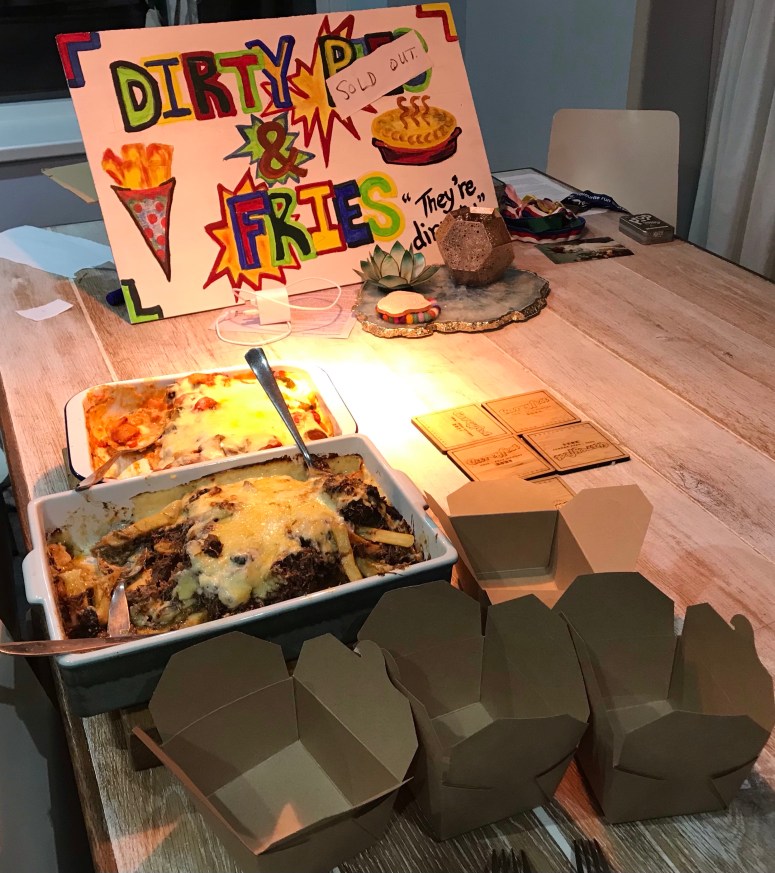
This is the kind of dish that people NEED after a long day. Now whether you have spent your day watching England v India at the test cricket, or on a great long walk around Cornwall, or, as we did, in our mates’ garden doing a kind of mini festival there comes a point where all present need a few carbs and a heap of smoky meat to keep themselves on an even keel. The origins of this recipe lie in the Canadian staple called Poutine which is french fries covered in gravy with cheese curds on the top. It’s a food-truck favourite and often the culmination of an evening sampling the local artisan micro-brewery beers.

Now at our mini festival we (the planning committee) recognised that those present were all firmly going to be in middle age and, although the attraction of drinking beers, ciders and cocktails all afternoon was a powerful one, there was an equally powerful need to avoid the dreaded hangover, especially for those present with younger children to look after in the morning. Ever the pragmatist, Polly came up with the idea of having a nice stodgy carb-heavy meal available at about 11:30. She correctly felt that this would mirror the genuine festival experience when the last band have finished and one is taking a circuitous route back to one’s accommodation and all the food stalls have left is chips and gravy. Perfect.

Our late-night dirty fries comprise 3 easy-to-make elements:

  1. A base layer of fries. We used Aunt Bessie’s oven chips and cooked them for a bit longer than the packet said – you need the fries nice and crunchy.
  2. A load of Ox cheek Barbacoa. I used 4 big Ox cheeks which was plenty for 5 hungry adults and two 14 year-old boys who should have been in bed but got lured downstairs by the smell of cooking like the Bisto kids
  3. A dirty cheese sauce. Basically, a normal Béchamel sauce with a load of cheese melted into it.

I made the Barbacoa the day before as it takes about 7 hours altogether. The link above will take you to a more detailed recipe, but essentially I smoked the cheeks with hickory chips for about 3 hours at 130°C in the Big Green Egg. While this was happening, I roughly chopped a few carrots, a couple of onions, 2 sticks of celery, 5-6 garlic cloves and 2-3 fresh red chillies and softened these for 20 minutes or so in a pan. Once they were pretty much cooked, I added a couple of big blobs of Chipotles in Adobo, that intense, smoky sauce and gave everything a good stir. I transferred all of this mixture to a big dish and, when the smoking period was up, added the cheeks on top. I put in enough beef stock to cover the veg and the underside of the cheeks, covered the whole thing in foil and carried on cooking at 130°C for another 4 hours or so. You know it’s done when the cheeks literally come apart in your hands.

Carefully lift the cheeks into a big bowl and shred them into chunks using a couple of forks. Blend the veg and stock to make the sauce; a lot of fat cooks into it so it can be a bit cloying. If yours is, adding a drop or two of any kind of vinegar will help remedy it. Now pour the sauce over the shredded meat and try not to eat it until the big night.

The Béchamel can’t be made ahead and so the chef must retain a clear enough head to avoid catastrophe. I started with 50g butter and melted it gently in a pan, then added 50g cornflour and whisked it all together to make a roux. This needs to be cooked for a couple of minutes as otherwise your finished sauce will taste a bit floury. To this, I gradually whisked in about 500ml of milk until I had a smooth sauce and cooked it on a gentle flame for about 5 minutes until it had thickened nicely – it should be the consistency of a good thick yoghurt. Now on it’s own, this is quite bland and I wanted something a bit punchier so I stirred in a good dollop of English mustard, plus a large handful of strong cheddar. You could add any cheese you like – I suspect some strong blue cheese would be sensational, but I guess you’d have to be careful to not overpower the flavour of everything else.

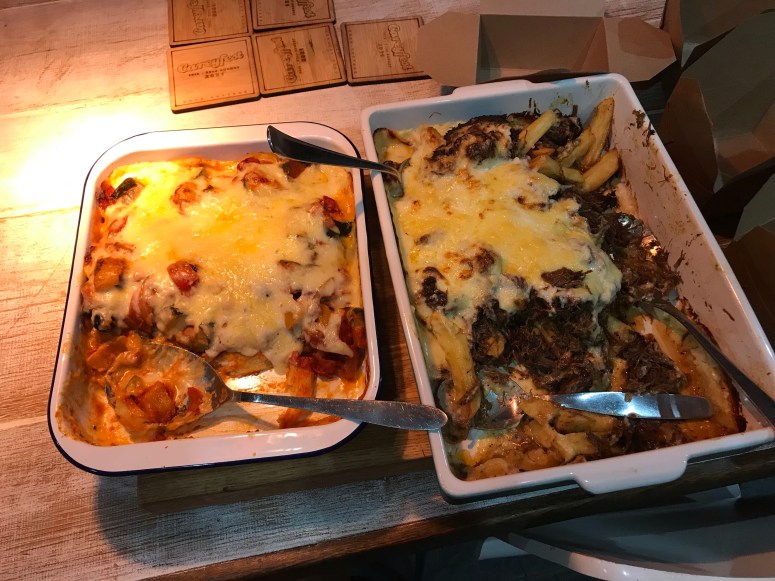
To create the finished dish, arrange the chips in an even layer in the bottom of a suitable dish. On top of them, spread your Barbacoa out, leaving some chips poking out. On top of this, pour your cheesy sauce and on top of that add another handful of grated cheddar. Return to the oven at about 190C and cook until the cheese has got nice and brown.

Polly created a brilliant sign and bought a load of takeaway boxes and wooden cutlery from Amazon for the authentic festival experience. The only difficult thing was waiting for it all to cool down enough to eat it. We did make a vegetarian version which substituted a chunky chilli tomato sauce for the Barbacoa. The vegetarians present confirmed it was also just the ticket.

DISCLAIMER: Live Fire Journal and its contributors accept no responsibility or liability for any artery hardening or blockage as a result of following this recipe. Lower-fat recipes are available. Always consult a physician before consuming late-night dirty fries. Do not consume late-night dirty fries on a regular basis as there is a risk of addiction.

Getting started on your Live Fire journey

Last month it was my parents’ 50th wedding anniversary. We had a family get-together in their beautiful garden; my brother supplied the booze and Polly and I did the catering. It was great fun and, even if I say so myself, the food turned out brilliantly.

As I was cooking, I got a couple of questions along the lines of “how do you know how to do **gesturing at piles of meat, plates and grills** this?”. Which got me thinking about where I started and how I got to where I am now. It is not that long ago where a BBQ for Polly and I was a disposable foil one, perched on some bricks in the back yard cooking chicken kebabs, sausages and burgers; all fine and easy to do but there are definite improvements to be made. It was really getting the Big Green Egg that kicked off a real deep interest for me and I have learned so much since then.

The purpose of this post really is to help people get started and get delicious results. It can be demoralising when a cook does not turn out how you planned – I have made plenty of mistakes and so what follows might hopefully help you to avoid doing the same things. In my mind, there are 3 essential components of good live fire cooking:

  1. Good recipes and ingredients
  2. Good equipment
  3. The right Temperatures

Recipes

Recipes and ideas are easy to come by – get online and get searching. There are plenty of brilliant live fire cooks with YouTube channels and Instagram accounts, but start with Devon-based Marcus Bawden (@countrywoodsmoke) and you will not go far wrong. Another guy with an amazing YouTube channel is Tom Jackson (@cheftomjackson) from the USA. I’ve also got a few books by chaps like Francis Mallman, Niklas Eksted and Richard Turner which are all brilliant, but the one I go back to time again is “Grillstock; The BBQ Book” by Jon Finch and Ben Merrington. Although they are two Brits, the recipes and philosophy is based on BBQ from the Deep South of the USA. More importantly, every time I have followed a recipe it has worked, and this does instil confidence. I often adapt recipes from “normal” cookbooks – anything designed to be cooked in an oven can be cooked in a Big Green Egg. The Lamb Raan I have posted about before is a great example of this

I do not plan to get too preachy about the produce you buy for your cooks, but I do know that buying better quality meat does improve the finished dish no end and I would encourage people wanting to get into live fire cooking to find a good butcher. If, like us, you do not have a great one on the local high-street, the advent of online butchers has been brilliant and you will not go wrong with Philip Warren, based in Cornwall. Everything we have had from them is excellent (it is possible I might one day turn into a black pudding, so many have we ordered from them) and the produce arrives beautifully packed and chilled. You can request joints to be trimmed a certain way and once you have placed your order, they will engage in a Whatsapp conversation to double check. They are great.

Equipment

The problem with equipment is that the more you look, the more there is and the bigger the hole in your wallet gets. You will need to make your own decisions depending on both your bank balance and whether you are seeing cooking with live fire as a fun change from the norm or essentially a lifestyle choice. There are a seemingly infinite number of different products you can use; gas grills, kettle BBQs, Kamados, drum smokers, pellet smokers, pizza ovens and so on. I would say if you are graduating from the disposable foil option and wanted something to get on to the next level look at a Kettle BBQ. These burn charcoal, have a lid and vents to help you control the temperature of the fire and can be set up to grill or to cook low and slow. You can get a pretty good one for £60-80. With any luck you have a place within a decent drive from your house that has a good range that you can go and look at and get your hands on. Talk to the staff about what you want to do and hopefully they will point you in the right direction.

Good BBQ/Kitchen tongs are really useful for moving things about on the grill and so are heat-resistant mitts. Things do get hot and you do really want to be able to finish off a cook with all the skin on your hands that started with.

I would say the only other thing that could be classed as a “need” rather than a “want” is a decent meat thermometer. No-one wants overcooked steak or undercooked chicken and using a thermometer is really the only accurate way of doing this. They fall into 2 broad categories; the first is “instant read” where you push the probe into your meat, and it tells you the temperature. These are ideal when you are grilling. The second kind has probes which are left in the meat whilst it cooks and the temperature is displayed constantly on a unit which sits outside your BBQ which come into their own when you are doing those long, slow cooks. If you are looking for brand names, ThermaPen, Inkbird and Meater are all pretty good.

Temperatures

If you are cooking with wood and/or charcoal, you need to be in control of both the heat of the fire and the temperature of whatever you are cooking. Each type of grill will have its own way of setting a good, consistent temperature and certainly any time you spend in experimenting with vent settings and the quantity of charcoal you add will be worth it. Decent charcoal is important – pretty much anything by Big K will be good, but there are lots of British charcoal producers around. Like the meat, they will cost a bit more but are more likely to be produced in a sustainable way. Some types burn hotter than others; briquettes do kick out a lot of heat when compared to lump-wood charcoal. I tend to use the latter, but for no other reason than that was what was recommended when I bought the Egg.

For the food itself, you will see lots of advice to “cook to temperature, not to time” and I fully endorse this. THIS PAGE on Heston Blumenthal’s website is a good reference for the target temperatures for different meats and fish. in both Celsius and Fahrenheit which is useful since practically all American recipes use the old imperial units. There is an important point at the bottom of that page which reminds us that even when you take, say, a steak off the heat, its internal temperature will carry on going up by 4 or 5°c which means you need to remove it from the fire that much below the target temperature you want. There’s no need to fully ignore any cooking times given in your recipes – if you use them as a guide you can adjust as necessary. It is important to think ahead and work your timings out based on the time you hope to eat. Sometimes things just don’t cook as quickly as you thought, or are done in a flash so it is important to stay as flexible as Mrs Incredible.

Above all, have fun and enjoy the creativity of what you are doing. Personally, I love cooking for other people but if that’s not really your thing, do not let that stop you from lighting the coals and putting some produce on them. Start simple – sausages, chicken thighs, burgers to practice grilling (aim for about 250°c and above). If you want to explore the glorious world of low and slow (around 125-150°c), get a pork or lamb shoulder which are economical and resilient (i.e., it’s quite difficult to cock up the cooking of them).

Don’t forget I have Instagram (@livefirejournal) so take some pictures and share them with me. I’m feeling up for a bit of interaction, rather than just hunger-scrolling through pictures of enormous Argentine Asados, so ask questions and seek advice; I’m happy to help where I can.

Photos all courtesy of @Jake.Price_

The Aldi Mini Kamado

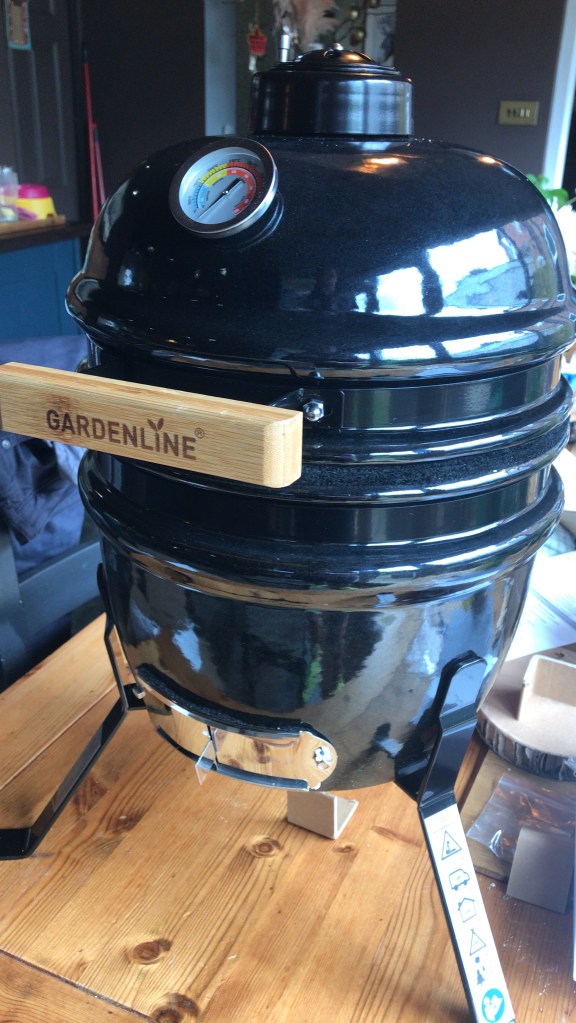
Now there is no doubt that this was a bit of an extravagant buy. We have a Big Green Egg, so why get another Kamado? For us, there were a couple of reasons actually.

Primarily, we wanted something that was more portable. Our BGE is the small size, but that weighs in at about 60KG and even for an athlete like me it’s just too big to move around easily. We travel and camp a lot and love campfire (or gas-fueled) cooking so the fact that the advertised weight of the Aldi Kamado is only 20KG was an enticing one. Secondly, the price. EIGHTY QUID! It almost seemed too good to be true but in that price range we felt we could take a bit of a punt and not feel too burned if it turned out to be a bad buy.

It is not a bad buy. Rather worryingly, the delivery guy left the box on it’s side by the front door so I panicked at first when I picked it up to hear the ominous grating of ceramic on ceramic. We’ve all seen those clips of Amazon drivers lobbing parcels over fences and I was worried that I was about to have to get on the phone to Aldi and organise a replacement. However, it turned out that is was the inner firebox rubbing on the main shell so, you know, panic over.
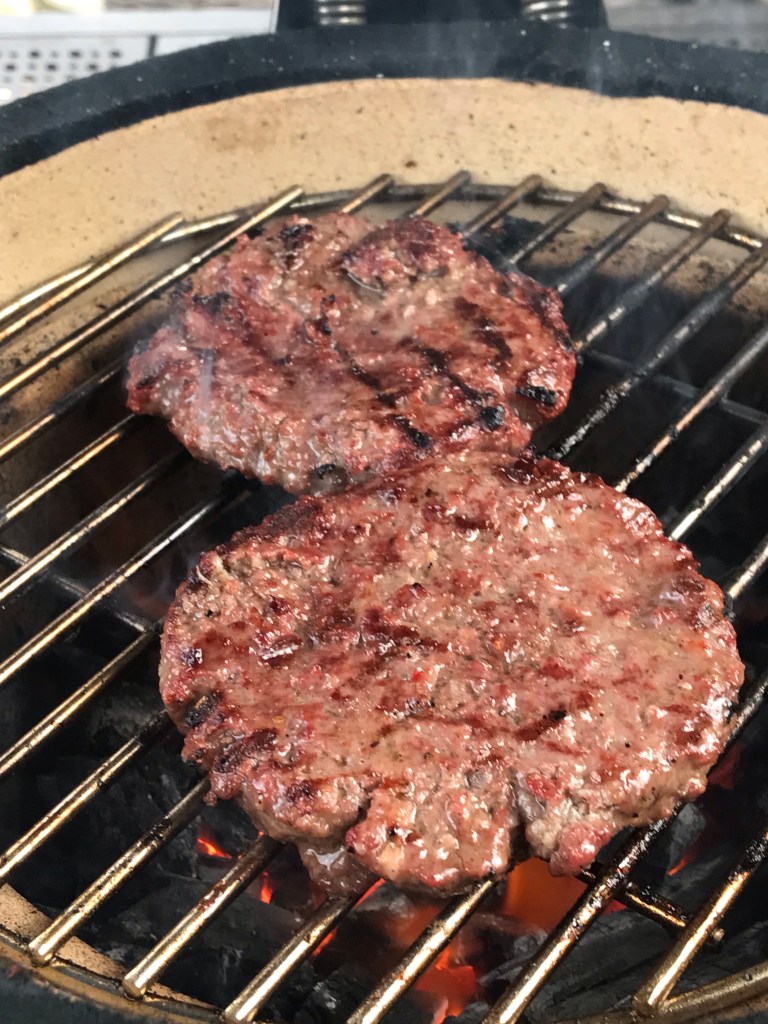
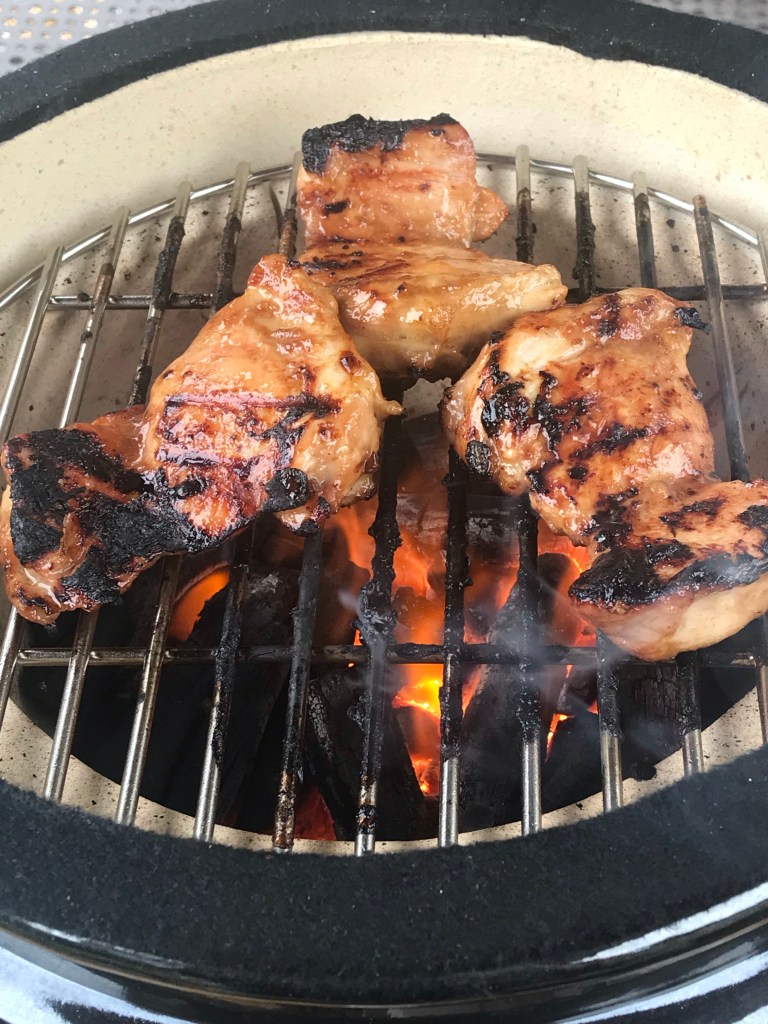
The Kamado comes with the above-mentioned 1 piece firebox, a 25cm grill (which is nice and heavy and sturdy-looking) and a tripod stand which needs to be assembled with a few bolts. You get a cheap spanner and screwdriver in the pack for this – they look ropey as anything but they do the job. You also get a daisy-wheel type cap for the top of the dome – this is like the old-style BGE cap but looks like it is stamped out of a metal sheet, rather than being cast iron. In all honesty, I would say this is the only part of the package that looks cheap and nasty. The Kamado itself looks great – the outside is smooth, not dimpled and the black finish is really good. The hardware holding the top dome to the bottom looks nice and sturdy and the springs at the back do noticeable help when opening it up. The felt forming the seal looks OK, but it has been applied a bit haphazardly so my guess is that this will need to be replaced before the end of the summer.
It really is portable. I haven’t weighed it, but I would guess it would be in the same ball park as a sack of flour. Or a biggish dog. Or three quite podgy cats. Suffice it to say, I would have no problem getting it from the garden to the van to take away with us. The tripod stand really is good and keeps everything nice and stable.
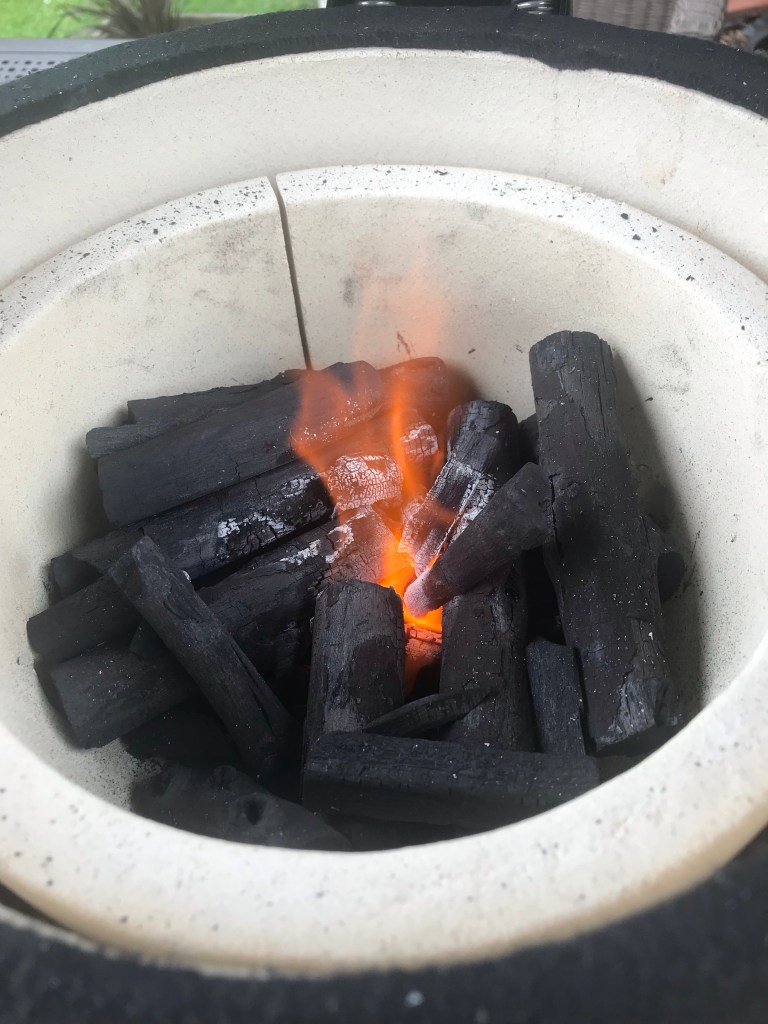
Having loaded it up with a couple of handfuls of charcoal, I lit a small fire just to try to warm it up quite gently for it’s first outing. It worked really well, but already I can report that the top vent cap is shockingly poor. It’s incredibly loose and so each time the dome is lifted, it falls open. It also doesn’t seal particularly well so when you’ve finished cooking, it doesn’t really shut off the fire very well. It’s my only quibble with the whole thing I think and sourcing a third party replacement is going to be something I look out for in the coming weeks.

Anyway, on to the cooking which is, I guess, why most of you are here anyway. The first thing I did was chicken thighs marinated overnight in a shop-bought teriyaki sauce. I cooked them whole and sliced them up to serve as part of a Japanese-style salad. They were absolutely lush! I got all the benefits of Kamado cooking and the chicken was firm, juicy and delicious. The thighs did stick to the grill a bit, but I put this down to the sugar content of the marinade coupled with the fact that I probably should have oiled the bars a bit to try to get them seasoned up.

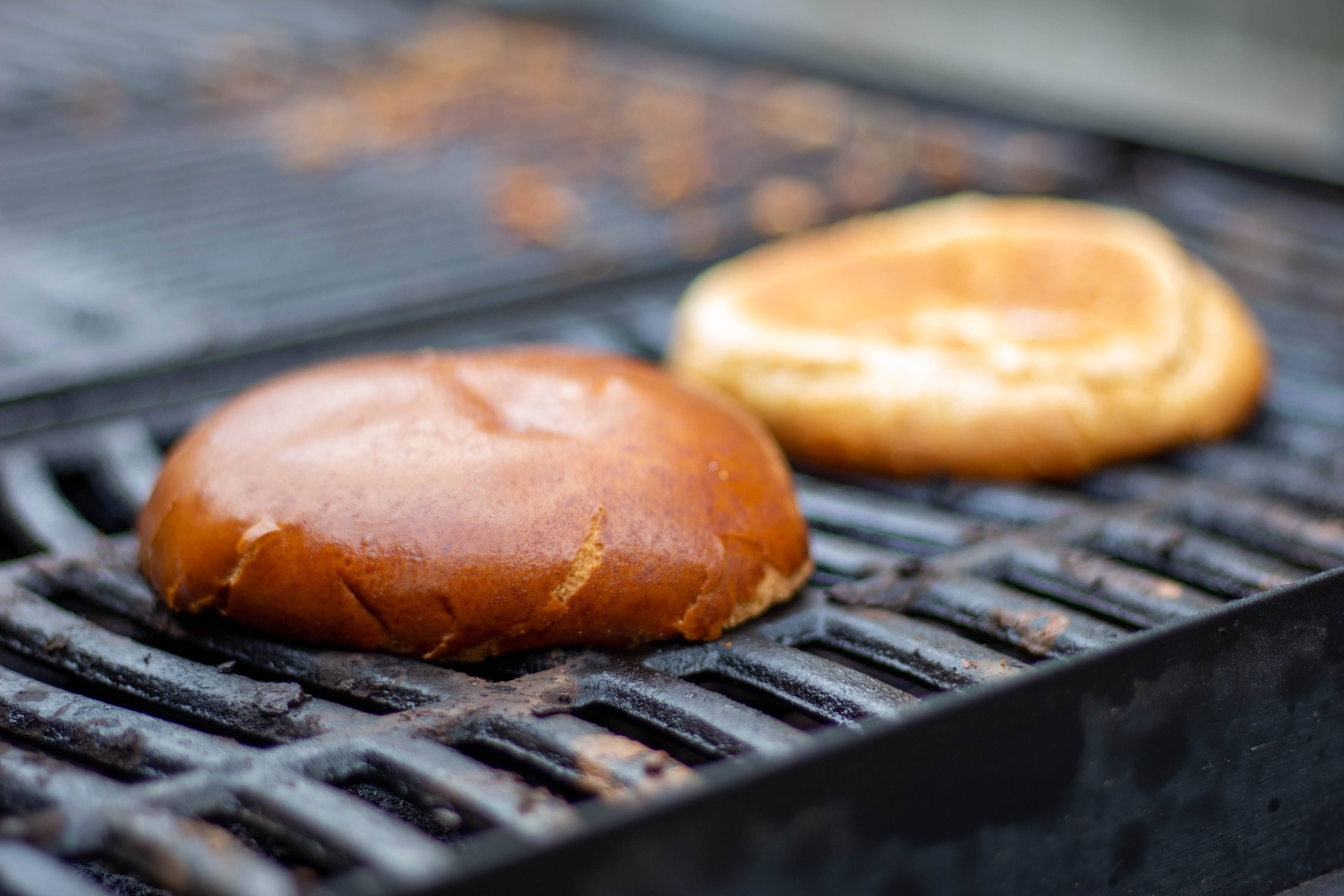
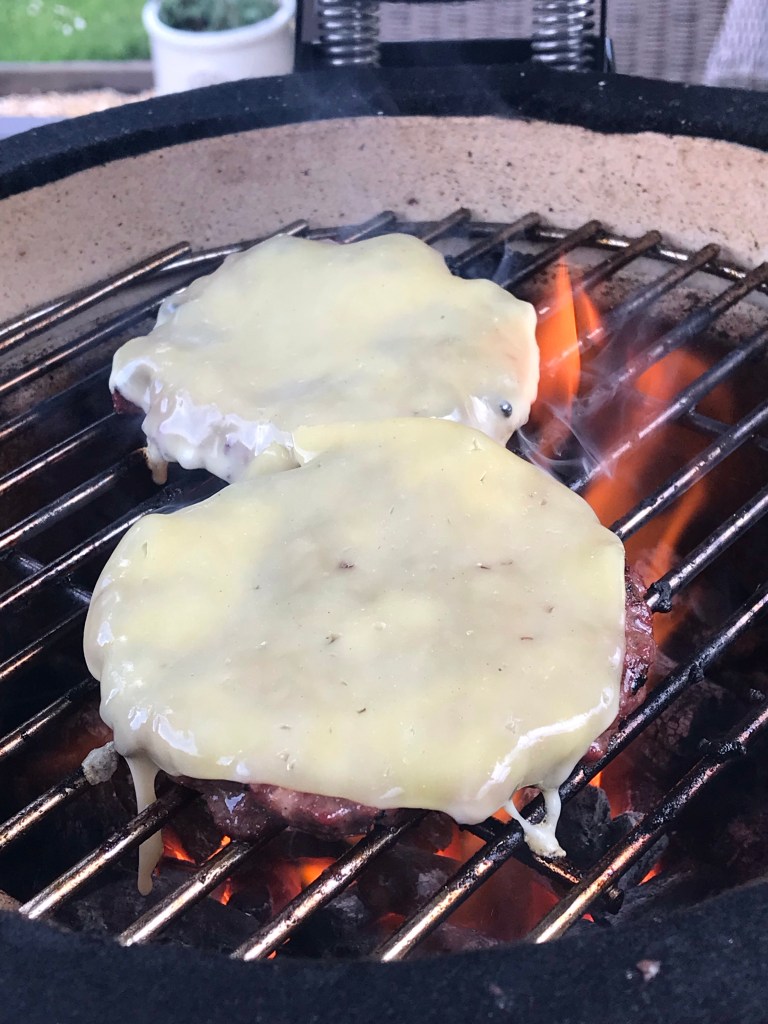
The next thing was venison burgers from Marks and Spencer’s. They were amazing; super lean as you would expect venison to be but still juicy and really tasty. The cheese you see in the photo is bog-standard, plasticky Monterey Jack which melted perfectly, just like the Marshmallow Man at the denouement of Ghostbusters. We had them simply served in a ciabatta roll with ketchup and a Greek-style salad that Polly put together. They were great.

All in all, I think the Aldi Kamado has been a great buy. It does what we need it to do, it’s easy to move around and I am sure it will get a fair bit of use on our travels this summer. The 25cm grill is big enough for 4 burgers and 4 chicken thighs, so I guess for a family meal you’d have enough space. It’s pretty efficient on charcoal and gets nice and hot quite quickly. Adjusting the temperature is more of a challenge because of the poor quality of the cap, but perfectly serviceable if using it just as a grill. I notice there are guys on eBay selling deflector plates for about £30 that will allow one to cook low and slow – maybe I’ll take the plunge and report back. To sum up, I would say that for £80 it’s a proper bargain. If you are looking to get into the BGE/Kamado Joe world, getting one of these would be a great place to start.

The Tomahawk steak train

Choo Choo! All aboard the steak train!

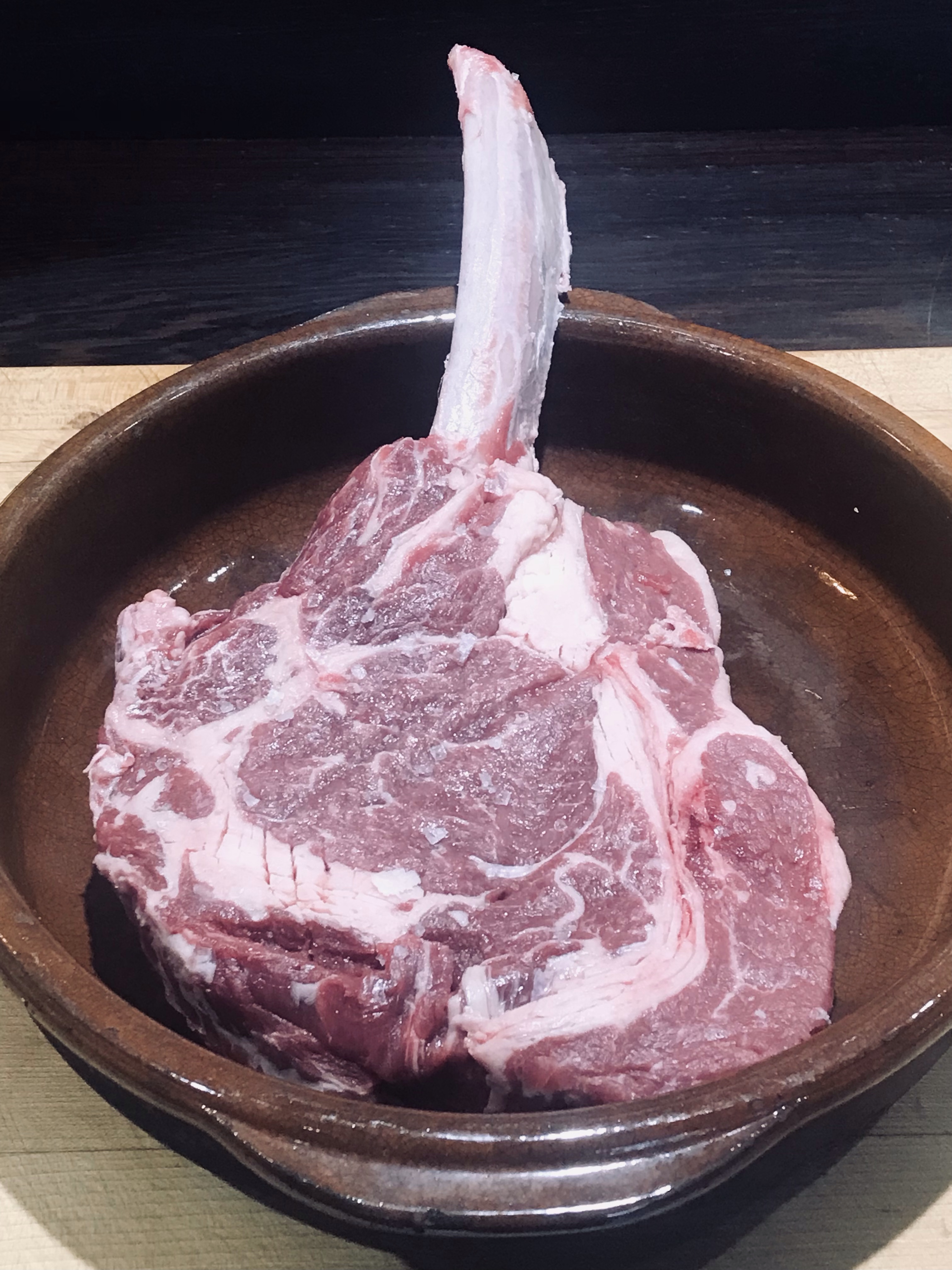
I’ve finally got round to tomahawk steak, a phenomenon that has existed for the last couple of summers, fueled by some pretty hardcore marketing by supermarkets and online butchers.

They look good don’t they?

As I understand it, a tomahawk steak is basically a big rib-eye, with the bone left on, allowing the diner the opportunity to pick the whole thing up in one hand and pile in like a George A Romero creation attacking an unsuspecting consumer in a shopping mall.

Generally speaking, we get our beef from a butcher (usually Philip Warren online or Webbs in Wychbold) as providence and animal welfare matter to us, so as we got this one from Waitrose on a bit of an impulse buy, I was really interested to see what it was like.

It. Is. Massive.

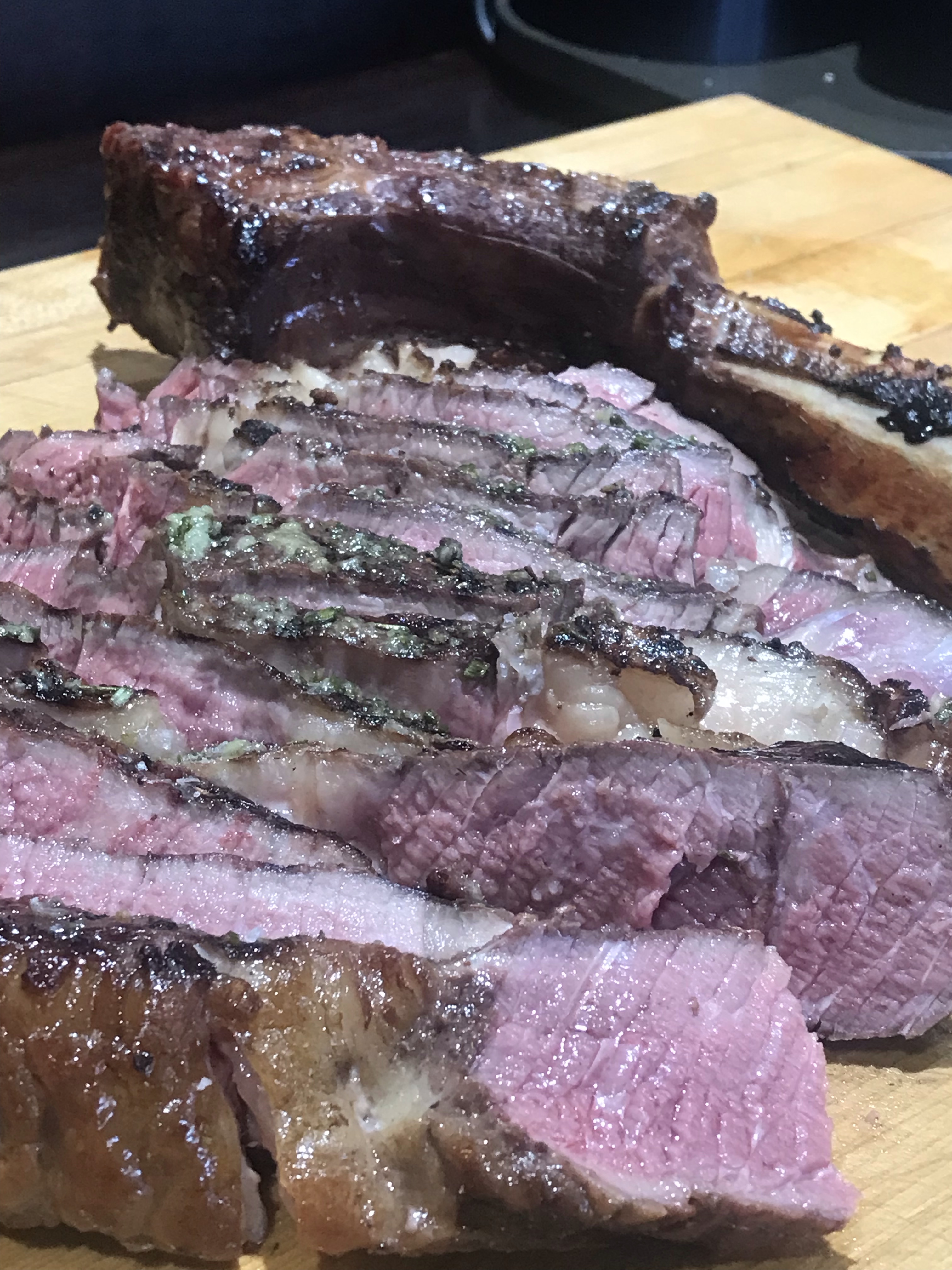
The flesh was a deep red and there was a lovely marbling of fat throughout, plus a good bit around the outside, some of which I trimmed away once out of the vac-pack. I then dried it off with kitchen paper and sprinkled a good pinch of Maldon salt on each side to start the magical process of de-naturing proteins. It really is worth it. I’ve previously covered the reverse sear method for steak cooking and for a slab of beef like this one, it is the perfect way.

Once the salt had worked it’s magic, I gave the beef a good sprinkling of Braai seasoning. The Egg was set to 100C and I used Hickory smoking chips to give a strong smoky flavour. It took about 40 minutes for the steak to come up to 45C whereupon I took it off the heat and wrapped it in foil. The Meater+ probe showed that in 15 minutes of resting, it went up to 50C; this is always something that I find interesting. There must be some kind of thermodynamic effect going on here which I can’t explain; my A level physics course (which I failed) only seemed to cover the effects of heat on solids like copper and iron or liquids, not cow-based organic material.

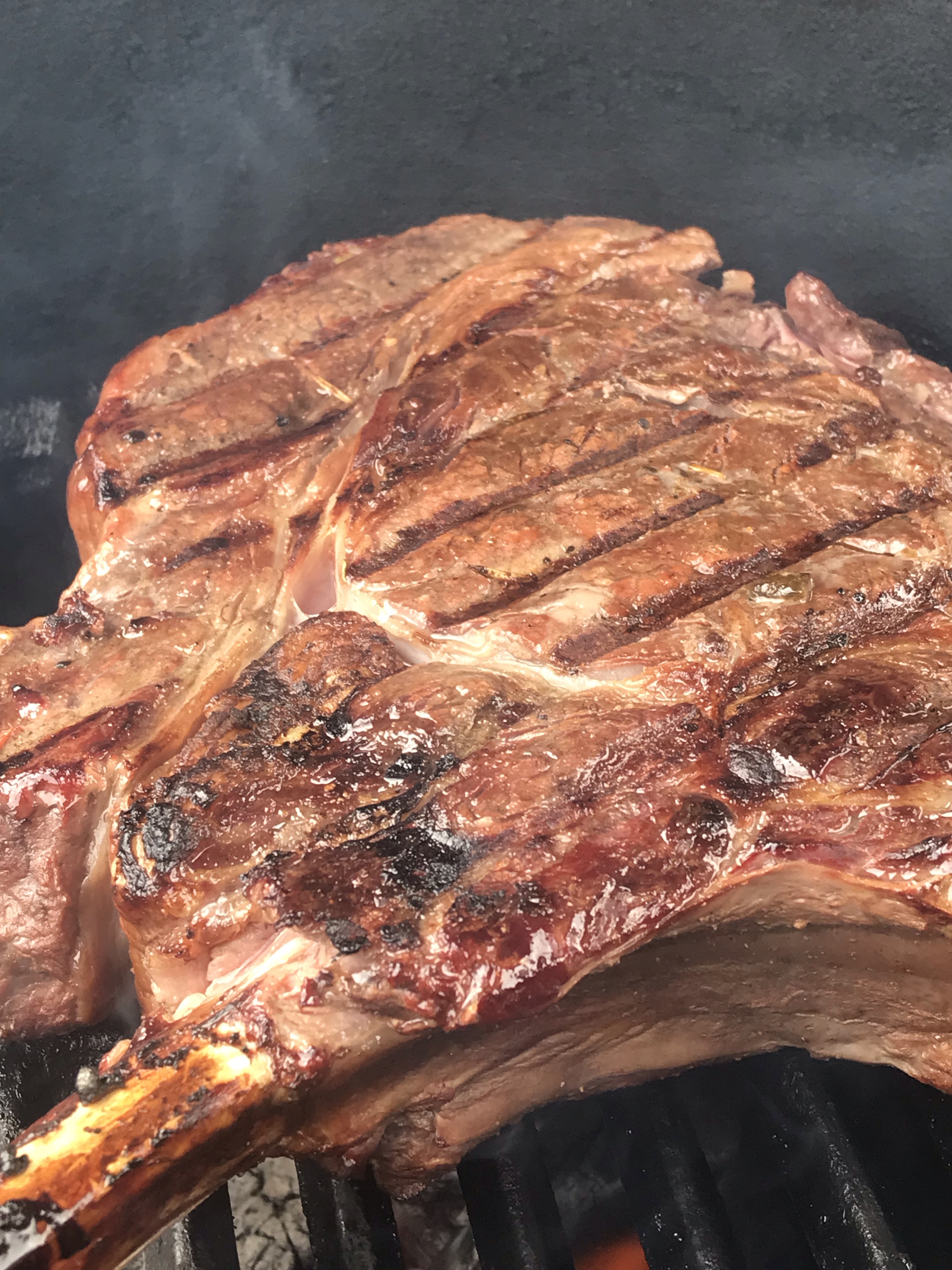
Meanwhile, I opened the vents on the Egg to get up to searing temperature (250C+). The tomahawk went on for about an additional 2-3 minutes on each side, turned 90 degrees to get the pleasing bar marks and the Maillard reaction (basically the science of artfully burning).

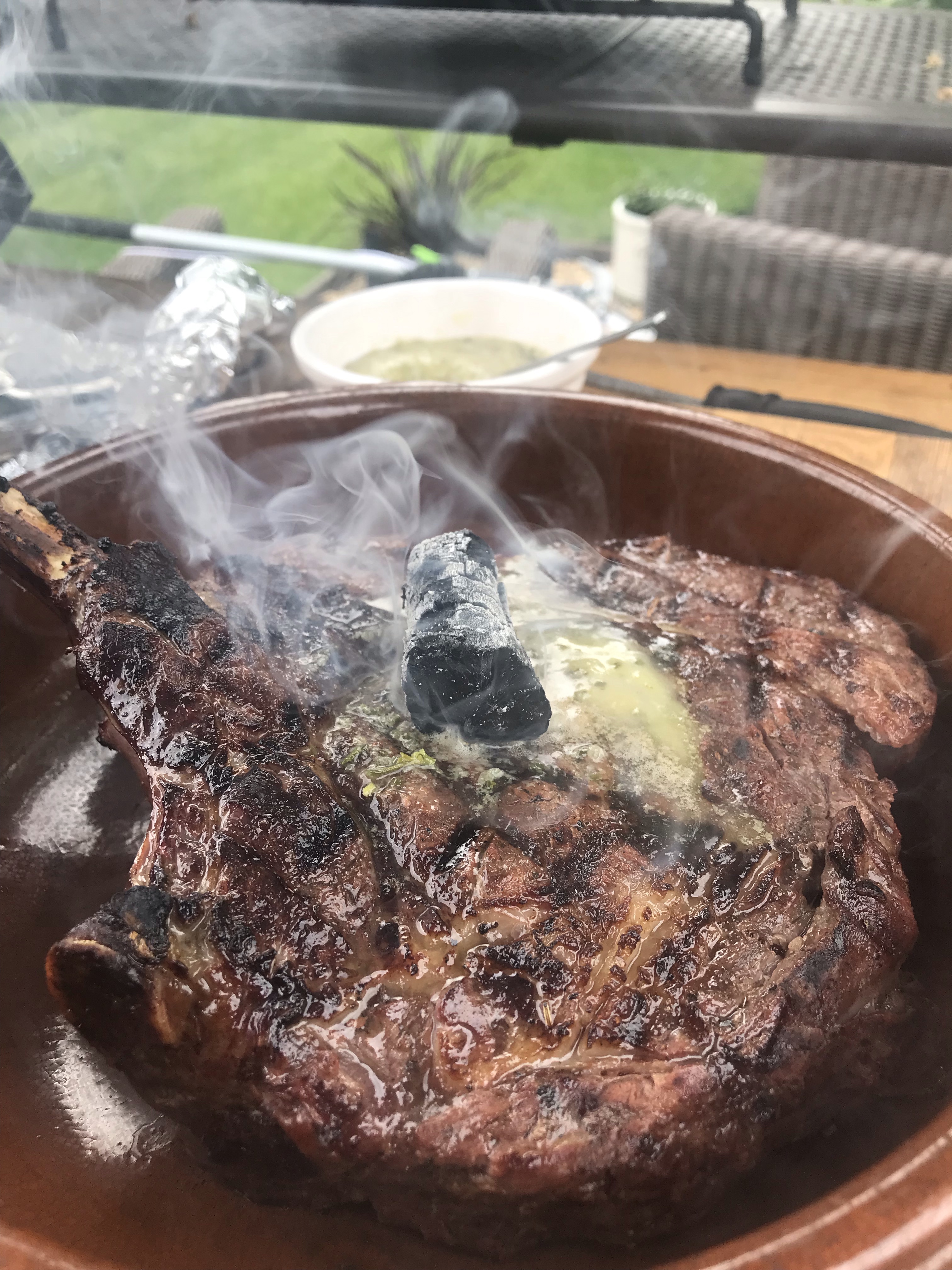
At this point, I tried a thing which I’d seen on Marcus Bawden’s (@countrywoodsmoke) YouTube channel where you stick a good block of flavoured butter onto the cooked beef, then plonk a bit of hot charcoal on the butter to melt and caramelise it. I made a garlic/rosemary/anchovy butter (see below) and it was great. The charcoal certainly added an extra layer of flavour. I’d definitely recommend giving this technique a go.

Despite the temptation to eat it all with our bare hands, I did actually carve it into sturdy slices. Polly made a luscious salad of green leaves, tomatoes and artichoke hearts, plus we had new potatoes on the side which was just perfect. I think Waitrose have done us proud. There is LOTS left over – Polly and I didn’t exactly hold back and there was definitely enough for a family of 4 so I think it represented pretty good value for money.

All in all, the Tomahawk train was definitely worth getting on board.

Steak Butter

  • 100g butter
  • 25g beef tallow (optional)
  • A big sprig of rosemary – chopped very finely
  • 3 garlic cloves – crushed with the back of your knife into a fine paste
  • 2 anchovy fillets – chopped very finely

This was definitely an experiment, but one that worked and I will repeat in the future. You could make this with just butter, but I have a jar of beef tallow that I made so I experimented to see if it added an extra beefy flavour (it did).

First, measure out your butter and beef fat (if using) and melt it super-slowly over the lowest flame you can get on your hob. Once melted, add all the other ingredients, give everything a good stir, turn the heat off and put a lid on your pot. Leave to infuse for 10-15 minutes. At this point, I used a stick blender to whizz everything together which helped to break down the anchovies even more. Pour the whole lot into a small dish or ramekin and bung in the fridge. Every 20 minutes or so, you’ll need to give the mixture a quick stir otherwise all the garlic/rosemary/anchovies will sink to the bottom. The more it chills, the more solid it gets and the more the bits are evenly distributed.