From Chinatown to Table: Making Jianbing at Home

This last weekend’s live fire adventure was very much a team effort. Polly had a great idea for a dish, I did the meat cooking and she did the marinading and the veg which is often how we roll, but perhaps her contribution is not always conveyed in full by my use of language. Perhaps I just want to hog all the credit. My blog, my rules.

The dish in question was inspired by the appearance of Scottish comedian Fern Brady on the Off Menu podcast hosted by James Acaster and Ed Gamble. If you haven’t come across the show, it is definitely worth a listen. In this episode, Fern introduced us to the concept of “shite calories”; those where you eat something and are immediately filled with hard, bitter regret. Things like extra cheap, sugary biscuits that really taste of nothing, those soft, bland pastries which count as “breakfast” at a conference, or a glass of acid reflux wine are all classed as shite calories. It is a pithy mantra to keep in mind when hungry and the temptation is that “anything will do”, so we have adopted it into our everyday lexicon to remind ourselves to try to eat a little better. There is nothing more satisfying than eating something that you have made yourself, and this has the benefit that you know what went into it and the calories are all accounted for. However, the point of this blog is not to hector the reader about what they should or should not be eating, it is to explore the joy to be had in cooking with fire! And thus, we move to Jianbing, the Chinese crepes described so eloquently by Fern on the podcast. She gets hers from the Chinese Tapas House which is on Little Newport Street at the Charing Cross Road end of Chinatown nearest to Leicester Square tube. Polly was in town to watch a play and got one. After 2 bites she rang me and said, through a mouthful of crepe, that this really was a taste sensation, and I should definitely get one the next time. I did. I had no regrets.

Jianbing are made using those big, flat, circular griddles you see in every French market, but here the batter is a little more glutinous. A ladle full is poured into the middle of the griddle and spread around to form a perfect circle. Once one side is cooked, the Jianbing is flipped and an egg is cracked onto the cooked side and stirred around a bit. The whole thing is flipped back again to cook the egg, and the filling ingredients are then laid on the top, after Tianmian, a sweet, spicy, mahogany-hued sauce is brushed over – you can ask for it to be extra hot and I encourage you to do so. The one I had contained pork belly. coriander, spring onion, deep-fried wonton wrappers to add a lovely crunchy texture and a random frankfurter which I was not altogether convinced was a traditional ingredient. Once ready, the whole thing is wrapped up, not unlike a burrito and handed over. These things come off the griddle so hot that you have to hold them with alternating fingers, like those lizards cooling their feet in the Namib desert, and so you have plenty of time to walk to Leicester Square itself to sit on one of the benches and watch the tourists whilst you wait for your Jianbing to cool to eating temperature. Fern is not wrong; they are delicious and really filling with not a single dodgy calorie anywhere. A perfect breakfast/brunch/lunch option.

Fast forward to last weekend and we saw a 1.5kg boneless pork shoulder in Aldi and thought we’d give making Jianbing a lash, using the pork as the main filling. Polly had seen a good recipe for Char Siu pork on the BBC food website – CLICK HERE if you want to give it a go yourself. If the Arctic winds are cutting through to your very marrow too much to light a fire outside to cook at this time of year, the recipe handily explains how to do it in the oven. 

On Saturday, we cut the shoulder into 4 reasonably even chunks and marinaded overnight in hoi sin sauce, garlic, ginger, soy, rice vinegar and swapped the sugar in the recipe for a bit of our friend Guy’s honey. Sunday was bright, clear and freezing – a perfect day to get the Big Green Egg going; once lit, I set the vents to get it to about 150°c and added the plate setter for indirect cooking. The pork went straight on the wire rack, with a bit of foil underneath to catch the drips. I used hickory smoking wood, but pretty much anything that has a bit of punch to it like oak or cherry would work I reckon. The recipe said to cook for about 90 minutes, but I wanted a bit more of the fat to render out, so I let it go a bit longer. The internal temperature got to 75°c which seemed about right; definitely cooked enough to eat, but not so much it turned into pulled pork (I bet it would be great if you let it get that far though). The initial test slices where very much better than satisfactory. There was a lovely pink smoke ring around the periphery and just enough smoke flavour for it not to be totally obscured by the deep flavours of the marinade. That said, I think next time we would beef up the level of chilli and maybe add some 5 spice in the marinade. The finished pork was really delicious, but probably would be even better with a slightly denser Oriental flavour and a bit more heat. Maybe a bit of a sear over direct heat at the end would be good too

Meanwhile, Polly had made the batter for the crepes which is basically a 50:50 mixture of plain flour, wholemeal flour and about the equivalent weight of water – you end up with a sort of double cream consistency. She had also finely chopped fresh chillies, coriander, spring onions and chives and in true TV chef style arranged all these neatly into little bowls (you should do this too – not only does it make you feel like Michel Roux Jr, it also makes everything a bit easier once you get to the business end of the cooking). While the pork was resting, I reduced the remaining marinade down on the hob to use as the sauce to brush onto the crepe. It got a good bit thicker and syrupier – I think this was an additional benefit of using the honey instead of the sugar.

Now to the cooking of the crepes. If you’ve ever made pancakes, you will know the first one always turns out really badly and this was no exception. This was largely down to two reasons. The first is that having seen the film Dark Waters a year or two ago, we got freaked out by the historical horrors of DuPont dumping Teflon chemicals in the water supply and so, since then, our cheap, slightly peeling non-stick pans have been relegated to camping use only. The lovely Le Creuset frying pan we have is a vintage charity shop special. It weighs about the same as a very fat cat, so takes ages to heat up and thus we arrived at reason 2; it just wasn’t hot enough. Our first attempt went in the bin. I am all for reducing food waste so please heed my warnings if you have a crack at this yourself. All the fashionable young Instagram chefs are using Hexclad pans these days which are apparently excellently non-stick, but these do come with a hefty price tag, so we persisted with our cast iron, enamelled (not quite) non-stick pan. I think next time I would use the big, flat, square steel plancha I got from Axel Perkins which would have the advantage that there is no lip and so it would be easier to get the crepe a bit thinner and to slide a flat palette knife underneath to loosen and flip it. If you are having a go at this recipe, definitely leave it for longer than you think necessary on the first side; a lot of water needs to evaporate before it can be turned over. 

Once we switched the pan onto the biggest ring, with the fiercest flame and a bit more oil, we made our second crepe more successfully than the first, cracked the egg over it, flipped it back, brushed over the reduced marinade, filled it with the chopped veg and a crushed handful of Thai crackers in lieu of the wonton wrappers. On top of that went a couple of thick slices of the Char Siu pork and then we folded it. Honestly, it was so good. Not as good as the Chinese Tapas House, but pretty bloody fantastic. We made another one for the sake of practice, then a third just to be sure. Since this was all home-made, we were fairly comfortable that the calories we had consumed were anything but shite and, if you have spent time on the marinading and the smoking and everything else, I am sure you will feel the same glow of satisfaction that we did. Also, 1.5kg of pork shoulder goes a long way, so we have leftovers to craft into something in the week. If you wanted a leaner option, you could use pork loin instead of shoulder, but you would need to be very careful when cooking it to not let it dry out. I am sure chicken would work really well and for vegetarians I wonder if you could marinade and cook a few of those enormous Portobello mushrooms to go in your Jianbing. Go on, give these a go and let me know how you get on.
Glamping Adventures in Northumberland: Fires, Food, and Fun

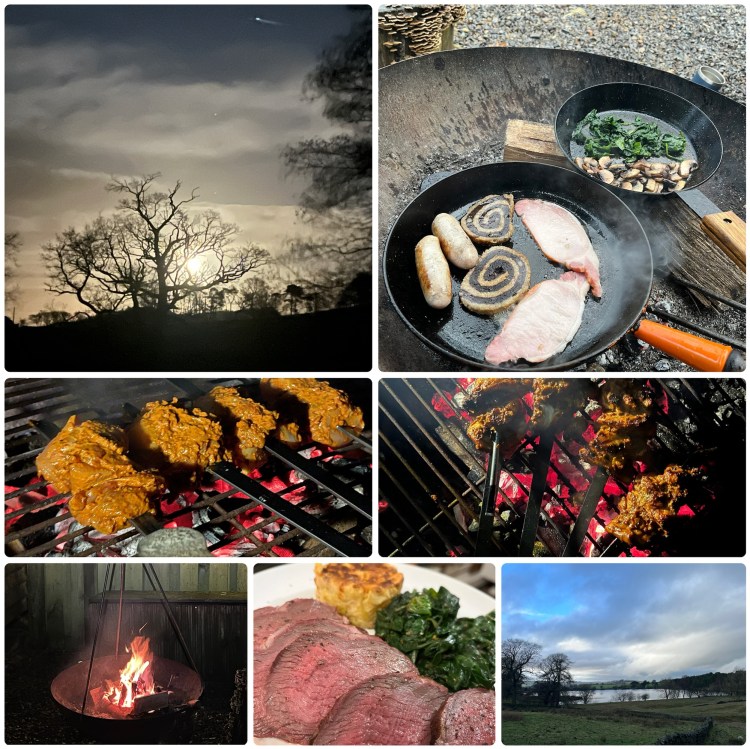
The last knockings of 2023 are upon us and we find ourselves glamping in beautiful Northumberland. It’s freezing and the wind is blowing the rain sideways, but we are having great time and looking forward to seeing in the new year by watching the nearby Allendale Fire Festival where 45 brave (foolhardy?) men each carry a flaming tar barrel above their heads through the town in what can only be described as a health and safety officer’s worst nightmare. It is a great deal of fun.

The place we are staying at allows us to conduct our own fire festival as each glamping pod comes equipped with a fire bowl, plus cooking grate. Me being me, I also bought along knives, a plancha, skewers, a flambadou, a burger press and cloche to play with and Polly being Polly, brought along all the actually useful stuff like herbs, spices, onions, mushrooms, chicken thighs and so on. One of our best 2023 buys was a new camping fridge which runs off the leisure battery in the van, so anything perishable was put in it. Alongside some beer. Obviously.

On the way up, we stopped at Mainsgill Farm Shop which is just off the A1 after you pass Richmond going north. Here we picked up bacon, sausages, a pair of individual dauphinoise portions and a beautiful bit of venison fillet. We also found they had a sort of black pudding/hogs pudding roulade which looked interesting as well as calorific. With our wallets considerably lighter we carried on through Barnard Castle and across the North Pennines AONB, which is breathtakingly beautiful, to Langley Dam where we are Glamping in a lovely pod by the reservoir. With all the ingredients we had, this is what we cooked:

Breakfast.

Breakfast should be easy; a couple of hot pans and an array of ingredients that get popped in in descending order of time it takes to cook. Sausages first, followed by bacon, then slices of the black/hogs pudding roulade thing, then mushrooms and eggs and so on. This breakfast required some perseverance however as I was very keen to use the fire bowl. Given that it was 2°, windy and a bit drizzly getting a fire hot enough to actually cook on was a challenge. Not only were the atmospheric conditions not in our favour, the supplied logs we had were definitely on the damp side and so the couple of hours I spent creating the fire, and breakfast I made using it were very satisfying indeed. 

Getting a fire going with damp timber is not an impossible task, but it does require patience and, preferably, an axe or hatchet to split your logs into smaller pieces. I always bring an axe when we go to places that let you light your own fires and, on this occasion, it was invaluable. The wood we had was a mix of oak and (I think) birch which are both excellent for cooking with – the downside is that they are both quite dense and take a while to get going even if the moisture content is below the recommended 20%. Before I struck a match, I spent time splitting the wood, not quite to kindling size but not far off – more surface area tends to increase the likelihood of the wood catching as more oxygen can blow through the fuel. I set the fire using the top-down method espoused both by Genevieve Taylor the chef and author, and Phil our chimney sweep. Picture a kind of airy Jenga arrangement with thicker bits of kindling at the bottom and thinner, more combustible bits at the top. The fire then gets lit with a couple of those waxy, twisty, wood shaving firelighters on the top and, as the uppermost bits of kindling catch, sparks and heat drop down to the next layer and so on. In relatively little time I got a decent flame going and so was reasonably optimistic about breakfast appearing in the near future. 

My optimism was misplaced.

All fires require fuel, oxygen and heat to get going and the problem when timber is damp, is that all the energy that should be radiating heat is spent on boiling and evaporating the moisture within the wood fibres – you can hear it hissing and can see liquid oozing out of the cut ends of the sticks. This means the fire never gets very hot, so never really burns, so you get loads of smoke, usually the kind that follows you around so that no matter where you stand, or what the prevailing wind direction, it is always blowing in your face. To solve the problem, I laid a ring of logs around the edge of the fire bowl to heat up, away from the direct flame, in the hope that this would drive off some of the moisture before adding them to the fire. This worked, and I was very pleased with myself, but it still took about 2 hours to get a fire that was hot enough to cook over. No matter! We are on holiday! We have all the time in the world! As a contingency, Polly did have the foresight to make a small mug of porridge oats with spiced apple in it as First Breakfast which all the hobbits present appreciated. 

The full English Second Breakfast was lovely when it was finished and, honestly, well worth the wait although had we actually been in Middle Earth, Strider and Legolas would definitely have been keen to crack on with adventuring before it was cooked. A word on the black/hogs pudding roulade; it was delicious but it’s the kind of thing a chap should only have in very small quantities. Your arteries will thank you.

Dinner number 1.

Our adventuring for the rest of that day consisted of sitting around, reading books and doing a Christmas jigsaw. While this furious activity was undertaken, a number of chicken thighs were busy marinading away in the fridge, covered by Polly with a tandoori paste from Gymkhana, the restaurant sort of behind the Ritz and nearish to Green Park tube in London. It smelled incredible before it went anywhere near a flame which I always think is a good sign. The fire was much easier to light this time with the wood I had seasoned up a bit earlier, plus I threw in a few handfuls of charcoal which definitely helped. The chicken got threaded onto flat skewers I got from Axel Perkins whose kit is brilliant. I’ve not met Axel, but he adds little handwritten notes into the packages he sends and he seems like a lovely bloke. 

After about half an hour, the fire was hot enough to cook on and, with much less smoke than before, I plonked the chicken onto the griddle with a very satisfying hiss. I’d brought along my Meater+ probe to monitor the temperature and make sure I didn’t poison anyone. Meanwhile, Polly made an amazing rice side dish with onions, mushrooms, spinach and chicken stock. The thighs took about 25 regularly turned minutes of cooking by which time they had a very satisfying colour with the characteristic blackened corners of good tandoori chicken. We slid the meat from the skewers and tucked in. My God they were good. We both agreed this is the closest we ever got to an “authentic” Indian restaurant tandoori and, with the rice, it made for an amazing meal. The jar of paste was quite expensive at £7, but we could have made it go further – probably to marinade enough chicken for 6 or 8 people so that would make it a bit more economical. I used the paste left in the marinading tray as a baste and brushed it on each time I turned the skewers. I could imagine having a bunch of mates round and serving slices of the chicken with those yoghurt and flour flatbreads which are a breeze to make.

Dinner number 2.

The day after, we had a fun day pottering about in Hexham which is about a 15 minute drive away. There we met an old friend for lunch – Janice did the catering for our wedding and is originally from the northeast. We had a lovely time, in a lovely pub that served lovely beer and amazing fish finger, beef or sausage sandwiches. That evening, we returned to the pod with the Mainsgill venison fillet on my mind. I had wrapped it in a blanket of streaky bacon which I’d got from the butcher in Allendale who, very generously, chucked in a bit of butcher’s twine so I could tie it all together. The bacon is important for venison fillet as it is so lean, and if you are going to cook it over fire, you run the risk of it drying out a bit. The bacon acts a porky shield and adds a little of its fat into the bargain.

I managed to light a great fire with very little fuss and got the fillet hung on a hook over the flame – the fire bowl comes with a tripod that fits over it that you could hang a kadai, or Dutch oven from if you wanted to cook something with liquid in it. The idea was to let the fillet cook gently over the indirect heat, then finish it off on the grill closer to the embers. All was going swimmingly until the heavens opened and it absolutely belted it down with rain. Luckily, I had an umbrella handy, but sadly this was not quite big enough to protect the fire, the venison and my person, so I bore the brunt of the deluge. Stoically I continued, braving the elements whilst periodically Polly would appear to hand me a can of beer to keep my spirits up. My sacrifice was worth it however as the venison turned out to be amazing. I’d cooked it for around an hour to about 52° and then let it rest; the temperature when I sliced it to serve was 57° which was absolutely perfect. There was a lovely, uniform pinkness to the meat and a great smoky undertone provided by the oak wood from the fire. Meanwhile, Polly had cooked the dauphinoise portions and some excellent, nutmeggy spinach. I cannot imagine a better camping meal.

The joy of all the above was to be doing it outside, in beautiful surroundings even if the elements and the fuel were not necessarily running in my favour. It shows what can be done with a little knowledge, intuition and perseverance. It was great to cook using the fire bowl and, with better timber, it would be absolutely joyful. Once it got going, it kicked out loads of heat and so on drier nights, with company, a bottle or two and marshmallows on skewers, it would provide the centre point for a really fun evening. I’m pretty sure the recipes outlined above could be done on pretty much any cooking set up, be that open fire, BBQ or gas grill – give them a go and let me know how you get on. As a write, the sky is blue, the wind has dropped and we are about the sally forth to the Cart Bog in, a mile or so away for Sunday lunch. A perfect way to see out 2023 – see you next year for more live fire adventures (assuming I survive the tar barrels).
PS – Happy platinum birthday Dad!

How to Prepare Monkfish Like a Pro

The Mighty Monkfish

Stuck, as I am, watching the rain (absolute stair rods as Paddington might say) batter the windows of the departure lounge in a Balkan airport, I have been afforded the opportunity to write a new blog. We’ve been in Montenegro for a week; a land of unbelievable beauty and whose people have provided us with a great welcome and lovely hospitality. As we always like to, we have sought out local cuisines and have had some incredible meals. The highlight being a place where we chose a fish from the selection which they then turned it into a starter which was kind of a truffled ceviche with loads of olive oil, then cooked the rest of it over a wood fire. It was then filleted at the table by an expert waiter, who then whisked the resting fish juices into olive oil and lemon juice to act as the sauce; a bit like the Basques do with their turbots. This got me thinking that I’ve tried a few different fishes on the Fire Cage and in the Big Green Egg. The aforementioned turbot is great, so is Bass, but I found skate wings are a bit too delicate to cook well. One of the best I have cooked over live fire is Monkfish. If you have seen one before it is filleted for the fishmonger’s block, you will know that they are pretty fearsome looking beasts, all head, of which most seems to be mouth filled with rows of pointed teeth. Polly saw a whole one up in Morrisons a few weeks ago and the lady at the fish counter was reluctant to pick it up, let alone vac-pack it. But pack it she did, and when Polly got home, she presented me with her prize and the words “do you think you can fillet that?”, to which my answer was “probably” without being entirely sure. Luckily, the internet again came to my rescue, and I found a number of resources to help me go about the job:

  1. Sharpen your knife – the monkfish skin is pretty rubbery and tough. Use the thinnest and narrowest blade you have.
  2. Remove the cheeks just under each eye – these are lovely and can be cooked a bit like scallops. They sit in a shallow depression in the skull so you can slide your knife underneath, following the bone to get them off.
  3. Now make a cut in past the pectoral fins on each side to remove the head – you need a good bit of force to get through the cartilaginous backbone so be careful and keep your fingers out of the way.
  4. Pull the dark skin off from head end to tail like you are pulling off a sock – hold the body with your left hand and grip the skin with a piece of kitchen paper to give better purchase. It comes away from the flesh easily but is more tightly attached to the backbone.
  5. Now the fiddly bit. The flesh is covered with a thick layer of greyish, pinkish connective tissue which needs to be removed before cooking as it tightens and shrinks under the heat and becomes chewy and pretty inedible. If you have removed silver skin from a beef or lamb joint you can use the same sort of process; slide the tip of your knife under the membrane and, keeping the blade as flat as you can, slide the knife sideways until you have released some of the tough tissue. You can then trim this piece off and repeat the process until you have covered the whole tail section – be careful as it’s easy to end up with a bit more wastage than you might have wanted.

Now this monkfish was going to be for a special occasion, so I wanted to cook it whole and portion it up once it was done. Using butchers’ twine, I tied up the tail like a Sunday roast – this one was about 1.6kg – to try to keep it a more uniform shape which I thought would help it to cook a bit more evenly. I then put the whole thing in a vacuum bag along with thyme, rosemary, a couple of gently crushed garlic cloves, the juice of a lemon plus strips of its peel and a good pinch of salt. Vacuuming means the marinade flavours penetrate the flesh a bit more deeply, plus it helps to keep the shape. I left this in the fridge overnight.

The next day, I lit a mixture of charcoal and braai wood on my Fire Cage and let it burn down to embers. For this cook, I wanted to hang the fish over the fire as the monkfish is uniquely adapted to help with this endeavour; a butcher’s hook can be pushed through the thin end of the tail, through the backbone and out the other side. The spine of the fish is cartilage so does a great job of holding the fish where you want it. I pushed my Meater+ into the thick end, aiming for a temperature of 50°C, then just hung it from a chain over the embers. I had a bit of the marinade left over, so brushed this on at regular intervals with a brush made from rosemary fronds which is either an example of pure chefmanship, or a bit ostentatious depending on your viewpoint. Either way, it worked.

It took a while to get up to temperature – over an hour in fact – which if you are used to pan frying fish fillets in a matter of minutes seems like an age. I think this low and slow method works and we got a really juicy end product. I did, however, flash it for a minute or two on the plancha just to get a bit of colour on it, as it looked a little anaemic. Next time, I think I will experiment with more of a hot and fast method, hanging the fish nearer to the both the embers and the brasero in the hope of getting a bit more char. By the time it had rested, the internal temperature was up to 57°C which I think seemed about right – I certainly would not have wanted it cooked any more than that. To serve, I cut all the strings, and swept my knife along the backbone to remove both fillets – this is one of the joys of monkfish in that there are no ribs or pin bones that need to be removed. Each fillet was then sliced into chunks and served on a warmed dish with the last bit of the rosemary lemon marinade. It was delicious – the marinade seemed to have penetrated the flesh really well and imparted really good flavour. 

On reflection, I did end up adding a little additional salt to the dish as the chef’s treat I sampled before putting it up on the table told me it needed just a smidge more. Maybe next time, especially if it is such a big piece again, I will salt it for 12 hours, then marinade for another 12 before cooking. This dry brining concept does work and helps to ensure the salt gets all the way through the fish before cooking. If you want to try the dish and end up with a smaller fillet, you probably won’t need to. 

PS – sorry there are no photos. We’ve just been told there’s a 6 hour delay, so demand for internet bandwidth is colossal!

Texas BBQ: A Journey Through Old and New Schools

The summer holidays are upon us, and this year Polly and I were off to Texas together; our 20th wedding anniversary was to be celebrated. Now Texas conjures one thing and one thing only in my mind: BBQ. It’s not so much a cooking style but a way of life over there and a lot of the brilliant chefs that have influenced and informed my cooking have been influenced by Texans and their techniques. Texas Monthly publishes a list of their best 50 BBQ restaurants every 5 years or so and the most recent in 2021 identified a definitive “new school” of BBQ cooking which I was very interested in. King of the BBQ world in Texas is smoked brisket, followed closely by pork spareribs and smoked sausage which all fall under the “old school” category. The new school is taking these standards and adding a little freshness and zinginess, seemingly often looking to Asian flavourings for inspiration.

But first, to the BBQ Capital of Texas: Lockhart. This small town, reminiscent of Hill Valley in Back to the Future is about a half hour drive to the southeast of Austin and boasts 3 venerated BBQ joints, all mainstays of the Top 50 up to the current iteration, plus a couple of others. Many Texans will know Blacks, Kreuz Market and Smitty’s Market by reputation alone, so we decided to start with these three, all within walking distance of each other. Each place works in the same way, more of a buffet style service than a sit down and order restaurant. You choose your meats, choose your sides, they are served on a paper-lined tray, and you find a seat. There are no bells or whistles. The first thing that hits you when you walk in is the delicious smoky smell, no doubt built up over decades. At Kreuz and Smitty’s, you walk in through the smokehouse, so you are also assaulted by the heat from the smokers which, given it is 42°c outside is pretty full on.

At Blacks, there is a lovely, homely atmosphere and the meats are really well cooked; the brisket has a lovely dark outer bark, a ring of pink showing where the smoke has penetrated to, the meat firm yet yielding. The sausage is good with a lightly crumbly texture once you cut into it. On the side we had mac n cheese with sweet potatoes; these were unbelievably sweet. If they have been used as a filling in a dessert, they still would have been too sugary for our palettes.

Onwards to Kreuz market; a 10 minute walk over the railroad track. The smokehouse is vast with about 40 metres’ worth of brick smokers lining the walls. Here the sausage is another level, really peppery and with much more of a distinctive bite. We tried the pork ribs, and these were brilliant. Succulent and yielding, the meat literally slid off the bone. They were served with no sauce, the rub applied before cooking giving the flavour. Special mention also to the pickle we got on the side which was deliciously salty and vinegary and was the perfect accompaniment to the fatty pork.

Brisket of the day went to Smitty’s Market where the staff were fabulously and hilariously grumpy. This is a real spit ‘n’ sawdust place where the concept of bells or whistles hasn’t even been considered, let alone consciously omitted. In contrast to the frosty welcome, the brisket was hot and simultaneously soft, crunchy and delicious. I would say the bark here was much more well developed which I really liked, whilst the meat was still pull-apart tender. We also had the sausage, which was great, but by now we were stuffed to the gunwales so packed most of it up to take back to the ranch.

On our way out of Lockhart, we stopped in at the drive through Chisholm Trail BBQ where we went rogue and didn’t order anything with beef or pork in it. Instead, we went for their chicken which was absolutely incredible. The skin was burnished a dark bronze with smoke and was delicious in itself; not crispy in any way but had a kind of gentle leatheriness which I really liked. We spent some time trying to work out how this was achieved – I think the chickens get brined for a day or so and then dried in the fridge before cooking. Should have asked them really – every member of staff seemed like a lovely person, proud of their restaurant and they all looked like they were having a great time. The meat was really well cooked and a great example of what smoke and live fire can add to a raw ingredient. We again encountered some, to us, mad side dishes including a carrot salad so sweet that it felt like my teeth were melting with each bite and corn on the cob which was literally floating in butter before being plonked on the plate. 

From this tiny snapshot of the Texan BBQ scene, I can see why these old school places are falling out of the Top 50. The meats are the stars of the show; all 4 places in Lockhart did more or less the same thing, with more or less the same techniques. I guess there are some folk who can discern Smitty’s brisket from Black’s in a blind taste test, but the differences seemed minimal to me. The quality of the sides did not match up for us however. Mac ‘n’ Cheese is ubiquitous but tended to be a bit claggy and not especially cheesy. Vegetable dishes were incredibly sweet and, having sat on the hot plate for a while, tended to be on the mushy side and almost appeared as an afterthought. It seemed strange to me that a place can invest 15-20 hours in creating the perfect brisket, only then to put 5 minutes into swamping some corn in butter or adding syrup to carrots. 

We first had a chance to sample the new school when our expat friends Bernie and Lyndsay took us to Loro in Austin. Loro describes itself as an Asian Smokehouse and Bar so I was really interested to see elements like yuzu vinaigrette, and chilli gastrique on the menu. I went for their Smoked Prime Bavette which came with a shishito salsa verde (shishito is a type of Asian chilli). The bavette was amazing. It had been lightly cured with salt and then cold smoked before being confited in beef fat and then finished on the grill to give a dense, dark crust. The meat was then thinly sliced across the grain with a dash of the salsa verde, which added a touch of much-needed astringency to lift the whole dish. An absolute knock out and one I made a load of notes about with the intention of recreating it – I’ll keep you posted. We also had their brisket which was cooked in the Texan way but came with the aforementioned gastrique; that sweet/sour French sauce which is basically a slight reduction of fruit juice or honey and vinegar. This one seemed to have ginger, lemon grass and coriander in it as well as the chilli and was a delicious accompaniment to the rich brisket; another idea I’m going to have a go at at home. Whilst Loro is a small chain of restaurants, and therefore seemingly not eligible for the Top 50, it did give a glimpse into which direction the new school of BBQ is heading.

So, after a road trip taking in Galveston, Rockport and San Antonio where you could pretty much eat anything you want as long as it was deep fried, we landed in Fredericksburg: originally a German settlement and home of Eaker BBQ, a new entrant into the Top 50. Run by a husband-and-wife team, Eaker is a place which pairs old school meat cooking techniques with Korean flavours. The best example of this is their Gochujang pork ribs where they are cooked with a dry rub, then glazed with a Gochujang sauce and blowtorched before serving with a few thinly sliced spring onions. The dry rub gave a great underlying bark, and the glaze added a luscious stickiness, and the onions a little freshness. Amazing. We paired this with sausage (great) and brisket (also great) and ordered the Korean cucumber as a side. This was really interesting in a not quite a pickle/not quite Kimchi flavour. It had great balance between sweet, sour and chilli and went with the meat really well. In a lovely moment, Lance the pitmaster gave a tour of his 2 x 1000-gallon smokers, plus it turns out he has a fire cage for private events which we both agreed was super-fun to cook on.

Our last stop was the one I’d really wanted to go to – LeRoy and Lewis in Austin who currently sit at number 5 in the Top 50. Instead of a bricks and mortar location, this is a food truck set up like the businesses at Digbeth Dining Club or Hockley Social Club for those of you familiar with the Birmingham independent food scene. Andy Stubbs (AKA Andy Low ‘n’ Slow), alumnus of both and one of the Grandest of Fromages of UK Texas BBQ cooking, cites L and L as a big influence so I was super-keen to see what they were about. And the short answer is, they are about quality. Their menu is relatively short, they only do certain things on certain days but, as their strapline suggests they are very much in the new school of BBQ cooking. I went for Beef Cheeks and Sausage, with kale Caesar slaw and house-made kimchi. Polly had the L & L burger, made from the trimmings from their briskets. The sausage was great, much like all the sausage we had in Texas, but the cheeks were something else. I have done them a few times at home, but never like this. Served sliced rather than pulled (I’m stealing this idea) they had a delicious crunchy bark and the meat was cooked to perfection. Soft, yet with a good chew they were pure sticky goodness. When paired on the fork with the kimchi, it was a perfect mouthful with the fermented cabbage offsetting the rich, gelatinous meat. Beautiful. Polly’s burger was also great, eschewing the Texan trend for smash burgers, this was a big, thick patty smothered with cheese and pickles in a soft potato bread bun.  

What was great about seeing such a range of places is working out that creating great Texan BBQ is not the preserve of incredible pitmasters; anyone can have a go at becoming a meat alchemist by adding a bit of heat and smoke to big chunk of meat. Doing this at home is not such a daunting prospect and a person can achieve success on pretty much any kind of BBQ or smoker. One of the first things we did when we got home was order a whole brisket. I’ve shied away from doing them before because a lot of online sources and books tell us that it is a difficult thing to do, but now I have seen them being cooked first hand I really want to have a go. I’ve cooked loads of low n slow dishes before to great effect and can use the same techniques again, the only difference is that brisket will take longer. I’ll let you know what the results were like when it’s done.

Have a nice day y’all.

Mastering Asado: A Complete Guide to Short Ribs

I realise that having a blog and writing about all the food one has cooked inevitably sounds like blowing one’s trumpet. This week I cooked something so delicious my trumpet blowing is going to sound like when Han, Luke and Chewie got their medals from Leia

Over a period of about 5 and a half hours, I turned nearly 3 kilos of beef short ribs into Asado short ribs, just by hanging the meat over a gently burning fire. There was no rub, no binder, no trimming, no prep at all really, just a sprinkle of salt and the heat from the coals.

The genesis of this was an amazingly perceptive Christmas present from my Mum and Dad which was a voucher for Philip Warren, the online butcher from Cornwall. Armed with this, and knowing we had folk coming for the weekend, I ordered the short ribs that they supply to The Ledbury which has just won its second Michelin Star. I figured that if the ribs are good enough for those guys, they would probably do for our small gathering. The ribs arrived as a pair of 3 bone joints, beautifully packed as always and that was that. Normally with short ribs you would take a bit of time to trim the extra fat and bits of silver skin from the upper surface but the Argentine way is to keep everything as it comes. I did sprinkle a good pinch of salt on each joint the night before as I am a convert to what people now call “dry brining” which I think is a way to sound clever, but really just means “sprinkle a good pinch of salt”. 

On the day, my brother-in-law James and I lit the fire at about 9:15, speculating that we’d have embers to cook with by 10ish and that the ribs would take about 4 hours. We used both Globaltic birch charcoal and the Kameeldoring braai wood I got from Firemasters last year. The braai wood is mad stuff really; it is very dense indeed and it takes a proper whack with a maul to get even the skinniest looking pieces to split. I find it quite hard to light as well as it does need a good bit of heat to get it going. However, once burning merrily it does give out a lot of heat and burns for ages, which is perfect for this asado style of cooking. We alternated charcoal and wood as we fed the fire, and this seemed to work pretty well. 

The beauty of the fire cage is that you can use the chains for hanging things over the embers – I’ve done this before but looking back at an earlier post, I made a note to myself to be slightly braver and let the meat cook for longer than seemed possible. The other trick I learned in previous cooks was that both the fire and the meat can be moved to best effect – if you get distracted by something and forget to feed the fire, just move the meat nearer to the coals. If you accidentally put too much charcoal on, move the meat away from the heat. All you need is a couple of big, sharp butchers’ hooks, pushed between the ribs and through the thick papery membrane on the back of the bones and you can then hang the ribs wherever you want them. The general rule of thumb is that, if you hold your hand next to the meat, you should be able to keep it there for 10 seconds without it getting too hot.

And then all you do is relax and let the embers do their thing. This is the whole point of Asado – you maintain the fire, move the embers, turn the meat and have a glass of Malbec. After a couple of hours, a bit of judicious testing can be done by slicing off a sliver for the chefs if you like. I used my Meater+ thermometer to keep an eye on the temperature, aiming for 95°c ish. The probe showed that the temperature plateaued for a while which we speculated might be due to the stall*, but we then realised it was more likely due to us neglecting the fire for a bit and there was just not enough energy going into the meat.

After about the 4 hour mark, the test slivers were starting to taste very good indeed, but still were a little chewy. After another hour or so, the probe was reading 93°c and we felt that was a good time to finish. Plus we were all starving at this point. In true Asado style, we cooked a lot of other stuff at the same time – we had rotisserie cauliflower, ember blackened red peppers, sausages, plus some hot cedar plank smoked salmon. It was all amazing but, in my view, the ribs were the star of the show. They had a real deep beefy flavour and, in the world of rubs and seasonings, it was a refreshing change to let the meat do the talking. The texture was different too – normally with braised short ribs, the meat becomes incredibly soft which might be good for your Granny and her dentures, but leaves a little lacking in what posh chefs call “mouth feel”. These ribs had a distinctive bite, akin I suppose to cooking pasta al dente.

After doing them this way, I suspect it will be difficult to do short ribs any other way. Not only is the finished product delicious, but it is difficult to emphasise how nice it is to light the fire, hang the meat and let time pass. Working in a sometimes high pressure job means it is beautiful to find a bit of time and use it to create something amazing which can then be shared with friends and family. 

The Argentinians are definitely on to something. 

*The Stall is a point in low and slow cooking where the fat and collagen in the meat starts to break down and are released as moisture which then evaporates from the surface of your joint. This has the effect of keeping the beef or pork cooler in the same way we sweat when we are too hot. Not really an appetising analogy, but there we are.

Live Fire Paella

Here we are then, the second blog of 2023. I have cooked and documented quite a lot in this new year so settling on a subject has been quite tricky, hence the lag since my last post. In truth, I have been experimenting with filming what I have been cooking and this, whilst being a fun evolution to my Live Fire experience, has been quite a time-consuming journey. As the temperature outside has settled back to single digits after a period of pretty spring-like weather, my thoughts turned back to the gastronomic trip to northern Spain that Polly and I went on last Easter. We had managed to snag a table at the peerless El Cellar de Can Roca in Girona which is the closest I think we will ever get to experiencing what it might have been like to tour the factory with Willy Wonka – proper molecular gastronomy spread over 5 hours and 30-odd courses. An astonishing range of flavours, textures, smells and sights; something stimulating for all the senses. 

After this feast, we travelled eastwards on the train to Begur on the coast and it was here, on a brilliantly challenging rocky walk we found a beautiful beach-side restaurant called Toc al Mar who, by chance, cook all their dishes over live fire. I could have spent hours watching them prepare their menu on 4 huge Santa Maria-style grills (these are the kind that have wheels to raise and lower the heights of the cooking surfaces). They cooked shellfish in special baskets and whole fish in special clamps – everything that came from the kitchen looked incredible but we did what we often do and had a look at what our fellow diners ordered to help sway our choice. We settled on Lobster Paella and did not regret it for a single second. It came out in a huge casserole, gently blackened on the bottom by years of exposure to the heat and smoke of the fires and it did not disappoint. The depth of flavour was incredible and the hugely generous portion we shared set us up perfectly for the walk back up the hill.

This is my version – we didn’t have any lobster, but we did have lobster stock from the last time we had one.  In truth, the main ingredients of this were the result of a trawl through the freezer to see what needed to be used up, and I think Paella is one of those things that, despite having some core elements (the rice, the paprika, the saffron) you can use whatever meat/fish/shellfish you have. Maybe the Valencian aficionados will shrug and tut at your lack of authenticity if you omit squid, but I won’t tell if you don’t. The rice you use is important, but not massively so. Risotto rice and Paella rice are two different beasts and they cook differently; the Carnaroli rice used in risotto gives that lush, creamy finish whereas the Bomba rice used in paella gives a slightly “drier” result (more on this later). If you want a more traditional paella, Bomba (or Redondo) rice is the way to go.

Ingredients (makes 4-5 portions):

250g Calasparra paella rice
400g chicken breast
350g raw prawns
100g chorizo sausage
3 white onions
2 red peppers
4 whole garlic cloves
2-3 bay leaves
4-5 whole peppercorns
3-4 Saffron stems
2-3 tsp smoked paprika
500ml of lobster stock
500ml Salsa Rojo (you could use 2 tins of chopped tomatoes instead)
A glass of red wine
Salt and pepper

First, light your fire – it will need time to burn down to hot embers. I used my Fire Cage and, as usual, a mix of Globaltic birch charcoal and Firemasters kameeldoring braai wood. While this is burning merrily away, commence the Mise en Place; finely chop the onions, peel the garlic cloves, slice the chorizo (peel away the outer skin as well) and de-vein the prawns. Slice the chicken into chunks and marinade with olive oil and the smoked paprika. It does genuinely help to have all of these ingredients lined up in their own dishes like they do on the TV, especially if you are cooking outside, since having everything to hand saves traipsing up and down the garden, muttering oaths when something has been forgotten. Once the fire is ready, organise the embers into a suitable pile and blacken the peppers directly on them, turning every couple of minutes. Once ready, put them in a bowl and cover with cling film to steam and loosen the tougher outer skin. After about 10 minutes, the peppers can be taken out and the blackened peel scraped away with the blade of a knife. Chop the peppers into strips and reserve for later.

We have a “proper” paella pan from another visit to Spain, but you can use any wide, shallow pan you have. Adjust the embers and the grill to let the pan heat up and add a generous amount of the olive oil. Into this drop the garlic cloves, the bay leaves and the peppercorns and swirl them around for a minute or two until the garlic has browned a little, and the bay leaves have crisped up a bit. Carefully pick all of these out and reserve them for later (this is a trick taught to me by Suzanne, Polly’s Mum, which both flavours the oil and adds a finishing kick when the bits are added in at the end). Now add the chorizo and fry until lightly browned and the sausage has given up a some of  its oil. Fish the bits out and fry off the chicken pieces – these need to be pretty much cooked through. Again, take these out and keep them warm alongside the chorizo – this is where the shelves on the Fire Cage come in real handy. 

Now, there may be a need to redistribute the embers a little, since a more gentle heat is required for this stage of the cooking. Add the onions to the oil, which by now will have a lovely reddish tint to it and let them cook away for 5 minutes or so until they are nice and soft. Slide in the rice and give everything a good stir to ensure the rice is covered in a nice slick of the flavoured oil. Pour in the glass of red and let it reduce down a bit before adding the Salsa Rojo. This is a sauce made from blitzed up blackened peppers and red onions, tomatoes, garlic and chilli which I make quite often as I always think it is useful to exploit the heat created when I light a fire. It freezes really well and I just happened to have some left over – it is perfectly fine to use a couple of tins of good tomatoes instead however. Again, give everything a good stir and let the temperature of the pan come up again; leave it to bubble gently and reduce a little. Add the lobster stock and stir to incorporate and note that here is the point where the making of paella deviates a little from making risotto. The latter requires constant attention and stirring to bring about the starchy, creamy texture of the dish, whereas Paella is just left to its own devices. Be careful to check that the pan is not exposed to too much heat otherwise things will stick and give the rice a cursory agitation every now and then. Once the liquid level is noticeably lower, and the rice has softened, add the peppers, the raw prawns, the chorizo and chicken. Add the Saffron fronds to a small dish or ramekin and pour over a little hot water. Let this infuse for a minute or two until the liquid has turned a beautiful golden colour and then pour the whole lot in. Keep testing the rice; the grains need to be cooked through, but certainly not mushy in any way. At Toc al Mar, you can choose whether you want your paella to be wet or dry; the wet version is definitely more soupy in consistency, and if this is the desired result, add a little more water. “Dry” does not actually mean dry and crunchy, it just means that more of the liquid has been evaporated and this tends to be the way Paella is served in Spain. Check the chicken and the prawns are cooked all the way through (with a meat thermometer, the chicken should be at 75°c and the prawns over 50°c).

Lastly, take the reserved bay leaves, finely slice them and add them, plus the peppercorns and browned garlic and smash to a paste in a pestle and mortar. Stir this through the paella for that finishing kick I mentioned before. Check for seasoning and add a bit of salt and pepper if needed. If you have some, a little extra virgin Spanish olive oil glugged over the top finishes things off nicely. Serve with a salad and a couple of doorsteps of good bread.

Saddle up pardner!

saddle of venison

I have written before about my love of Venison – it is flavourful, easy to cook and cost effective. In my mind it is as good as beef and is generally higher in protein and lower in fat. This week I had a crack at Venison saddle for the first time; this cut comes from a cross-section of the back, so you get the equivalent of 2 beef fillets or pork loins. Ours came from a roe deer so the 2 portions were definitely enough for the 3 people present for dinner. At this point in time, I was on holiday, and it was nearly Christmas so, with time on my hands I went all cheffy and took about 5 hours to cook a thing that you could easily bang out in a quarter of that time, but I was having fun and didn’t care. I remember once reading a quote from a top chef that the general public would be astonished at how much butter and salt goes into Michelin-level cooking. Whilst in no way claiming that level, there is potentially a LOT of butter in what follows, but you do not need to use as much as indicated if you don’t want to. Or you could use more, who am I to judge? 

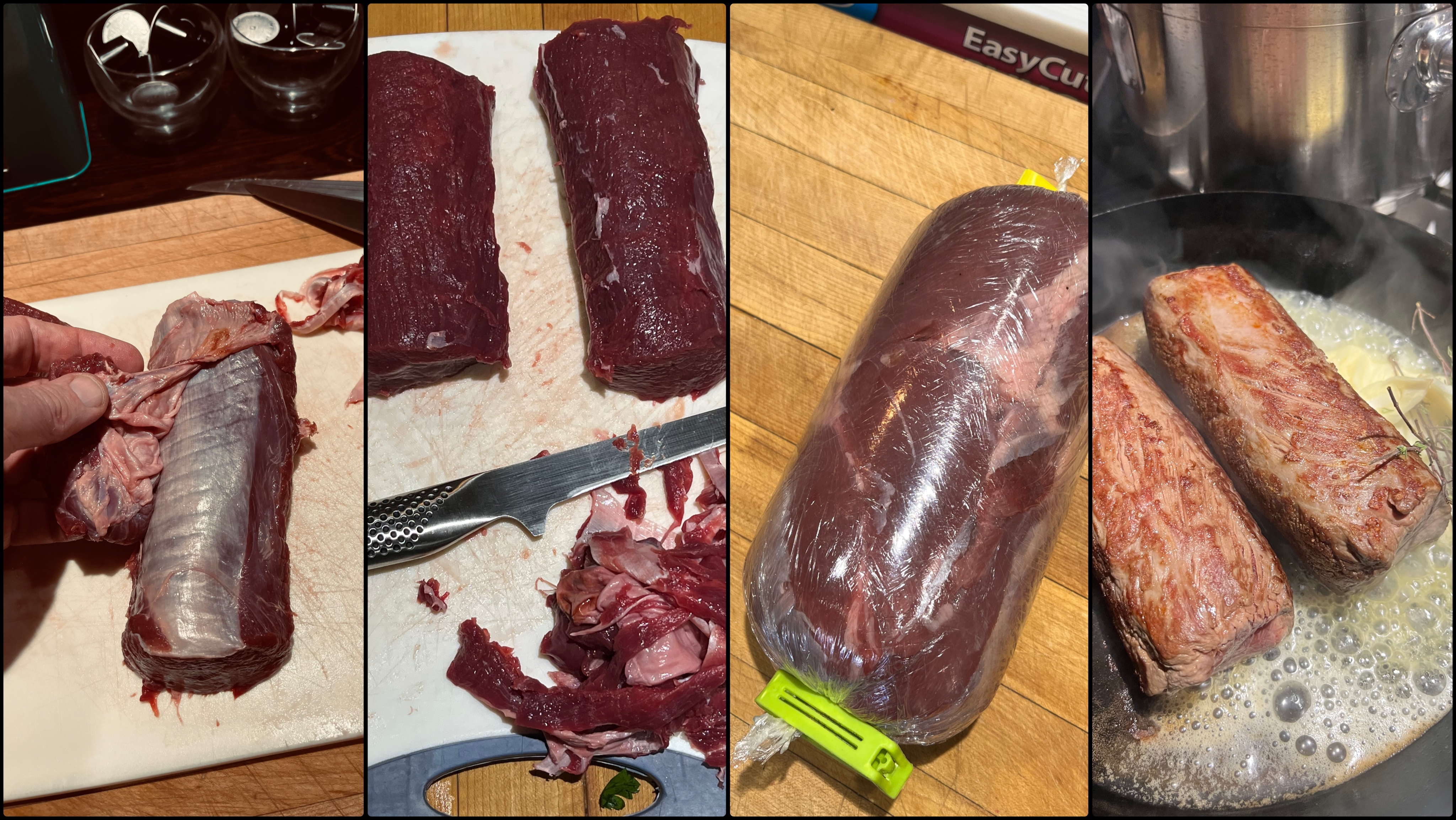
The saddle came deboned and tied with that elastic net that butchers use to hold everything together. After snipping away the net, I spent a bit of time with a sharp knife trimming up the venison, removing the silver skin and any extra slivers of meat and kept all these trimmings to add flavour to the sauce later. I really wanted the saddles to keep their shape, so I wrapped them tightly in cling film and did that trick where you grab the free ends, roll everything up tightly to make them even more cylindrical and left them in the fridge until I wanted to cook them. You can easily skip this bit if you are running against the clock, but you could do it the night before if you are pressed for time on the day of the feast. For this meal, the venison was actually the last thing to be cooked, and took the least time, so I turned my attention to the sauce. 

Over the last year or so, I have spent a lot of time trying different sauce techniques and I guess this one would be described as a “jus” since it does not use flour to thicken it. You need the following ingredients to make it, and about 40 minutes. You can do this ahead and reheat with no problem at all. 

  • 2 onions finely chopped 
  • 1 large carrot finely chopped 
  • 1 celery stick, finely chopped 
  • 1 clove of garlic crushed or roughly chopped 
  • The Venison trimmings 
  • 50ml Port 
  • 250ml red wine 
  • 500ml good quality beef stock or demi-glace  
  • A couple of thyme sprigs 
  • A couple of bay leaves 
  • A sprig or 2 of rosemary 
  • 5-6 cubes of very cold butter (50-75g in total approximately) 

In a saucepan over a highish flame, fry the trimmings in a little oil. When the meatier pieces start to get a nice, dark, caramelised colour on them, you can add the onion, carrot and celery and keep on frying for a few minutes. Now add the crushed garlic along with the port to deglaze the pan; give everything a good stir to help the port dissolve the brown bits. Turn the flame down and let the port reduce until there is very little liquid remaining. Once this has happened, chuck in the herbs and bay leaves, pour in the wine and, keeping the heat at a medium level, let it all bubble away until you have about half of the liquid you started with. Next, add your stock and do the same thing, letting the liquid reduce by half. At this point, pass the whole lot through a fine sieve into a clean saucepan; you can discard the veg and herbs. The next stage requires a bit of judging but fear not; if you overdo the reduction, it can be rescued with a glug of water or wine. Essentially you once again gently reduce the strained liquid; keep stirring and you should see your sauce getting ever so slightly syrupy. Classically trained chefs will talk about the sauce coating the back of a spoon and this is what you are aiming for. Push the spoon through the sauce and lift it up; if you swish a quick finger through it, you should see a clearly defined line where the sauce has not simply run off back into the pan. At this point, whisk in the chilled butter one cube at a time which will enrich your sauce and give it a lovely glossy shine. Once you are happy, have a taste of your creation and add a bit of seasoning if it needs it. Sometimes the sauce gets really rich in flavour and you can take the edge off this richness by adding a few drips of red wine vinegar or Worcester sauce (be careful here obviously) to add a balancing acidic note. 

Venison and mashed potato are a lush combination, so this was going to be the principal veg on the plate (wilted spinach was the other). It was Christmas and I wanted to go a bit luxurious, so I decided to take a leaf out of the late Joël Robuchon’s recipe book and make a kind of pommes purée. Now, the original recipe uses the same quantity of butter as potato (I know, right?) so, given the quantity of butter in the sauce, I decided to reign myself in a little. The dish is simplicity itself: peel and chop your spuds, boil until soft then drain and leave them in the colander until they stop steaming. Now mash them (I used a Moulis legumes with the fine mesh) and light a gentle flame under the pan. Add about 50ml of milk (you could use double cream) and stir in. Now, beat in cubes of butter, one at a time, until the potatoes are smoother than Arthur Fonzarelli giving his 2 thumb salute; you might need 80-100 grams or so of butter which sounds an awful lot but, to paraphrase Delia, it’s not like you’re going to have this every day so you can live a little. Lastly, check for seasoning, and add a little grated nutmeg if you like. I went full MasterChef and spooned my potatoes into a piping bag ready to dress my plates for service. If you have gone this far it is worth noting that the purée can be kept warm by dropping the bag into a pan of hot water – just make sure the top is tied off securely.  

On to the venison. 

Quick Version. Out of the cling film, bit of salt, hot pan to sear all the way round, into the oven for about 10 minutes until it is at 50-51°c, rest for 10-15 minutes. Job done. 

Slower version. Out of the cling film, bit of salt, hot pan to sear all the way round, turn the heat down, fling in thyme, rosemary, garlic and butter, baste with the butter until it is at 50-51°c, rest for 10-15 minutes. Job done. Check arteries. 

Venison saddle is definitely a cut that should be served at least medium rare, so taking off the heat at 50°c will allow the core to rise to a perfect 54-55°c while it rests. If you like your venison a little rarer, take it off at 48°c. To serve, slice thickly across the grain into the equivalent of beef tournedos and arrange in a neat line on your plate. Now pipe your pommes purée in a nice swirl and lastly place your wilted spinach alongside. Now you can cheffily spoon your beautiful jus over the venison as you serve it. 

Dig in. And lick the plate clean; you deserve it. 

PS. It would be completely remiss of me to forget to remind you to warm your plates. There is nothing worse than turning your feast clammy by omitting this simple step. 

Homemade Smoked Salmon

Now we are trudging into the teeth of Winter, I always find it helpful to focus on positives. I will admit that I find it difficult to get used to leaving for work and coming home in the dark, but one of the things I can look forward to is it is becoming chilly enough to get back into cold smoking. There is something almost alchemic about turning a slab of raw salmon into a delicious, smoky, oily, treat to be had with scrambled eggs, on a crispbread, as part of a smorgasbord or late at night in front of the fridge when you think no one is looking. One of the joys of making your own is that it is a pretty straightforward process. Yes, it takes a few days from start to finish, but most of that time is taken up by waiting for things to happen rather than direct involvement from the chef. If you read this and think “by Jove I’m going to have a go at that” then I will add the smallest of caveats. Curing raw ingredients does require pretty scrupulous hygiene and the finished cold-smoked product is technically not cooked. I did a lot of reading before doing my first salmon and the information I found on keeping your food safe to eat ranged from “YOU MIGHT ACTUALLY DIE IF YOU GET THIS WRONG” to a much more laissez-faire “what’s the worst that can happen man?” kind of vibe. From my point of view, if you keep your work surfaces, utensils, and knife clean you will not go far wrong. 

The Smoker  

I built my smoker a few years ago out of plywood, using cheap supermarket cake cooling racks for the shelves. I don’t have much of a workshop, but I sketched out my plan, worked out some measurements based on the size of the racks and took these to my local DIY shop who cut out the plywood panels for me. I then just glued and screwed everything together and used 4 clips to hold the front door on. I drilled 2 big holes in the door to let air in at the bottom and smoke out of the top. The 4 shelves sit on wooden rails and each shelf has space for 2 sides of salmon. Now I’ve used it a load of times, it has a beautiful smoky aroma about it which is lovely. If you have any kind of barbecue with a lid, you can use this instead, as long as it has vents where you can control the flow of air.

The Smoke

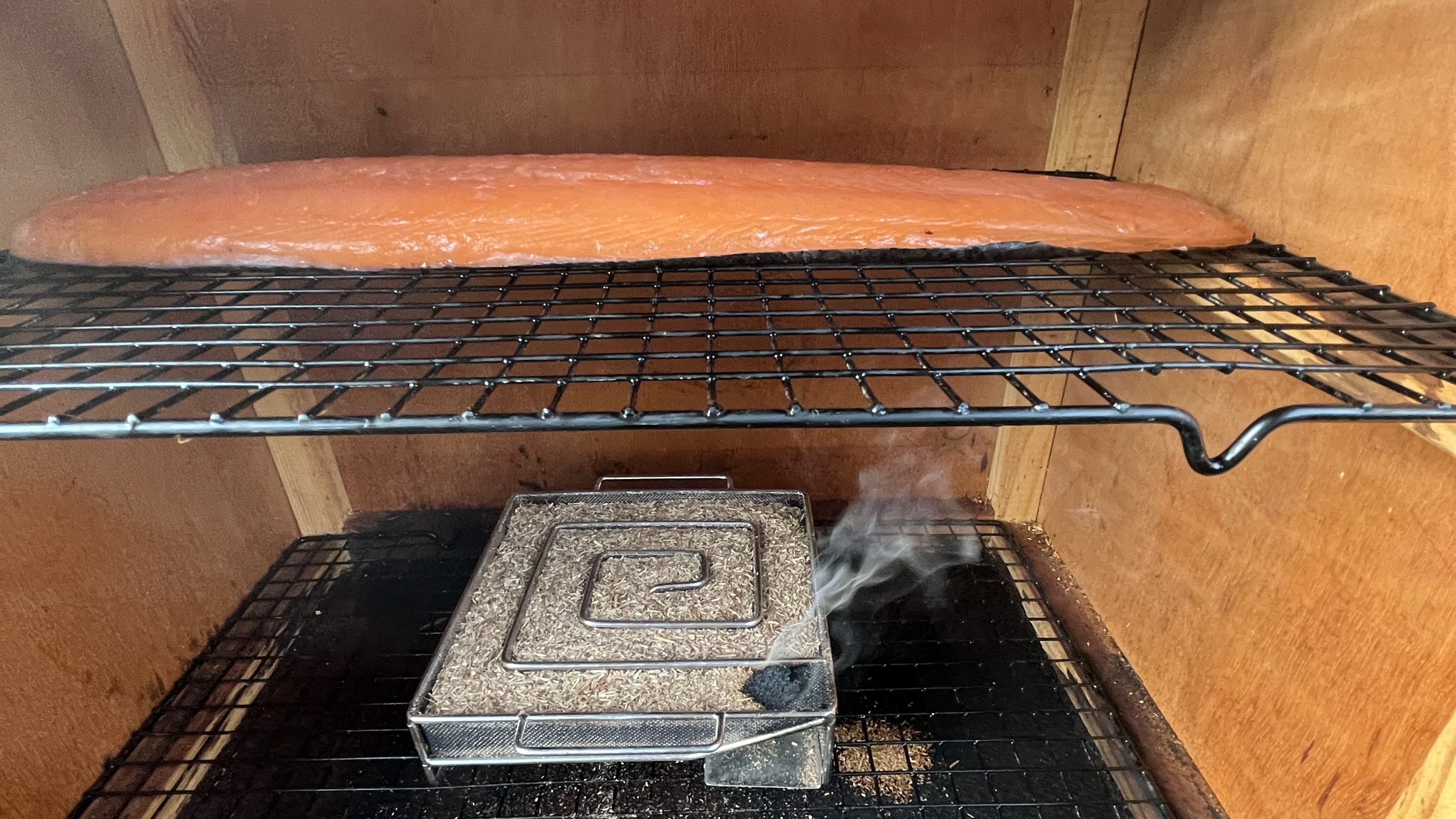
The smoke needs to impart flavour to the fish, but not be hot enough to cook it. There are number of cold-smoke generators on the market, but the one I have is from Pro-Q. It is square in shape and is what is called a “maze” design where basically, you fill it up with sawdust and set fire to one end and, because the wood particles are very small, they smolder giving off lots of smoke without ever getting hot enough to catch fire. Clever. A full load of smoking dust will last about 10 hours which is perfect for salmon. 

The Salmon 

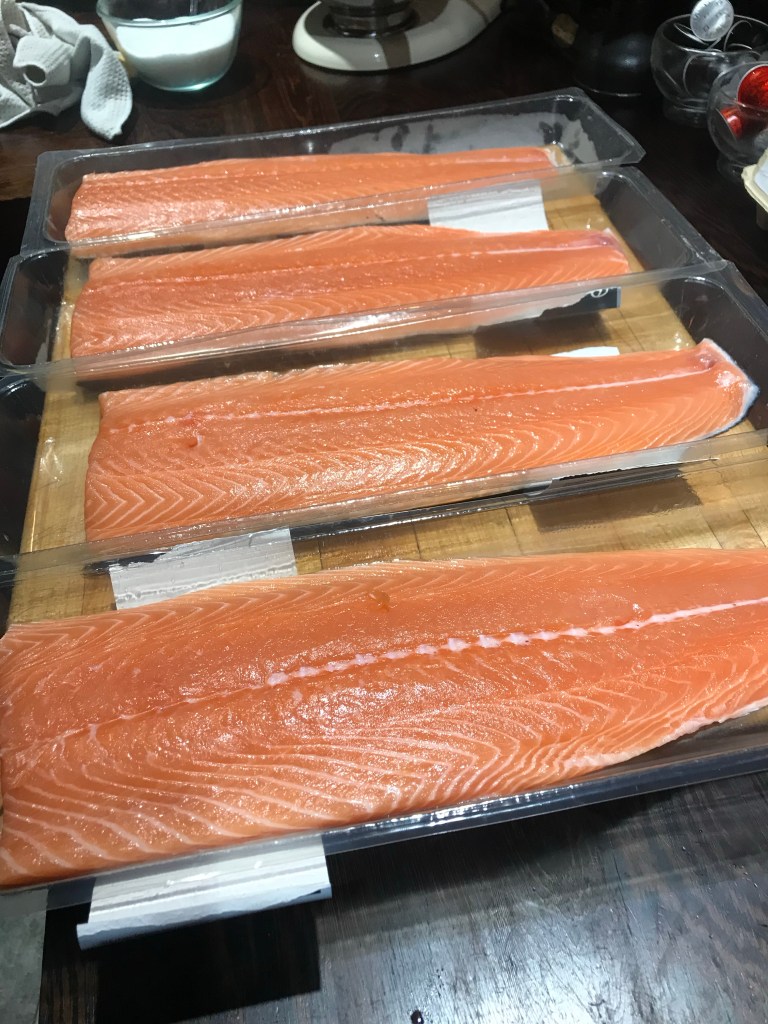
Now salmon is traditionally seen as a luxurious ingredient and there is no doubt that line caught ones from Scottish rivers will set you back a few quid. I only make this recipe when we see whole sides of farmed fish on sale in the supermarket. Farmed salmon is a bit flabbier than wild, but for the process of curing and smoking, it turns out that this is a pretty desirable trait in your fish. Depending on where you get your salmon from, you might be able to get your fishmonger to prep it for you. If not, the only thing you really need to do is, with a sharp knife, remove the belly portion to make the finished product a more even shape. Save all the bits because salmon belly makes delicious fishcakes. You can remove any pin bones at this point, but by happy accident, I have discovered that they are easier to find and remove once you have cured the fish. I never bother removing the scales but I guess you could if you wanted to. 

The Cure 

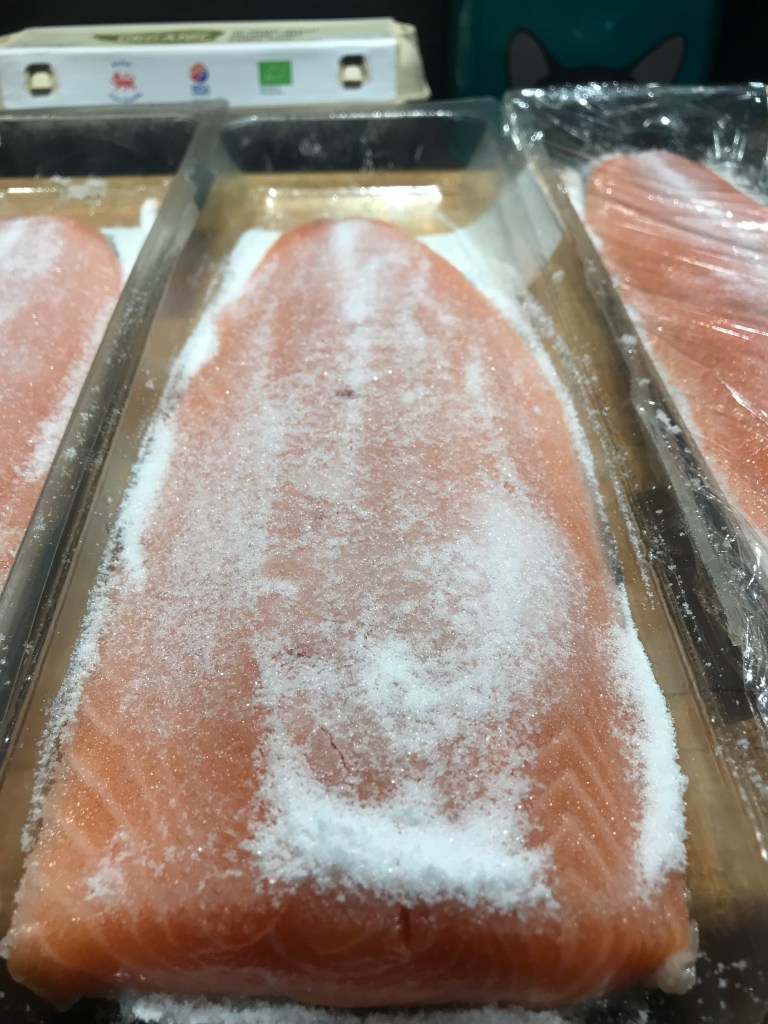
This is stage which really does determine how the finished product comes out. Curing is a pretty ancient technique for preserving foods using salt. The salt draws moisture from the fish and prolongs its shelf life. There are loads of online sites that sell salmon curing kits (and Pro-Q do a starter pack that comes with the smoke generator) but it is a matter of moments to make your own and it is very satisfying to do so. The curing mixture I use is simply a 50:50 mixture of salt and unrefined castor sugar. One side of salmon needs about 100-150g of the cure depending on how big it is, but I tend to make more and store the leftovers in a Kilner jar in the pantry. We have those digital scales with the tare function, so I just plonk my jar on them, set it to zero, weigh 100g of salt, set it to zero again and weigh out the sugar. The jar needs a good shake to make sure everything is evenly mixed. 

The process 

Timing is important, so you need to work backwards from the time you want to eat your smoked salmon. If you want a beautiful Sunday brunch with toast and scrambled eggs, you need to start on Wednesday morning. There are 5 stages: 

  1. Curing the salmon. 

The salmon I tend to get comes in its own plastic tray, which is a very handy vessel to cure it in. If your salmon doesn’t come this way, you need a non-metal dish that will fit your fish. If you only have a metal tray, then line it with a few layers of cling film. Once you have trimmed the belly piece off, lay the fish nice and flat and dry the flesh off with some kitchen paper. Now sprinkle over the cure until you have got the whole thing covered, making sure you get all the edges as well. Aim to put less on the thinner tail end, or it can get a bit tough and hold a saltier taste when it is finished. You can cure your salmon for anywhere between 12 and 36 hours, depending on how you want it to turn out. The longer you leave it, the more moisture is drawn out and the firmer the flesh will be. I tend to go for about 18-20 hours which seems to give pretty consistent results. What you end up with at this point is basically a kind of Gravadlax but without the dill and you can slice it up and eat it at this point if you wish. If you didn’t remove the pin bones before, now is the time to do it. 

  1. Forming the “pellicle” 

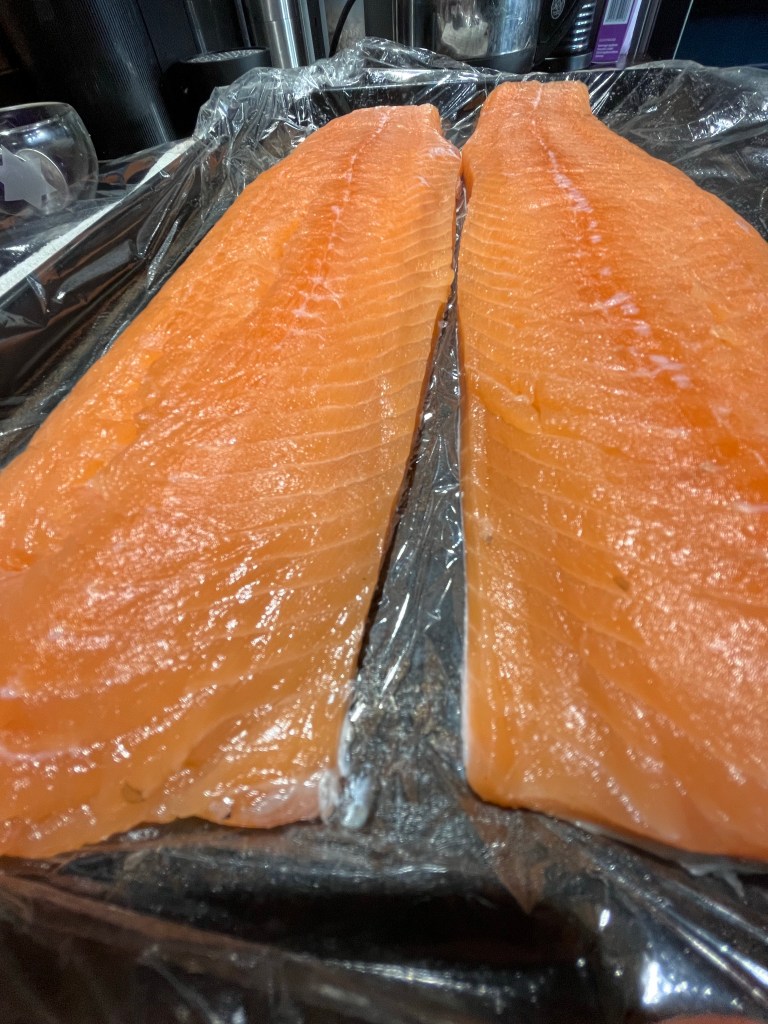
The pellicle is a layer of proteins on the outside of the flesh and it is to this that the smoke sticks and imparts its flavour. Luckily, to create your pellicle, all you need to do is leave your cured fish in the fridge, uncovered, for about 24 hours. Once the cure has done its job, pour all the liquid in your tray down the sink and then carefully wash your fillets under cold running water to remove any remaining cure. Now, taking a good few sheets of kitchen paper, get the fillet as dry as you can. Put it on a rack over a tray, then put it in your fridge and leave it until the next day. Don’t cover it with anything and make sure that nothing else in the fridge can drip on to it. 

  1. Smoking 

The next day, check your fish by lightly tapping it – there should be a kind of chilly tackiness to the flesh. Now you can turn your attention to your smoker. Load your sawdust (I tend to use oak as it smells and tastes lovely, but maple is also excellent) and set it smoldering. Now transfer your fish to your smoker, place your cold smoke generator in the bottom and shut the door. Now all you have to do is leave it until the smoke runs out.  It couldn’t be easier. You now have smoked salmon! 

  1. The patient waiting 

Now, you can slice some strips and find a handy bagel with cream cheese and get it down your cakehole straight away, but I have found it makes a difference if you wait you wrap your salmon in cling or vac-pack it for a day or so, it allows the fish to rest a bit and the smoke seems to penetrate more evenly. We bought a pretty cheap vac-packer on Amazon for about £35 and it works really well. I use it for lots of other things, so I do recommend getting one if you get the cold smoking bug. 

  1. The eating 

There are 2 traditional ways to slice your salmon. The first is the thin, almost translucent lateral cut which is usually what you get when you buy smoked salmon from a supermarket. For this you do need a relatively long, thin knife as sharp as you can get it. For a right handed person, put the head end of the salmon to the left and cut from head to tail starting the first slice about two thirds of the way along. Make a shallow cut and move your knife as smoothly as you can; ideally you will slice so thinly you can see the blade through the flesh. If you don’t have the patience, or the right kind of knife, you can go for D cuts where you cut vertically downwards to the skin and then slide your knife along the skin to release all the bits you have just cut. These give more meaty morsels and do work very well with the aforementioned bagel and cream cheese or Eggs Royale. 

Not only is the process of making your own smoked salmon fun and extremely satisfying, it is also pretty cost effective. Supermarket smoked salmon tends to be priced at between £6-£9 for 100g so it does carry a fairly premium price tag. I wait until I see a good deal and usually pay about £10 or £12 for a whole side which would usually weigh about a kilo and yield somewhere between 800-850g. Smoked salmon freezes brilliantly so if you can get a few sides in one go you can have some in your freezer over the summer months.  

There are a few startup costs, but I’ve had my Pro-Q smoke generator for probably about 5 years and made 80 to 90 whole sides in that time – it’s a robust piece of kit and looks like it will last. The smoker I made cost about £20 in plywood, and I had the glue and screws knocking around in the shed. The cake racks were £2.50 each I think. Since I made the smoker, I have added handles onto the sides to make it a bit easier to carry round. If you fancy giving it a go to make your own, send me a message and I’ll point you in the right direction by sending you the measurements. 

Alternatively, look up the splendidly alliteratively monikered Turan T Turan who can show you how to use a big cardboard box as your smoker. 

Good luck! Have fun!  

Season of Mists and slabs of Venison

I have a friend called Guy who is a very good chap to know indeed. Amongst other things he is a very keen apiarist, which means that every so often he drops round large quantities of honey that his bees have produced. He is also the kind of bloke who gets a massive venison haunch for his birthday. A while ago we talked about him bringing it round so I could cook it, and a couple of weekends ago we did exactly that. The joint was bone in and weighed about 2.5 kg – I guess it was from a Roe deer from the size. I did a bit of research on the best way to cook it and, having recently done a Porchetta, I wanted to get it on the Fire Cage rotisserie.  

Now, as most folks know, venison is a pretty lean meat and so a cook needs a way of adding a bit of fat to the meat to help to keep it nice and juicy. In the days of Mrs Beeton, home cooks would use a larding needle to make holes in their joints and insert thin strips of fat throughout. Fun though this sounds, this is the one bit of kitchen equipment I am yet to acquire and so I decided instead to make a lattice of streaky bacon to wrap around the whole thing. However, for this to be effective the joint needs to be a fairly uniform shape, and that meant deboning it. 

If you haven’t deboned anything before, I will admit that it can be a little daunting at first but there is a great YouTube channel called the Scott Rea Project which is an excellent butchery resource for the home cook. He rather handily has a “How to Butcher a Haunch of Venison” video. The end goal is to “butterfly” the haunch so it can be rolled and tied up in as uniform a sausage shape as possible. Take your time and make lots of small cuts with the tip of your knife and you will get there in the end. Keep all the bones, roast them for half an hour and make a stock out of them. Once you have got your joint butterflied, have a good look at it and make further cuts parallel to your board into any fatter bits so that it lies as flat as possible. Guy had requested chimichurri to serve it with, so I made a load and spread some all over the inside of the meat and roughly rolled it all up. 

Now for the bacon lattice. For this joint I used 16 rashers, eight vertical and eight horizontal. Put a roll of cling film at the top of your board and pull down a piece so it lies across your board with a bit of extra at the front. Don’t cut it off at this point. Place the eight vertical rashers, with a little gap between each one from left to right. Now place your first horizontal rasher at the bottom and fold every other vertical one back over it. Place your next horizontal rasher and then return the vertical ones to their original position. Keep going this way, alternating the vertical rashers to make the lattice; you should end up with a rough square of bacon. Place your venison at the edge nearest to you and, grasping the extra bit of cling film, roll the joint away from you until you have wrapped the bacon all the way around. Next try to tuck the cling under the joint as tightly as you can get it and then hold the joint and pull out more cling and keep tightly rolling the venison until you have got 4-5 complete layers. Grasp the extra bits at each side and roll the whole lot towards you to make it even tighter. If there is enough “spare” you can tie off the cling film, but I find it easier to use a couple of plastic clips (the kind you use to keep open packets closed). In all honesty, this is a bit of a faff, but it does help to create the perfect round shape for the rotisserie, especially if you chill it in the fridge for a few hours. 

Once out of the fridge, you will still need to tie up the whole thing so carefully remove the cling and use good butcher’s twine to hold it together. I tried to line up my string with each of the vertical bacon rashers, so I made eight knots in total. The time in the fridge does make this a bit easier so is worth it. I’ve written about butcher’s knots before and, if you need a refresher, look up any of the excellent YouTube tutorials.  

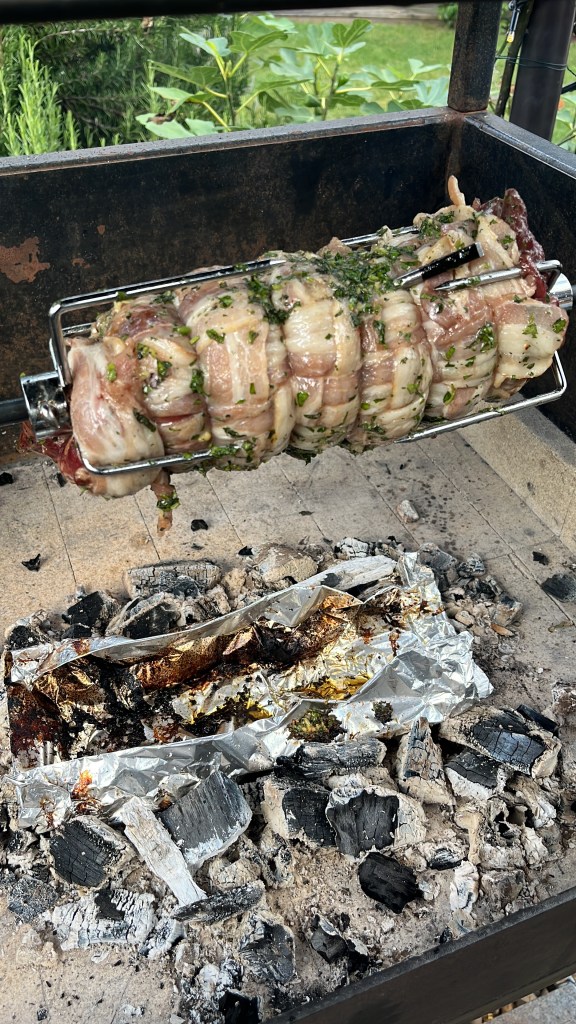
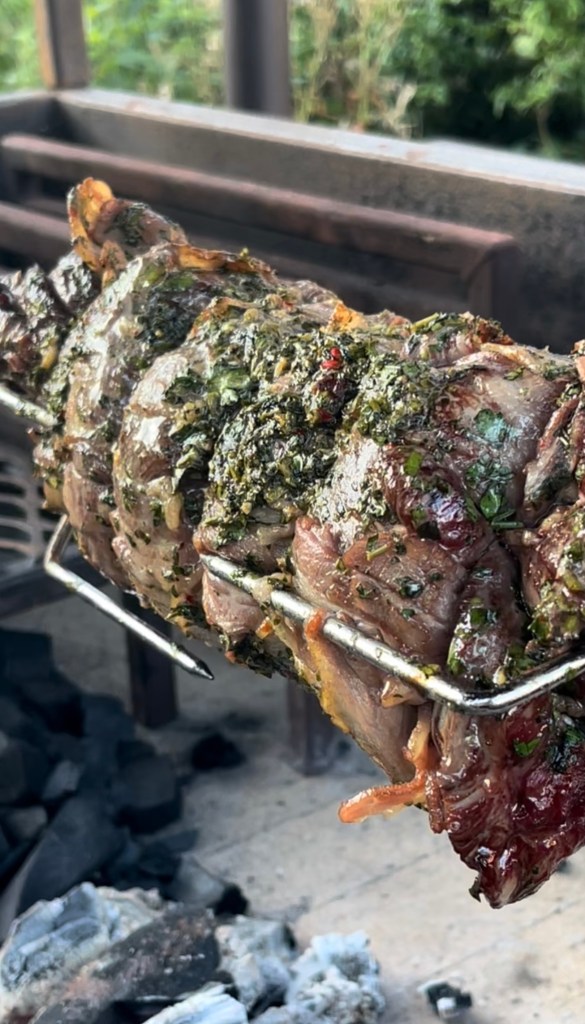
When you are ready, light your fire. As usual with the fire cage I used a mixture of Globaltic lump charcoal and Braai wood from Firemasters. The fire needs to be lit at least 45-50 minutes before you want to cook to let the embers develop their lovely consistent, intense heat. Just before starting to cook, I threaded the rotisserie spit through the venison and secured it with the prongs. Meanwhile, I created a kind of foil tray to catch any drips and arranged 2 rows of embers either side of where the spit will rest – I wanted the meat to get a kind of glancing blow of heat as it turns leading to a nice slow cook. Every now and then, I stuck a big sprig of rosemary onto the fire to add another smoky note – it is really hard to describe what rosemary smoke smells like (can a smell be astringent?) but I really like it. To get a nice medium-rare, the internal temperature should be somewhere between 51-53°c when you serve the venison, so it should be taken off the heat at about 47-48°c – the temperature will keep rising when the joint is resting. The perfect tool for monitoring this is the Meater+ probe which has the advantage of being wireless and gives a constant reading. It took an hour and forty minutes to cook and every 10 minutes or so I painted on a bit more chimichurri. There’s something almost alchemic about the oily/vinegary combination of this sauce which just works wonders with any meat.  

When it was done, the bacon still looked a little peely-wally (look it up if you don’t have Scottish ancestry) so I put a stout pan directly on the embers to crisp it up a bit. I snipped off the butcher’s twine, cut it into fat slices and served in brioche burger buns with yet more chimichurri. It tasted amazing. The bacon lattice had done its job and kept the venison nice and juicy, and the rosemary and Braai wood had imparted just enough smoky flavour to be delicious without being overpowering. The cooking was just right for sandwiches, but I think if you wanted this to be a Sunday roast, it would be wise to take it off a degree or two earlier.  

All you need now is a mate who gets meat for their birthday! 

Chimichurri Sauce 

This is one of those things, a bit like Salsa Verde, that does not necessarily have a clearly defined recipe, more a starting point from which you adapt the ingredients and the quantities as you like them. This is roughly what I used, but bear in mind this should be a bold, punchy flavour so if you are in any doubt with the quantities of garlic, mustard or anchovy, go big:

A whole packet of parsely 

A whole packet of coriander 

A whole packet of basil 

2-3 finely chopped anchovy fillets  

2 – 3 tsp capers roughly chopped 

2 tsp Dijon mustard 

2-3 garlic cloves crushed into a paste 

A red chilli finely chopped 

Olive Oil – a good glug, say about 50ml 

Red Wine vinegar – a good swig, say about 20 ml 

Salt & Pepper 

Now you can just throw all the ingredients in your food processor and blend away, but this does produce quite a fine, almost emulsified sauce. I much prefer to chop everything by hand, add it all to a big bowl and then add the oil and vinegar, tasting as I go until I’m happy. The sauce should be quite loose, and I definitely prefer it with a stronger acidic tang from the vinegar, so I probably put in a touch more than most recipes would suggest. Make loads as it keeps pretty well in the fridge, but it is so good you will probably, like me, find plenty of ways to use it up quickly! 

I like Pork Ribs and I cannot lie…

At the start of the summer, Polly had to take a 2-week trip to Texas for a conference. Honestly, I wasn’t jealous in any way. Honestly. However, being the absolute beauty that she is, she bought a load of brilliant presents when she got home. Among them were 2 books; the first a big tome called “Life of Fire” by Pat Martin. This is one of those glorious cook books which is way more than just recipes – you can read it like a story book and, just as “Ripailles” by Stéphane Reynaud makes me want to put on a beret and cycle about France with onions round my neck eating a lot of duck, Life of Fire inspired me to dig a massive hole in my garden, light a huge fire and cook a whole hog over a 24-hour period. There is, however, a lack of practicality in that, not least that we’ve worked bloody hard on the garden to make it look nice so I turned to my other new volume. In contrast, “Texas Barbecue 101” is one of those lovely, totally literal guides to cooking. Author John Lopez (AKA Chef Wally) has produced something akin to those beautiful old Observer’s guides that I am sure everyone in my immediate family will remember from our holidays in the late 70’s and early 80’s. There is no embellishment to the recipes and you get the feeling that Chef Wally is a no-nonsense kind of guy who does things his way and he’ll be danged if anyone tells him how he should run his business. It’s brilliant, and so with some old friends coming over that we’d not seen in a few years, I turned to the Barbecue Spare Ribs page. The recipe is as pared back as can be with 5 steps which can be paraphrased thus: 

  1. Remove the membrane off the bone side of the ribs 
  1. Apply a rub 
  1. Light your smoker and get it to around 120°c 
  1. Put the ribs in and wait 5 hours 
  1. Add BBQ sauce, but only if you are “One of the wet ribs crowd” 

Polly made the rub (also from the book); the recipe for it begins with the memorable phrase “if you eat barbecue at my house, this is what you get” and I feel there is a clear inference through the page that Wally’s rub is the best and that all other versions are inferior. If you are in any doubt, the next recipe in the book is called “Everyone Else’s Rub” which begins by listing a whole load of Fancy Dan ingredients that Wally categorically does not use. To make the rub, add 2 tablespoons each of salt, pepper and five-spice powder (which doesn’t sound especially Texan but who am I to argue?) to an empty jam jar and then add 1 tablespoon each of brown sugar, cayenne and chilli powder. Put the lid on and give it a good shake to mix everything together and it is done. 

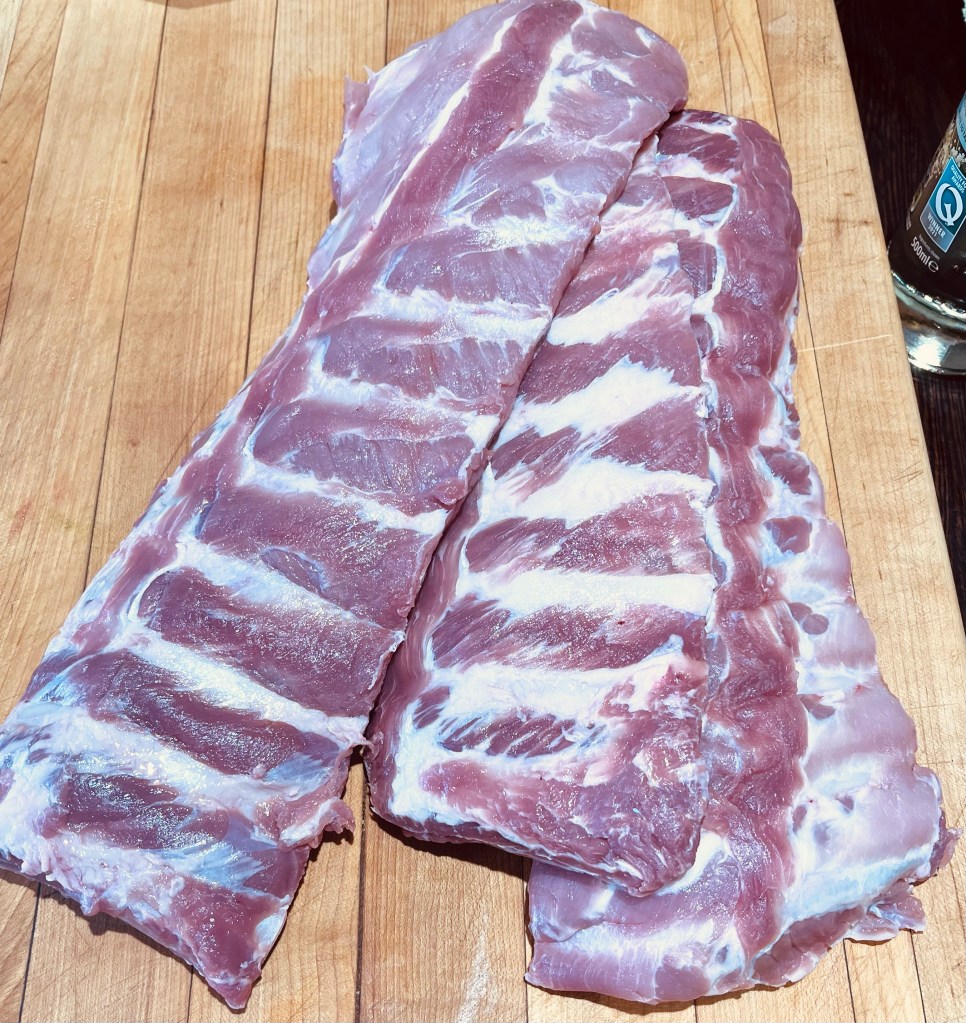
We were going to be a group of 5, so we got three racks of ribs from the supermarket and, once out of the packet it is important to dry them off with kitchen paper, which makes it much easier to remove the papery membrane from the back of the bones. To get started, use a normal table knife and insert the blade between the meat and the membrane, then trapping it with your thumb lift the membrane up, away from the flesh. Once you have got a good bit lifted, use another dry bit of kitchen paper to grab the membrane then pull back along the ribs and it should peel away in one go in a very satisfying way. 

To get the rub to stick, use a pastry brush to apply a very thin film of mustard over both sides of each rack then take the jam jar of rub and gently shake out enough to evenly cover the meat. Take care not to add too much would be my best advice. It takes about half an hour to “set” – when it has you can see the rub will look darker because the salt in it will have drawn out some moisture from the pork. The ribs are now ready to be cooked. 

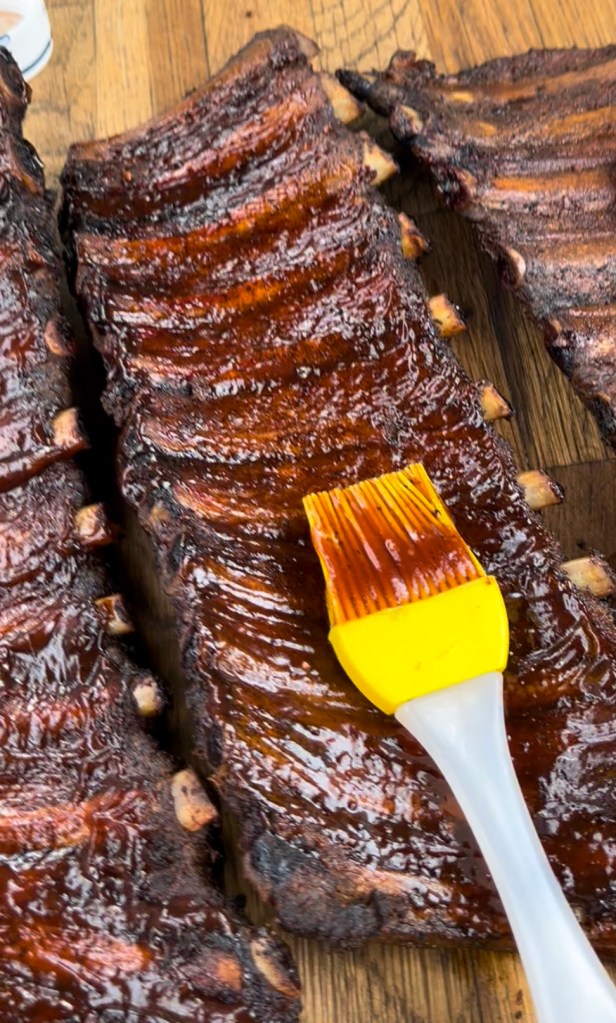
Like a lot of barbecue recipes, you can do these ribs in the oven, but I used our Big Green Egg and dropped in some oak chips to get a nice smoky flavour. The ribs went in for a total of about 5 hours until the meat was tender enough that a skewer poked through met with very little resistance. Since we are part of the “wet rib crowd”, I painted on a couple of layers of BBQ sauce and left them for another 20 minutes or so for the sauce to become a nice sticky glaze. When I took the ribs out of the Egg, I wrapped them in foil to rest for a good 30 minutes which was definitely worth doing as the meat relaxed a bit and all the juices, sauce and rub melded together nicely. 

Now, this is the bit where I tip my Stetson to Wally and tell you about thing that I DID NOT do. There is a school of thought that using a 3-2-1 method produces juicier, more succulent meat that falls off the bones. This basically means you smoke your ribs, uncovered, for 3 hours, wrap them in foil with a slosh of cider vinegar and cook for 2 hours, then take them out of the foil, apply your sauce and cook for another hour. The ribs end up effectively braising for that 2-hour period wrapped in foil so will appeal to folk who prefer softer meat with less of a chew to it. I probably will give this method a try in the future, but for now I am staying in Wally’s lane and doing exactly what he tells me.

The results were amazing. To serve the ribs, I sliced in between the bones, put them in a big bowl and tossed another lot of BBQ sauce over them. They got HOOVERED. I really liked that the meat still had some bite to it and the rub had created a delicious, slightly fiery crust which was tempered a bit by the sweeter sauce. I’m not sure you still get this with the 3-2-1 method. Looking about the table, people had sauce on their cheeks, up to their elbows and big smiles on their faces. A ringing endorsement if ever there was one, but gentlemen with new, Top Gun inspired moustaches will require a lot of postprandial clean up work. There was a splendidly English “no you have the last one, no you have it I insist” moment at the end.  

Of all of the more traditional American barbecue recipes I’ve made, this one has to be the one which involves the least prep, the least fuss, the least checking on temperatures and so it’s one I would do time and again. We actually served the ribs as the starter to an even bigger slab of meat, but the recipe would scale up with no problem at all other than the limitation imposed by the size of your smoker or oven. The only remotely fiddly bit is getting the membranes off, but if you get your meat from a butcher, I’m sure they could do that for you. The rub uses ingredients that might already be lurking in your store cupboard.  

Go on, give this one a go and let me know how it went. Chef Wally will take umbrage if you don’t.