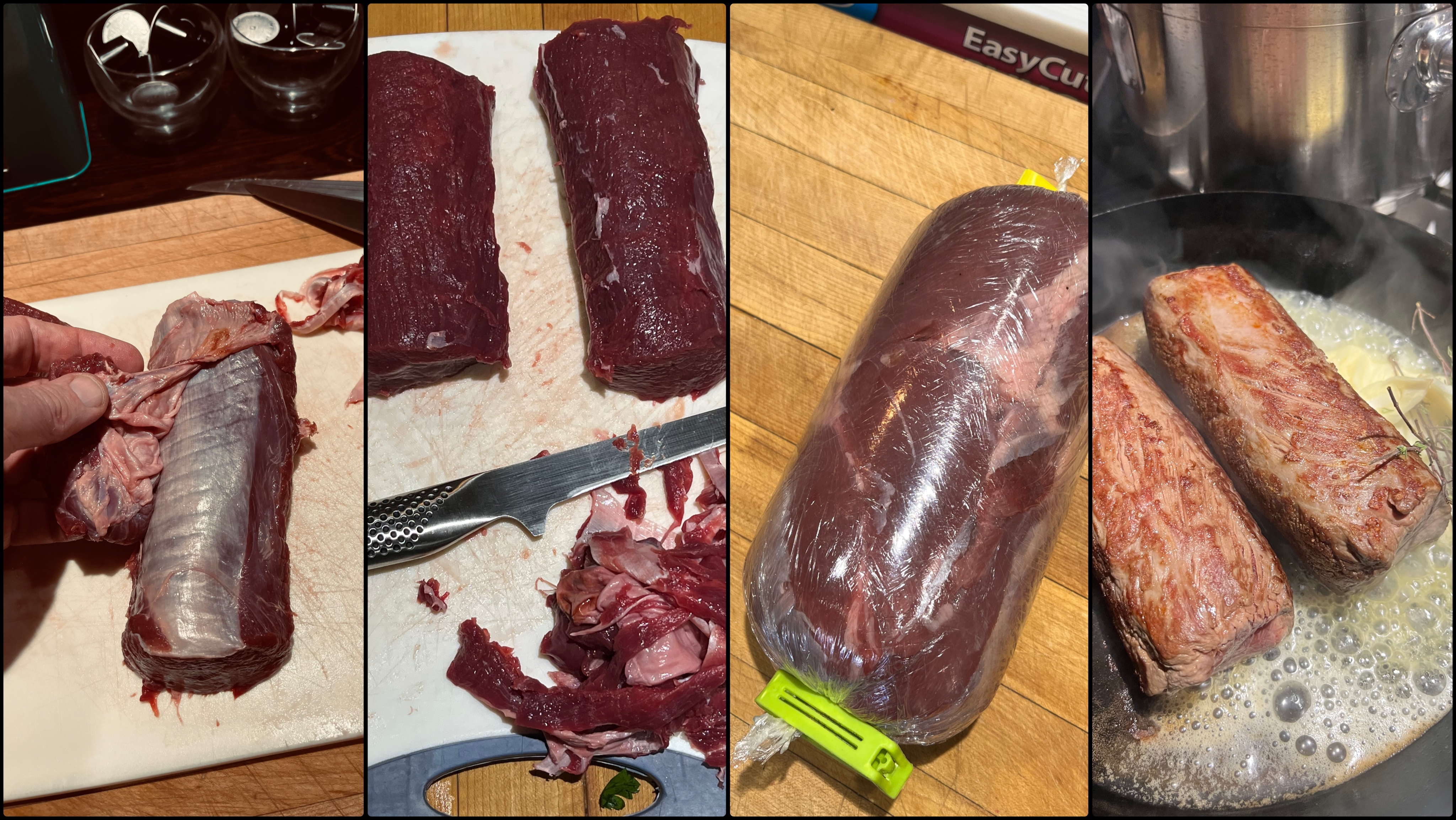
I have written before about my love of Venison – it is flavourful, easy to cook and cost effective. In my mind it is as good as beef and is generally higher in protein and lower in fat. This week I had a crack at Venison saddle for the first time; this cut comes from a cross-section of the back, so you get the equivalent of 2 beef fillets or pork loins. Ours came from a roe deer so the 2 portions were definitely enough for the 3 people present for dinner. At this point in time, I was on holiday, and it was nearly Christmas so, with time on my hands I went all cheffy and took about 5 hours to cook a thing that you could easily bang out in a quarter of that time, but I was having fun and didn’t care. I remember once reading a quote from a top chef that the general public would be astonished at how much butter and salt goes into Michelin-level cooking. Whilst in no way claiming that level, there is potentially a LOT of butter in what follows, but you do not need to use as much as indicated if you don’t want to. Or you could use more, who am I to judge?
The saddle came deboned and tied with that elastic net that butchers use to hold everything together. After snipping away the net, I spent a bit of time with a sharp knife trimming up the venison, removing the silver skin and any extra slivers of meat and kept all these trimmings to add flavour to the sauce later. I really wanted the saddles to keep their shape, so I wrapped them tightly in cling film and did that trick where you grab the free ends, roll everything up tightly to make them even more cylindrical and left them in the fridge until I wanted to cook them. You can easily skip this bit if you are running against the clock, but you could do it the night before if you are pressed for time on the day of the feast. For this meal, the venison was actually the last thing to be cooked, and took the least time, so I turned my attention to the sauce.
Over the last year or so, I have spent a lot of time trying different sauce techniques and I guess this one would be described as a “jus” since it does not use flour to thicken it. You need the following ingredients to make it, and about 40 minutes. You can do this ahead and reheat with no problem at all.
- 2 onions finely chopped
- 1 large carrot finely chopped
- 1 celery stick, finely chopped
- 1 clove of garlic crushed or roughly chopped
- The Venison trimmings
- 50ml Port
- 250ml red wine
- 500ml good quality beef stock or demi-glace
- A couple of thyme sprigs
- A couple of bay leaves
- A sprig or 2 of rosemary
- 5-6 cubes of very cold butter (50-75g in total approximately)
In a saucepan over a highish flame, fry the trimmings in a little oil. When the meatier pieces start to get a nice, dark, caramelised colour on them, you can add the onion, carrot and celery and keep on frying for a few minutes. Now add the crushed garlic along with the port to deglaze the pan; give everything a good stir to help the port dissolve the brown bits. Turn the flame down and let the port reduce until there is very little liquid remaining. Once this has happened, chuck in the herbs and bay leaves, pour in the wine and, keeping the heat at a medium level, let it all bubble away until you have about half of the liquid you started with. Next, add your stock and do the same thing, letting the liquid reduce by half. At this point, pass the whole lot through a fine sieve into a clean saucepan; you can discard the veg and herbs. The next stage requires a bit of judging but fear not; if you overdo the reduction, it can be rescued with a glug of water or wine. Essentially you once again gently reduce the strained liquid; keep stirring and you should see your sauce getting ever so slightly syrupy. Classically trained chefs will talk about the sauce coating the back of a spoon and this is what you are aiming for. Push the spoon through the sauce and lift it up; if you swish a quick finger through it, you should see a clearly defined line where the sauce has not simply run off back into the pan. At this point, whisk in the chilled butter one cube at a time which will enrich your sauce and give it a lovely glossy shine. Once you are happy, have a taste of your creation and add a bit of seasoning if it needs it. Sometimes the sauce gets really rich in flavour and you can take the edge off this richness by adding a few drips of red wine vinegar or Worcester sauce (be careful here obviously) to add a balancing acidic note.
Venison and mashed potato are a lush combination, so this was going to be the principal veg on the plate (wilted spinach was the other). It was Christmas and I wanted to go a bit luxurious, so I decided to take a leaf out of the late Joël Robuchon’s recipe book and make a kind of pommes purée. Now, the original recipe uses the same quantity of butter as potato (I know, right?) so, given the quantity of butter in the sauce, I decided to reign myself in a little. The dish is simplicity itself: peel and chop your spuds, boil until soft then drain and leave them in the colander until they stop steaming. Now mash them (I used a Moulis legumes with the fine mesh) and light a gentle flame under the pan. Add about 50ml of milk (you could use double cream) and stir in. Now, beat in cubes of butter, one at a time, until the potatoes are smoother than Arthur Fonzarelli giving his 2 thumb salute; you might need 80-100 grams or so of butter which sounds an awful lot but, to paraphrase Delia, it’s not like you’re going to have this every day so you can live a little. Lastly, check for seasoning, and add a little grated nutmeg if you like. I went full MasterChef and spooned my potatoes into a piping bag ready to dress my plates for service. If you have gone this far it is worth noting that the purée can be kept warm by dropping the bag into a pan of hot water – just make sure the top is tied off securely.
On to the venison.
Quick Version. Out of the cling film, bit of salt, hot pan to sear all the way round, into the oven for about 10 minutes until it is at 50-51°c, rest for 10-15 minutes. Job done.
Slower version. Out of the cling film, bit of salt, hot pan to sear all the way round, turn the heat down, fling in thyme, rosemary, garlic and butter, baste with the butter until it is at 50-51°c, rest for 10-15 minutes. Job done. Check arteries.
Venison saddle is definitely a cut that should be served at least medium rare, so taking off the heat at 50°c will allow the core to rise to a perfect 54-55°c while it rests. If you like your venison a little rarer, take it off at 48°c. To serve, slice thickly across the grain into the equivalent of beef tournedos and arrange in a neat line on your plate. Now pipe your pommes purée in a nice swirl and lastly place your wilted spinach alongside. Now you can cheffily spoon your beautiful jus over the venison as you serve it.
Dig in. And lick the plate clean; you deserve it.
PS. It would be completely remiss of me to forget to remind you to warm your plates. There is nothing worse than turning your feast clammy by omitting this simple step.
 Live Fire Journal