I noticed with a degree of horror today that is now 6 months or so since my last post here. I’ve wracked my brains and cannot really come up with any particular reason for the hiatus other than sometimes real life gets in the way. In this case my professional life has been pretty all-consuming for the last few months as we geared up for remembering how to prepare students for exams once again and we dealt with those who were finding the whole thing a bit traumatic. However, as the school holidays have started for both of us, I now have the luxury of space and time to get writing again. As I type this, I am listening to the crickets and looking out over the Adriatic of the north Croatian coast and the stresses and strains of the last couple of months seem like a distant memory. What opportunities the availability of time brings…
There are 3 things I have cooked in 2022 which stand out from the crowd, presented here in ascending order of the time required to cook them:
A snip in time – whole bavette caveman style (30 minutes or so)
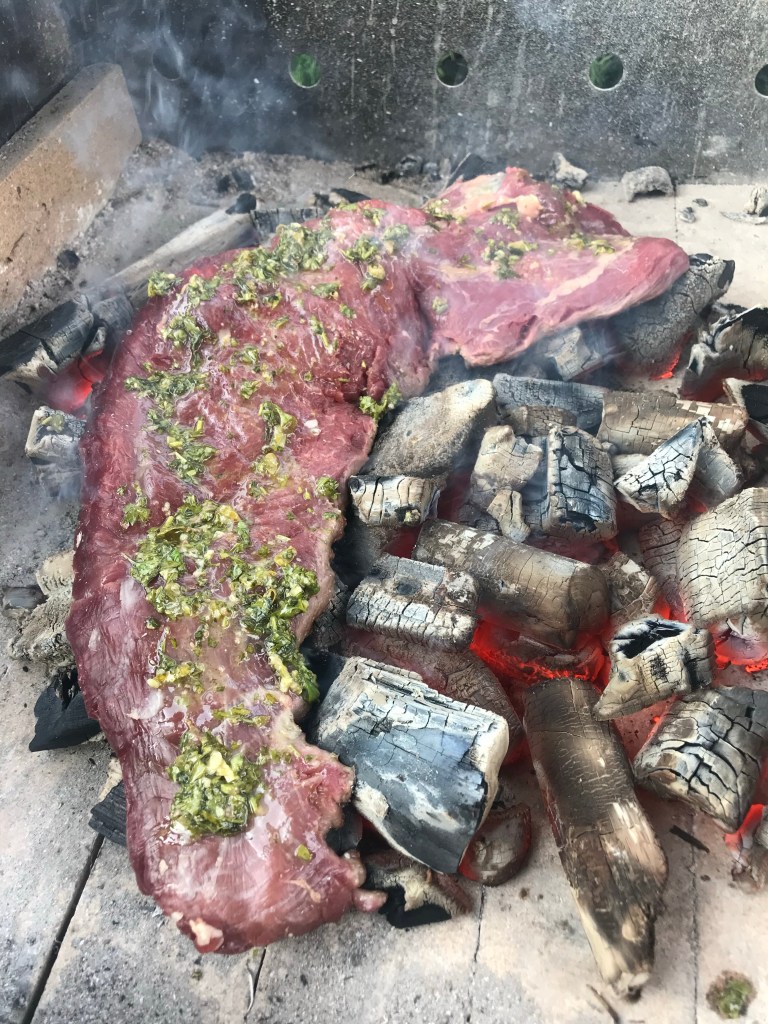
I think Bavette steak might well be the best steak discovery of my Live Fire journey so far. It’s a fairly unheralded cut doesn’t look particularly glamorous but is delicious as long as some golden rules are adhered to:
- It needs to be cooked to at least medium-rare which is in the realm of 60-65C if using a meat thermometer (take the steak off the heat at 60 and it will get to 65 while resting)
- Whatever you are cooking it on/in needs to be very hot
- To serve it, make sure you slice across the grain.
We had a party to celebrate Polly’s birthday and, whilst we had a bit of a show-stopper to serve for lunch (more on this later) we needed something to keep everyone going later on into the night. I’ve mentioned Philip Warren butchers in Launceston before and they sorted me out with 3 whole pieces of bavette – each one weighing about a kilo and probably measuring about 60-65cm in length – big bits of meat in other words. To keep the showstopper vibe alive, I decide to cook them directly on the embers (this is sometimes referred to as an “Eisenhower” steak after the US President who liked this method). I lit a small pile of Globaltic birch charcoal and waited 10 minutes or so for it all the really get burning, then raked out a long thin bed and plonked the bavette straight on (to a very satisfying hiss). Using tongs, I turned the steak every minute or so – each time the meat comes into contact with the embers a beautiful crust is created. More flips = more crust. If you give this method a go yourself, please note you will have to pick off bits of charcoal that have stuck to the meat – this is perfectly safe. Once the steak is cooked, leave it to rest for a good 10 minutes and slice across the grain. Most steaks will be more chewy if you don’t do this, but for Bavette, this is extra specially doubly important. Then smother with chimichurri, that delicious herby, vinegary South American sauce. The first one lasted, I think, under 2 minutes as it was devoured by hungry guests. The other two went the same way. Given what I’d cooked for lunch, this was an excellent effort and is also a guarantee of company; I noticed as the steak cooked I was encircled by friends drawn in by both the delicious smell and the spectacle as moths to a flame. Very satisfying on all fronts.
An afternoon of leisure time – rotisserie Picanha (About 3 hours)
A hugely popular cut of meat in Brazil, Picanha is the triangular tail section of a full sirloin steak. A whole piece will weigh in the region of 1 to 1.5 kg I guess. The Brazilian way of cooking is super-easy but does require a rotisserie to achieve it. The day before, I did my usual thing of finely scoring the fat layer, salting the beef and leaving it uncovered in the fridge overnight. Next morning, I built my fire and waiting an hour or so for the flames to die down to produce a lovely bed of embers to cook over. Next, I cut the Picanha into 4 thick slices. Each slice then got folded back on itself to make a kind of U shape, with the fat on the outside forming a protective layer; each slice then got impaled on the rotisserie spit (in truth, this bit was quite fiddly and I made have said some bad swears – sorry Mum). Once I’d set the rotisserie spinning, that was it.
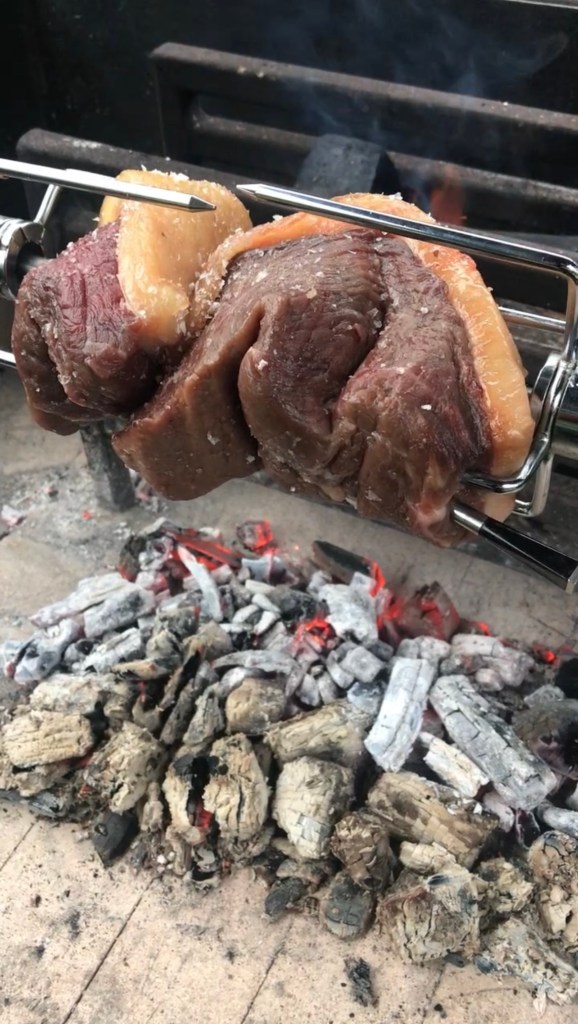
I used my Meater probe to check the temperature and then just left it alone for the thick end of 2 hours – about the length of time for a traditional Sunday roast. Every now and again I had to add a bit more wood to make new embers but this is one of the least “involved” cooks I’ve done on the cage. I took the steaks off when the internal temperature had reached 55c and let them rest for a good 15 minutes on the high shelf of the cage. I cooked a load of different vegetables on the embers as the meat span and this made a great lunch with plenty of leftovers.
A culinary age – Asado venison a la cruz (a whole day)
Now for Polly’s party we had a lot of people to feed and she wanted something to use the cage to its full potential. Cooking “a la cruz” means that the meat is mounted on an iron cross which is then suspended near a fire and cooked indirectly over several hours. Whilst not entirely considering the needs of the vegetarians who would be coming, Polly decided that we would go for a whole venison. We managed to source one locally, from a company called Deerbox (lovely, helpful blokes by the way), who are based in Cirencester – this was handy as it was the Queen’s jubilee weekend so in lieu of a delivery, I was able to go and pick it up in the van. You can buy Asado crosses, but for something one-off I decided to make mine out of 30mm box section mild steel, bolted together. A local company cut everything to length, charged me about £25 for the steel and delivered FOC – result. On the day itself, I was up at 0600 to light the fire, knowing it would take an hour or so to properly get going. I tied the venison to the cross using stainless steel wire and mounted the whole thing into the cage. In all honesty, I got the fire too hot to begin with, which led to a bit of a panic that I would overdo things, but there was in the region of 20kg of venison so it didn’t cook too quickly.
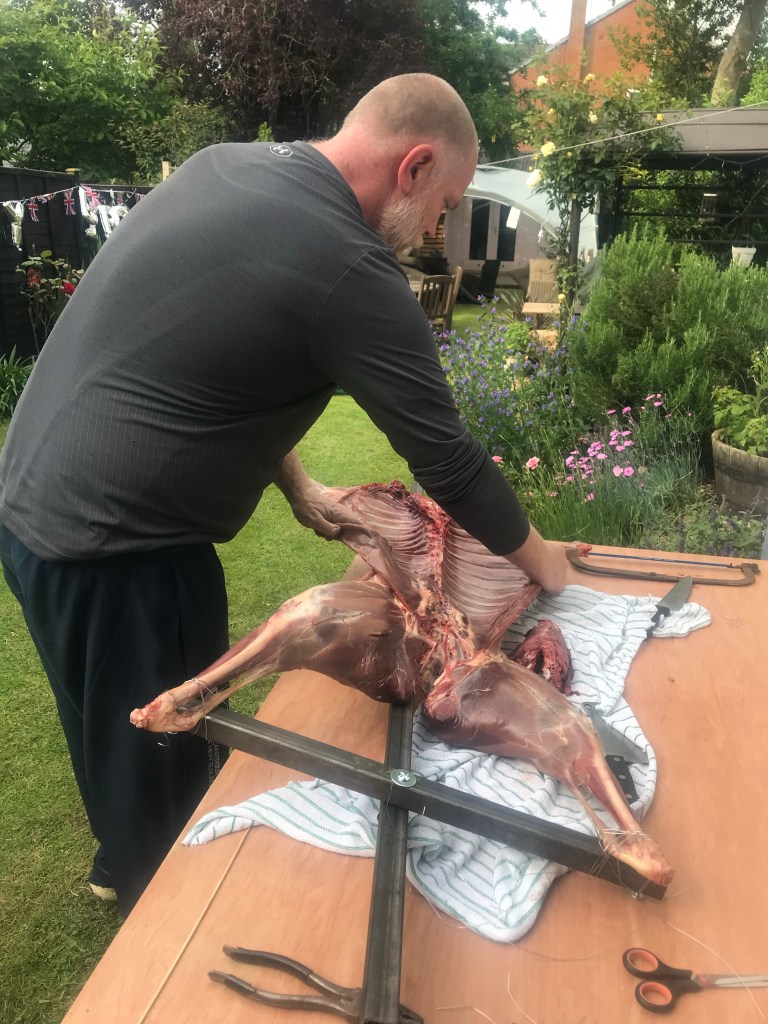
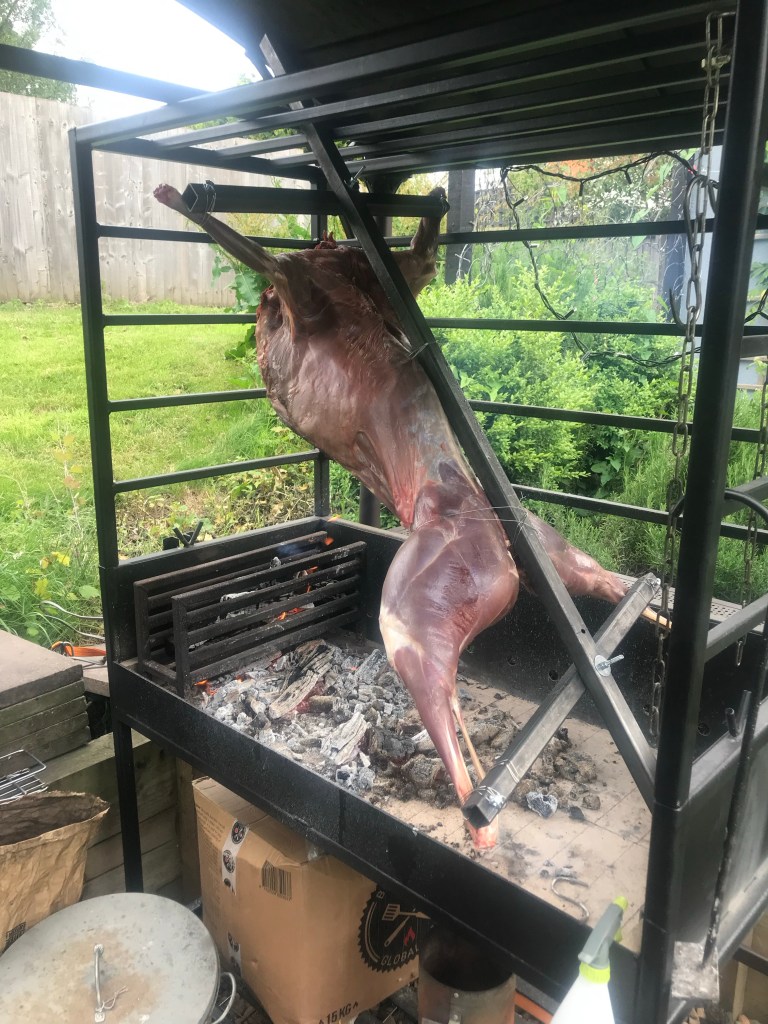
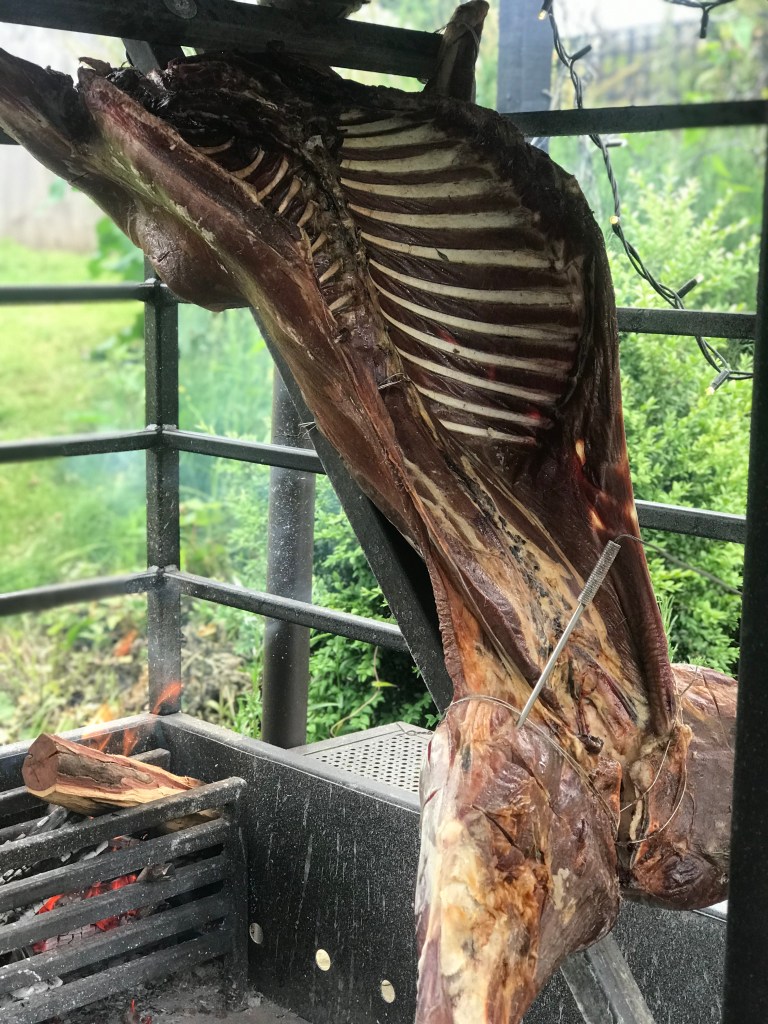
The trick to this kind of cooking is to keep the temperature low and to baste the meat with selmuera every 20 minutes or so. Selmuera is basically a brine flavoured with thyme, rosemary, bay and garlic – I made a brush with more sprigs of rosemary to paint it on with. It was ready at about 1400, meaning it had cooked for 7 hours or so. Polly had prepared some brilliant sides and salads to go with, plus we had the bavette steaks on standby, plus a slow-cooked lamb shoulder we did the day before. It was amazing. The outside bits had taken on a delicious salty, crusty texture (I had tested many of them in the cooking process) and the deeper bits of flesh were delicious; tender, juicy and full of flavour. In all honesty, carving the whole carcass felt quite primeval, and I did get more than one Henry XII comment. The party was a roaring success and, in contrast to the party bags with bits of birthday cake, we sent happy guests away with slices of venison – the leftovers just wouldn’t have fitted in our freezer!
 Live Fire Journal