If you’re feeling a bit glum about the world, then I can only recommend this dish as a means of improving your mood. It’s a piece of cake to make and, although it takes a long time overall, for the chef it’s mostly waiting around for things to happen.
The recipe is essentially made like a good old-fashioned stew, of the kind you can find in any Mrs. Beeton style cookbook of a certain age. Below is a list of what I used. I would say onion and carrot are necessary, but beyond these but you can roll with whatever you have in your larder:
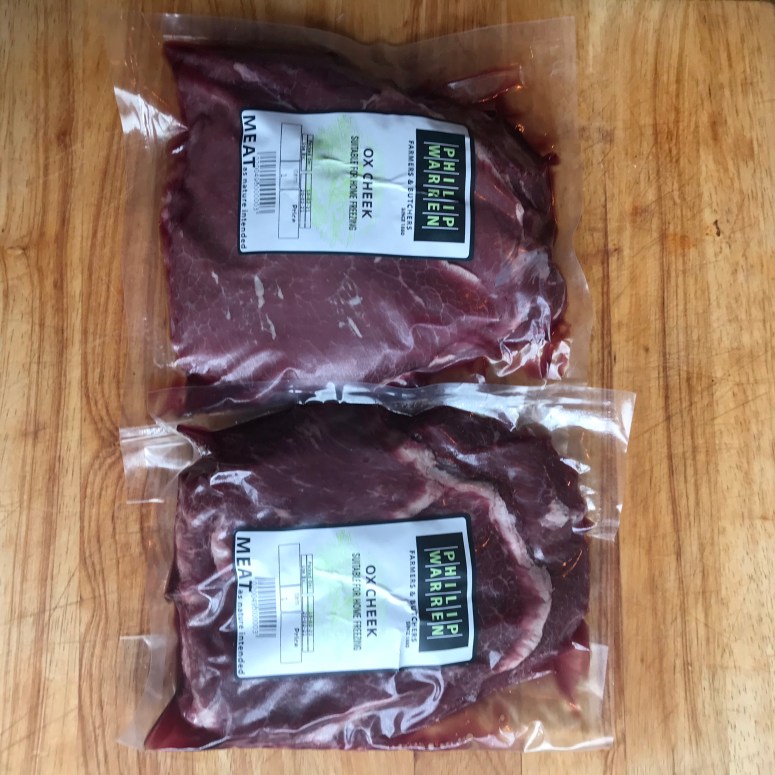
- 2 Ox cheeks
- 2 onions
- A leek
- 2 carrots
- A glass of spicy red wine
- About 500ml of stock – I used veg, but beef would probably be even better
- A couple of rosemary sprigs
- A couple of bay leaves
- A couple of thyme sprigs
- A dash of Worcestershire sauce
- A dash of cider vinegar (optional)
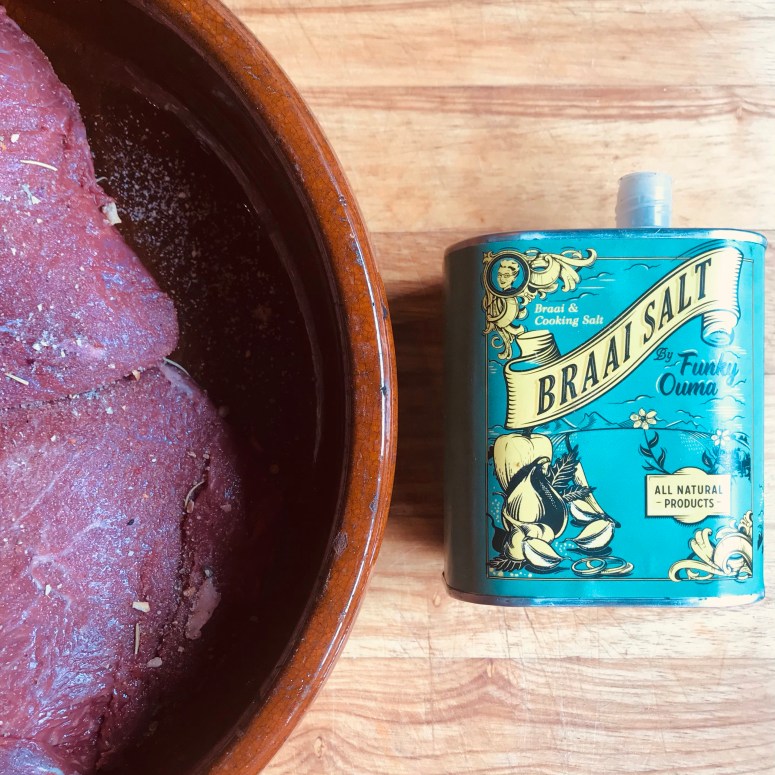
Where the recipe differs from a basic stew is that the cheeks get a good hour of smoking before the braising part. To kick it off, I took the cheeks out of the fridge and gave them a liberal shake on both sides with some Braai salt; this both imparts a bit of flavour from the spices in the salt, and helps the meat to stay juicy and tender once you have cooked it. Unlike a dry barbecue rub, this will not make a crust or bark on the outside of the meat. The cheeks went back in the fridge overnight.
In the morning I pre-soaked a handful of hickory chips in water and lit the Egg with the plate setter in for indirect cooking, aiming for a dome temperature of 150C. The chips went onto the hot coals and the slabs of ox cheek directly onto the bars. The intention here was not to cook the cheeks through, but to impart a deep, smoky flavour before getting to the braise phase. I left them for an hour or so until the hickory chips had burned off, which was a shame because there was a beautiful smell about the garden and which wafted out once I opened the Egg to see what I had created. The cheeks looked rather good, with a chestnut brown colour from the smoke. To the touch, it was clear the fibres had all tightened up and were looking forward to a relaxing soak in a strongly flavoured braising stock. I took them off the heat, dropped them into a bowl and covered loosely with foil.
Meanwhile, I prepared the ingredients for the braising liquor. I’ve got an ancient Le Crueset casserole that is perfectly sized for the Egg, so in it went onto the bars with a good scoop from a jar of beef dripping. The onion, leek and carrot got diced and added to the pot, along with a couple of bay leaves tied around some sprigs of rosemary and thyme. Making this kind of parcel with the herbs not only makes it easy to fish them out at the end, but it helps to stop the rosemary needles breaking off, which I find they are prone to do with this kind of long, slow cooking. Once this had all softened down, I added a good tablespoon of plain flour to give the sauce a bit of body as it cooks down. You need to stir the flour into the veg and will all look a bit claggy at this point – do not panic. I’ve got a bit of a Floydian approach to using wine – it is imperative that it is tested in situ then, once approved, gets added slowly until it looks like the right amount; I would guess about 150ml. It is important to stir as you pour to help break down any remaining lumps of flour. At this point I carefully slid the cheeks and the resting juices into the pot on top of the veg and then added enough stock to cover everything. I would have used beef stock for this, but the container I carefully defrosted the day before turned out to have soup in it. I used Swiss Bouillion powder and, to be honest, it worked well. The pot had its lid plonked on, the Egg had its lid shut, and then I needed something to do for 5 hours. Since there was no cricket to watch, we left to go to the OUTSIDE.
One of the main benefits of lockdown is the extent to which we now know a bit more about where we have lived for the last 6 years. From our house, within about a 15-minute walk we can be in the countryside and on a good day you can see the Malvern Hills in the distance, juxtaposed with the visual delights of the M5. If you close your right eye, you can kind of blot this out though. This was a good day, but the previous 7 had not been so it was biblically and sometimes comically muddy. We returned, rosy of cheek and empty of hip-flask looking forward to seeing what had become of our dinner. We opened the lid with the excitement of the Goonies discovering One-Eyed Willie’s treasure and were not disappointed.
The cheeks were gloriously pull-apart-with-a-spoon soft. The gravy was deeply brown and had thickened nicely. I took the cheeks out, put the pot on a high flame on the hob and added a couple of dashes of Worcestershire sauce (when in Rome and all that). With a rich sauce like this, I also like to add a smidge of vinegar as it helps to overcome any residual fattiness that has cooked out of the beef, although you can leave this out if you want. I left this on the hob for about 5 minutes, bubbling fiercely to reduce it down to that “coat the back of a spoon” consistency that is often cited by earnest TV chefs. Once I had it, I adjusted the seasoning. I pulled the cheeks into big chunks and put them back into the sauce.
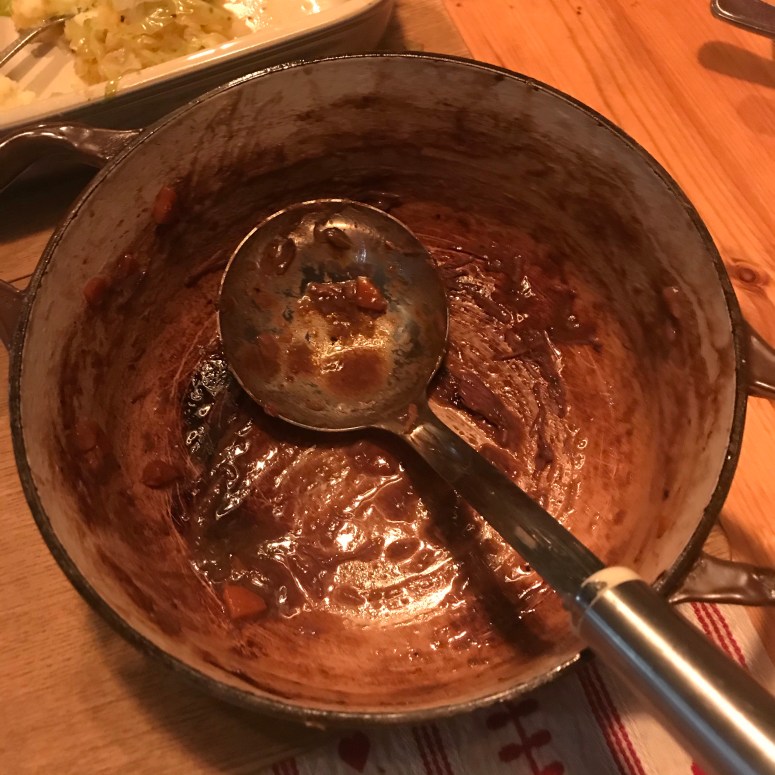
We ate it with a good mashed potato and some cabbage. It was delicious and fulfilling. Although in my previous posts I have lamented not having friends or family round to have a meal with, but on this occasion, I was able to have guilt-free seconds.
 Live Fire Journal
One thought on “Braised Ox Cheeks”